What is a disciple?

What is a disciple?Disciple Making Church-background

Little Tommy was doing very badly in math. His parents had tried everything; tutors, flash cards, special learning centers, everything they could think of. Finally, in a last ditch effort, they enrolled him in the local Catholic School.

After the first day, little Tommy came home with a very serious look on his face. He didn’t kiss his mother hello, but instead went straight to his room and started studying. When his mother went up to check, she found books and papers spread out all over the room and Tommy hard at work.

To her further amazement, the minute he finished dinner he marched back to his room without a word and hit the books as hard as before.

This went on day after day, for the entire first term until Tommy finally brought home his report card. He quietly laid it on the table, went on up to his room, and hit the books. With some trepidation, his mom looked at it, but to her surprise and relief, little Tommy had an “A” in math.

Unable to contain her curiosity any longer, she went up to his room and asked “Son, what was it? Was it the nuns?” Tommy shook his head. “Well then,” she continued, “was it the books, the discipline, the structure, the uniforms, WHAT was it?”

Tommy just looked at her and said, “On the first day of school, when I saw that guy nailed to the plus sign, I knew they weren’t fooling around.”

You see, Tommy developed a COMMITMENT that changed his life! The funny part is that we all know Tommy’s commitment was based on a misunderstanding. Tommy was a learner, but not a disciple. His work was good – by man’s standards – but his motive was all wrong.

Commitment is like faith in several ways. Like faith, the object or reason for your commitment is what determines how significant it is. Like faith, commitment can be based on the wrong motivation. And like faith, commitment is important, and must be focused on Christ if it to have any value.

From the Homan Bible Dictionary: “In the Greek world the word “disciple” normally referred to an adherent of a particular teacher or religious/philosophical school. It was the task of the disciple to learn, study, and pass along the sayings and teachings of the master. Disciples of the rabbis could select their teachers.

One can assume that Jesus used traditional rabbinic teaching techniques (question and answer, discussion, memorization) to instruct His disciples. In many respects Jesus differed from the rabbis. He called His disciples, saying, “Follow me”. He taught more as a bearer of divine revelation than a link in the chain of Jewish tradition.”

Disciples of Christ are called by Him – they haven’t chosen Him.

It’s the Heart of the matter

Here’s the unpleasant reality – behavior doesn’t necessarily reveal the heart. Tommy’s mother wanted him to do better in math. But no parent would want his child to have Tommy’s motivation as the reason for the proper behavior. That funny story points out a major problem in many people’s lives: they make major commitments based on misconceptions, we do the right thing for the wrong reason. When circumstances get difficult, the false premise of our commitment causes it to crumble. Like a house built on sand. Our boy Tommy probably lost his zeal for math after a few semesters. He may have found out the truth about the “guy nailed to the plus sign”.

What does the Bible say about those who would be Christ’s disciples? In Luke 14: 25 – 27 “And there went great multitudes with him: and he turned, and said unto them, If any man come to me, and hate not his father, and mother, and wife, and children, and brethren, and sisters, yea, and his own life also, he cannot be my disciple. And whosoever doth not bear his cross, and come after me, cannot be my disciple.” This is a standard traditional rabbis and other teachers did not require. But we Christians are to love Christ more than we love our Earthly family.

Matthew 28:16 – 20 The Great Commission: “Then the eleven disciples went away into Galilee, into a mountain where Jesus had appointed them. And when they saw him, they worshipped him: but some doubted. And Jesus came and spake unto them, saying, All power is given unto me in heaven and in earth. Go ye therefore, and teach all nations, baptizing them in the name of the Father, and of the Son, and of the Holy Ghost: Teaching them to observe all things whatsoever I have commanded you: and, lo, I am with you alway, even unto the end of the world. Amen.

This word, “teach” is the Greek word “math-ayt-yoo’-o“ (verse 19) or “didasko” (verse 20), both of which mean to disciple or instruct. One thing of interest here: Christ is telling His disciples to “teach all nations” – yet He is not telling each disciple to teach all nations. The church must evangelize and disciple the whole world, but only God Himself can tell you and I where and how we are to “go and teach”. It’s obvious that not every disciple can go to all nations. But the church can!

Luke 6:46 “why call ye me, Lord, Lord, and do not the things which I say?” The Lord wants us to realize that our words must be backed up by our actions. We aren’t the first generation to live at odds with our professed beliefs. And the world is watching us, to see if we live on Monday in accordance to our “Amens” on Sunday.

Matthew 22:37 – 40 The Greatest Commandment: “Jesus said unto him, Thou shalt love the Lord thy God with all thy heart, and with all thy soul, and with all thy mind. This is the first and great commandment. And the second is like unto it, Thou shalt love thy neighbor as thyself. On these two commandments hang all the law and the prophets.

If we are Christ’s disciples, we will love Him with the right motive and that love with be evident to others. If we don’t obey Him in the things that we know are His will, how can we claim to be His disciples?

Consider marriage, the most serious, sacred commitment one person can make to another person – created to give mankind a glimpse of Christ’s commitment to the church. Yet many marriages end in divorce and so often the reason – more properly, the excuse – is irreconcilable differences. Many people get married with prenuptial agreements in place. Plans already made and documented, detailing who gets what WHEN they divorce. These folk are planning to fail. Many people get married not realizing God is the author of the institution – whether they believe in Him or not. They get married thinking they are going to be able to change their mate into their own image. They get married thinking their own faults will be overlooked but they won’t overlook their mate’s. All of these misconceptions lead to unrealized expectations and frustrations. And failure. The sacred commitment is abandoned. One’s view of marriage reveals one’s view of God. This happens in the church as often as outside the church. By people focused on self, not Christ

The American Heritage Dictionary defines commitment as “A pledge to do. The state of being bound emotionally or intellectually to a course of action or to another person.” Why is it that our “pledge” to cherish until death often fails? Do we let the state of our emotions rule our intellect, creating irreconcilable differences where the Lord intended complimentary strengths and weaknesses? Many do, and the “life-long” commitment is abandoned.

Commitment Isn’t Enough

You recall the case of three teenagers, named Hananiah, to Mishael, and Azariah. The king ordered all his people to worship an idol and these boys were committed to their God – not his – so they refused. The king had the boys brought before him and told them to bow down to the idol or be burned to death in the furnace. These teenagers, you know them as Shadrach, Meshach, and Abednego, replied to the king, “O Nebuchadnezzar, we do not need to defend ourselves before you in this matter. If we are thrown into the blazing furnace, the God we serve is able to save us from it, and he will rescue us from your hand, O king. But even if he does not, we want you to know, O king, that we will not serve your gods or worship the image of gold you have set up.” Nebuchadnezzar was committed. He threw the boys into the furnace. But God had a plan working that the king could not see and did not anticipate, one that ultimately changed his plans to line up with God’s.

Mere commitment might have let them comply with Nebuchadnezzar because of irreconcilable differences between their religion and life itself. They could have rationalized this one compromise, because commitments are made to be broken. But their commitment had been left behind; they had surrendered their rights – abandoned their lives – to God and could not go back. Regardless of the outcome. The young men went beyond commitment – they were disciples. That’s the line that we must cross – leaving the future to God, obeying Him despite the consequences. Because we know Him and trust Him.

Abandoned to God

The American Heritage Dictionary defines abandon as “To surrender one’s right; give up entirely. To yield oneself completely.”

Commitment is good, but in our language today, it implies too much ongoing effort on our part. It is too often bound up in circumstances that shift as sand on the beach during a hurricane. As such, commitment falls short, leaving us free to re-evaluate our decision and change it as circumstances warrant. The call of Christ is for you and me to yield completely – no turning back. And commitment cannot take us as far as Christ would have us go in our walk. Like going to Europe – you can drive yourself to the airport, but you will have to trust completely in the airplane and its crew to get you across the ocean.

When a pastor calls upon you to make a commitment for Christ, he better be telling you to abandon your life to Christ. A former pastor of mine said, “God didn’t invade planet Earth to change your life, He came to kill you!” Jesus said to his disciples, “If anyone would come after me, he must deny himself and take up his cross and follow me. For whoever wants to save his life will lose it, but whoever loses his life for me will find it.” (Matthew 16:24-25) You cannot accept His gift of salvation on your terms – with an escape clause or an opportunity to bail out if times get tough. Life in Christ is complete – on His terms. With His unconditional love, Christ calls us to an unconditional surrender. Paul wrote in Galatians 2:20” I have been crucified with Christ and I no longer live, but Christ lives in me. The life I live in the body, I live by faith in the Son of God, who loved me and gave himself for me.” Nobody who was ever crucified lived. And there’s no turning back. Is your commitment strong enough to ensure you will never turn back? Mine isn’t and neither is yours. We’re men, our will is insufficient. As Dirty Harry puts it, “A man’s gotta know his limitations.”

This is standard Jesus set with His own life. Philippians 2:6-8 “Your attitude should be the same as that of Christ Jesus: Who, being in very nature God, did not consider equality with God something to be grasped, but made himself nothing, taking the very nature of a servant, being made in human likeness. And being found in appearance as a man, he humbled himself and became obedient to death – even death on a cross!” Yes, Christ was committed – perfectly. And there’s the rub – our commitments, and the efforts to keep them, are imperfect.

What was so special about the death of Christ that goes beyond commitment? He was arrested and dragged all over town during the dead of night, repeatedly beaten and mocked through six separate trails. Whipped 39 times with a whip of leather with knots holding bits of bone or balls of lead. Romans had scourging down to science, bringing the victim as close to death as possible. The balls bruised, the leather thongs cut open the bruises. Continued beating tore into muscles, tearing them such that bleeding flesh hung in quivering ribbons. Arteries, veins and muscles were torn open, at times even entrails were laid bare. Normally, a victim would faint after two and half minutes.

How many of us would find a way out of a commitment before we got to the whip? And He had yet to face the cross. And we deserve that death; He didn’t.

Mel Gibson’s movie did not exaggerate the cruelty of the suffering Christ submitted Himself to.

Prior to His arrest, Christ prayed “Father, if you are willing, take this cup from me; yet not my will, but yours be done.” Then He was led away, beaten, and nailed to the cross.

Abandon: “To surrender one’s right; give up entirely. To yield oneself completely.” Not my will, but His. This is the standard, the call of Christ to men.

Who Holds the Future?

Professional athletes are committed. They work hard, give of themselves and perform amazing physical feats. But how often do contract disputes, injuries, personal issues get in the way of their commitment? As remarkable as your favorite football player is on the field, his efforts fall short of perfection. Since Troy Aikman could not predict the future nor control the aging of his own body, his relationship with the Dallas Cowboys ended a year or two earlier than he planned. In spite of his passionate commitment to play baseball, Daryl Strawberry’s unplanned drug addiction was more powerful. These athletes are wonderfully talented, but they cannot control what is yet to come.

Your marriage will never be what you expected. No matter how hard you work, it’s a commitment that you may not be able to keep. Your life will never turn out how your planned it. Because we are not in control and cannot see the future, sacred relationships must be marked – controlled – by something that will not change. Something outside yourself, that is true whether you agree with it or not, is true whether you know about it or not. God’s Word is true, will never fail, will never change. Everything crafted by man will fail, will change.

He calls you and me to walk in obedience as sons of the most high King of kings. He says if we love Him we will obey His teachings. We should be able to say, “I’m abandoned to the One who love me and gave Himself that I might have life eternal.” So great a gift – all the world’s riches could not buy it. Such a small price for me to pay – not to earn it, but to demonstrate that He’s given it to me – obey the perfect will of my Father in heaven, rather than my myopic, self destructive will. And He promises peace and joy – something the whole lost world is dying for and cannot deliver. How could we refuse?

No Turning Back

When Hernando Cortez landed his Spanish fleet on the shores of Mexico in the spring of 1519, he considered his mission too critical to quit. So when the difficulties in the New World proved to be more than his crews envisioned, he ordered them to burn the ships that brought them the new world – and could take them back to Spain. It may be that he had heard the legend of a Greek general who torched his ships so his army would not be tempted to retreat in the heat of the battle. Whatever his reason, Cortez took the commitment he and his men had made and turned it into being completely yielded. No turning back – abandoned to the mission.

Why does this matter?

Everyone wants to live a life that matters. Every godly man wants to leave a godly legacy. What does it take to do so?

Consider Goodyear, Rockefeller, Pulitzer, Vanderbilt, Morgan, Macy, Gould, Crane, Astor. Names you know. In 1886 some of the East Coast’s most prominent millionaires purchased a coastal island near Georgia for a hunting preserve and winter family retreat. Members of the exclusive, clannish Jekyll Island Club, they controlled one-sixth of the world’s wealth, forging together an alliance that virtually controlled America’s corporations and government. As an example, in one of the elegant private rooms of the secluded Jekyll Island Clubhouse, top government officials hammered out the first draft of the Federal Reserve Act.

The first transcontinental telephone call was initiated from the Jekyll Island Clubhouse to President Woodrow Wilson in Washington and Alexander Graham Bell in New York. J. P. Morgan twice financed the teetering United States government, staving off federal bankruptcy. The Jekyll Island Club was the absolute highest form of a temporal kingdom. These men were committed – devoted – to worldly success and had achieved it!

Though they once commanded one-sixth of the world’s wealth, these power brokers have two things in common with every other man of their era: All their plans have come and gone, and they are all dead.

Today, the Jekyll Island Club is history. Curious visitors wander among a half-dozen restored buildings scattered around the grounds. The overgrown weeds, the peeling paint, the shattered glass – all vividly illustrate the futility of man-made kingdoms. Except those restored for tourists, the posh winter “cottages” lay in ruin, representing the final destiny of all the kingdoms of man.

What good will it be for a man if he gains the whole world, yet forfeits his soul?” (Matthew 16:26). All the benefits of prosperity are temporal. All the risks of prosperity are eternal. Tread lightly in temporal kingdoms, for all our plans will come to an end, and then we die. The only profit that matters is an eternal one. Are you spending your wealth for Earthly pleasures or are you sending it ahead to heaven by building the kingdom of God?

What are you committed to? If your commitment is to reform your flesh – compelling yourself to bigger and better things – your focus is on the wrong target and you will fail. Your commitment, if you are to succeed, must be in Christ – plus nothing. “Seek ye first the kingdom of God…” “Be anxious for nothing …” Not “Me first!” Where’s your focus? Your commitment? Want success in the battle over your sinful flesh? “Walk in the spirit and ye shall not fulfill the lust of the flesh.”

Commitment? Go farther. Mere commitment won’t take you where Christ calls you to go. You want success in your walk with the Savior and your marriage? Deny – abandon – yourself to a higher calling. Are you willing to answer His call? Want to leave a godly legacy? The legacy you leave will be the legacy you live. You don’t build a legacy in the last six months of your life. As the wall of Jerusalem was rebuilt one stone at a time, your godly legacy will be built one day, one decision, at a time. You can’t microwave it, buy it from L.L. Bean, or fake it. Live for Christ! Walk in the spirit and you will fulfill His plan for your life. Only at the end of such a life will you or I have the legacy we yearn to leave for our children and grand children.

In 1994, a team of Christians arrived in Stravopol, Russia to distribute Bibles. A local resident recalled seeing Bibles in an old warehouse – they had been confiscated in the 1930s when Stalin was persecuting the church. Amazingly, the Bibles were still there!

Among those who showed up to load them into trucks was a young agnostic student who was simply looking to earn some easy money. But he soon slipped away from the job with a Bible he had stolen. Some time later, a fellow worker found him in a corner, weeping. Out of the hundreds of Bibles, he had stolen one that bore the handwritten signature of his own grandmother. Persecuted for her faith, she had no doubt prayed for her family often. God used that woman’s Bible – preserved for 60 years – to convict her young grandson of his sins.

Romans 10:17 – “So then faith cometh by hearing, and hearing by the word of God.” It is the Word of God that convicts people of their sin and brings them to Godly repentance. We must know this or else we will fear failure about our ability to witness and evangelize adequately.

Want success that matters? I do. Abandon yourself to Christ and let Him direct your work, use your wealth, and secure your future. There is hope in none other and in Him alone is there eternal security.

Truth and Error

Truth and error

Near Truth:  Departing from what God has said is serious. quote-a-rusty-nail-placed-near-a-faithful-compass-will-sway-it-from-the-truth-and-wreck-the-argosy-walter-scott-166220

God’s Truth: Genesis 2:16 – 17 “And the LORD God commanded the man, saying, Of every tree of the garden thou mayest freely eat: But of the tree of the knowledge of good and evil, thou shalt not eat of it: for in the day that thou eatest thereof thou shalt surely die.”

The temptation: Genesis 3:1 “Now the serpent was more subtle than any beast of the field which the LORD God had made. And he said unto the woman, Yea, hath God said, Ye shall not eat of every tree of the garden?

Near Truth: Genesis 3:2 – 3 “And the woman said unto the serpent, We may eat of the fruit of the trees of the garden: But of the fruit of the tree which is in the midst of the garden, God hath said, Ye shall not eat of it, neither shall ye touch it, lest ye die.”

Consequence: Genesis 3:16 – 19 & 22 – 24 “Unto the woman he said, I will greatly multiply thy sorrow and thy conception; in sorrow thou shalt bring forth children; and thy desire shall be to thy husband, and he shall rule over thee. And unto Adam he said, Because thou hast hearkened unto the voice of thy wife, and hast eaten of the tree, of which I commanded thee, saying, Thou shalt not eat of it: cursed is the ground for thy sake; in sorrow shalt thou eat of it all the days of thy life; Thorns also and thistles shall it bring forth to thee; and thou shalt eat the herb of the field; In the sweat of thy face shalt thou eat bread, till thou return unto the ground; for out of it wast thou taken: for dust thou art, and unto dust shalt thou return…. And the LORD God said, Behold, the man is become as one of us, to know good and evil: and now, lest he put forth his hand, and take also of the tree of life, and eat, and live for ever: Therefore the LORD God sent him forth from the garden of Eden, to till the ground from whence he was taken. So he drove out the man; and he placed at the east of the garden of Eden Cherubims, and a flaming sword which turned every way, to keep the way of the tree of life.”

Lesson: That which sounds like Truth may not be. If one simple Truth (Do not eat from the tree of knowledge of good and evil) cannot be held in a more perfect mind than we have, how much more need do we have than Adam and Eve to study the Word of God in order to not depart from it? We have been given much more Truth and have a great need for the Holy Spirit to teach us.


Pragmatism: Doing God’s work our way can be dangerous, methods do matter.

God’s way: Numbers 4:14 – 15 “And they (Aaron and his sons) shall put upon it all the vessels thereof, wherewith they minister about it, even the censers, the fleshhooks, and the shovels, and the basins, all the vessels of the altar; and they shall spread upon it a covering of badgers’ skins, and put to the staves of it. And when Aaron and his sons have made an end of covering the sanctuary, and all the vessels of the sanctuary, as the camp is to set forward; after that, the sons of Kohath shall come to bear it: but they shall not touch any holy thing, lest they die. These things are the burden of the sons of Kohath in the tabernacle of the congregation.”

Man’s way: 2 Samuel 6:2 – 4, 6 -7 “And David arose, and went with all the people that were with him from Baale of Judah, to bring up from thence the ark of God, whose name is called by the name of the LORD of hosts that dwelleth between the cherubims. And they set the ark of God upon a new cart, and brought it out of the house of Abinadab that was in Gibeah: and Uzzah and Ahio, the sons of Abinadab, drave the new cart. And they brought it out of the house of Abinadab which was at Gibeah, accompanying the ark of God: and Ahio went before the ark. … And when they came to Nachon’s threshingfloor, Uzzah put forth his hand to the ark of God, and took hold of it; for the oxen shook it. And the anger of the LORD was kindled against Uzzah; and God smote him there for his error; and there he died by the ark of God.

Consequence: Departure from God’s clear instruction can kill a man.

Lesson: Focusing on “what works” is not normally the right thing to do. We know not what the future holds, therefore we know not “what works”. Man vainly imagines what is good and strives to acheive it. God tells us to obey Him and trust Him for the results.


Carelessness.

God’s way: Exodus 28:40 – 43 “And for Aaron’s sons thou shalt make coats, and thou shalt make for them girdles, and bonnets shalt thou make for them, for glory and for beauty. And thou shalt put them upon Aaron thy brother, and his sons with him; and shalt anoint them, and consecrate them, and sanctify them, that they may minister unto me in the priest’s office. And thou shalt make them linen breeches to cover their nakedness; from the loins even unto the thighs they shall reach: And they shall be upon Aaron, and upon his sons, when they come in unto the tabernacle of the congregation, or when they come near unto the altar to minister in the holy place; that they bear not iniquity, and die: it shall be a statute for ever unto him and his seed after him.”

Man’s way: Numbers 3:2 – 4 “And these are the names of the sons of Aaron; Nadab the firstborn, and Abihu, Eleazar, and Ithamar. These are the names of the sons of Aaron, the priests which were anointed, whom he consecrated to minister in the priest’s office. And Nadab and Abihu died before the LORD, when they offered strange fire before the LORD, in the wilderness of Sinai, and they had no children: and Eleazar and Ithamar ministered in the priest’s office in the sight of Aaron their father.”

Consequence: Negligence of God’s clear instruction can kill a man.

Lesson: God does not depend on any man or group of men. If we are careless with our charge, He will use others.

(Note: I am not, in these two examples, advocating that Christians should adhere to Levitical requirements; merely pointing out that God is serious about telling us what He requires.)


Doctrine: Compromising on God’s established teachings is evil.

God’s way: Ephesians 2:13 – 22 “But now in Christ Jesus ye who sometimes were far off are made nigh by the blood of Christ. For he is our peace, who hath made both one, and hath broken down the middle wall of partition between us; Having abolished in his flesh the enmity, even the law of commandments contained in ordinances; for to make in himself of twain one new man, so making peace; And that he might reconcile both unto God in one body by the cross, having slain the enmity thereby: And came and preached peace to you which were afar off, and to them that were nigh. For through him we both have access by one Spirit unto the Father. Now therefore ye are no more strangers and foreigners, but fellowcitizens with the saints, and of the household of God; And are built upon the foundation of the apostles and prophets, Jesus Christ himself being the chief corner stone; In whom all the building fitly framed together groweth unto an holy temple in the Lord: In whom ye also are builded together for an habitation of God through the Spirit.”

Man’s way: Galatians 2:11 – 14 “But when Peter was come to Antioch, I withstood him to the face, because he was to be blamed. For before that certain came from James, he did eat with the Gentiles: but when they were come, he withdrew and separated himself, fearing them which were of the circumcision. And the other Jews dissembled likewise with him; insomuch that Barnabas also was carried away with their dissimulation. But when I saw that they walked not uprightly according to the truth of the gospel, I said unto Peter before them all, If thou, being a Jew, livest after the manner of Gentiles, and not as do the Jews, why compellest thou the Gentiles to live as do the Jews?

Consequence: Polluting God’s doctrine with traditions of men will be noticed.

Lesson: Our public reputation and ego are of no consideration to God. His teachings – His doctrine – will be taught correctly or the false teacher will (sooner or later) be disciplined.


Summary: The Scriptures are full of instruction from God to us – as individuals and as a church. Being cavalier with our personal walk or public service is sin. Each man should humbly submit himself to the Holy Spirit of God for instruction and discipline, and be on guard to not let his heart become hard. It is the nature of deception for the one being deceived to be ignorant of his condition. Do not trust yourself. Submit to God. Study His Word. Fellowship with others who are serious about their walk with the Redeemer of your soul.

The Reformation We Need

BibleNone of us, as individuals or as local churches, has arrived. We all have need of continual repentance and reformation, knowing that sin easily entangles us and we all have different blind spot and unexamined presuppositions.

This sermon addresses three basic areas where men tend to go astray and exhorts all to repent and follow after Christ as revealed in the Scripture.

Voddie Baucham presents “The Reformation We Need” at the 2013 Founders Breakfast in Houston last month.

This is how good God is!

The video you are about to see is Todd Friel of Wretched Radio speaking to a group of atheist students, among others, at a college. It is part of a video titled “Wretched Worldview: Atheism – A Christian Response.” Todd gives a wonderful picture of the gospel in this video as he pleads with the atheists in the auditorium to repent and trust in Jesus Christ. I ask you to watch this and observe how we as Christians can compassionately and lovingly share the gospel with anyone.

wretchednetwork's avatarWretched with Todd Friel

View original post

God’s Wonderful Plan for Your Life!

Does God love you and have a wonderful plan for your life? Have you heard preachers declare this and then leave you  191324132_640wondering how on Earth are you supposed to determine what that wonderful plan is? Does the almighty creator and ruler of all things have one person you are to fall in love with and marry? Is there one job and place you are seek and find? I submit that God does have a wonderful plan for your life – and it’s the same as His plan for me and every other Christian: to conform us ever more to the image of Christ. As for these other pieces of life on this temporary planet which is not our home, we’ll discuss a little, later, to see how they fit in.

Listen to the message here.

The Necessity and Sufficiency of Scripture

Scripture: Necessity and Sufficiency 

Last week, we studied the authority and clarity of Scripture. Anyone recall anything about those subjects and why they’re important?  images

Today, we examine the necessity and sufficiency of Scripture. Again, two tightly connected attributes of God’s Word that are closely tied to the two we looked at last week. If any of these 4 attributes were to be determined false, it would call into question the entire cannon of Scripture. We study these attributes because they are important reminders of the character of our God and because it will equip us to stand against the wily schemes of Satan and countless minions.

Listen to this message here.

A Lone Voice

I always thought that you would have to be old to look back over your life and see substantial cultural change. But now, we have seen a major cultural change over the last few years.

In 1991, Magic Johnson was diagnosed with HIV. Isaiah Thomas began to question whether Magic was a homosexual. In 1991, it was obvious why Magic Johnson would have been offended that his friend was questioning whether he was homosexual. I seriously doubt articles were written rebuking him. For the vast majority of men around in the 1990s, having someone doubt that you were 100% heterosexual was very offensive.

But sports writers today don’t see it that way. For example, this guy says:

It doesn’t matter how you got [HIV]. It doesn’t matter if some people thought you were gay, because there’s absolutely nothing wrong with being gay. It’s as ridiculous as freaking out over whether or not people think you’re secretly left-handed.

Today, the big sports news is that Jason Collins announced he’s homosexual. He plays for the Boston Celtics. We are being assaulted with sports writers and newspapers falling all over themselves to applaud Jason Collins.

There is one exception to the deluge of accolades Collins is receiving. Chris Broussard had this to say on ESPN:

I think he did a great job answering the question.

As seemingly uniform as the honor Collins is receiving is the disdain Broussard is receiving.

For example, ESPN says, “We regret that a respectful discussion of personal viewpoints became a distraction from today’s news. ESPN is fully committed to diversity and welcomes Jason Collins’ announcement.”

It seems they’re not as excited about the diversity that Broussard brings. Some of those who pride themselves on their tolerance of perversion, cannot find it in themselves to tolerate Christianity, and are calling for Broussard’s career as an NBA commentator to be ended. This obvious inconsistency is because we all have a God-given conscience, and when Broussard calls sin a sin, he’s hitting the raw nerve that we all have–our conscience. For those who hate God, that is just too much to deal with, so they lash out at the messenger.

I doubt Broussard thought about whether he was putting his career at risk. Will those of us who do have the opportunity to think about what we’ll say choose career suicide and possible poverty or will we deny Christ and the truth? I think that we will all have to make that decision as the culture becomes more evil, but we should all make it today if we haven’t already. As for me, I choose Christ.

Matthew 16:26 says, “For what will it profit a man if he gains the whole world and forfeits his soul?”

Matthew 10:28 says, “Do not fear those who kill the body but are unable to kill the soul; but rather fear Him who is able to destroy both soul and body in hell.”

ABSOLUTE Predestination

ABSOLUTE Predestination

I just finished reading Jerome Zanchius’ book that a dear brother was so kind to give me. Wow! I Clipboard01wept and rejoiced and thanked the Lord for faithful men who have gone before. Thanks be unto God for the dear brother who worked to bring this book back to life. Absolute Predestination is an awesome work explaining systematically and biblically why this doctrine is true, what it means, and why it must be preached. I will treasure this book until the Lord deems my days are done. What follows is a short review and exhortation for my brothers and sisters to take this book and read. You can buy it here: http://www.heritagebooks.org/absolute-predestination-introduction-by-joel-beeke/

This current publication is from Free Grace Press and includes a very informative introduction by Joel Beeke. Zanchius was an Italian who lived in the early to mid 16th century, grew up as a Roman Catholic and served as a monk. It was during this time he read some Martin Luther, Martin Bucer, and John Calvin and was soon converted into a Christian. He lived the balance of his life studying, teaching, and writing and was widely considered a highly valued author of Reformed theological studies – all of which were in Latin. Nearly 200 years later, an Englishman ran across his Latin writings on predestination. Augustus Toplady was converted in his teen years and held to the free will teachings of his contemporary, John Wesley; until “an old man challenged him to stop arguing long enough to ask himself: Did he have any part in obtaining God’s grace? Wouldn’t he have resisted God’s grace if the Spirit left him to his own will? These questions from a Wesleyan brother stabbed him to the quick.” And so Toplady began a study on the sovereign grace of God, learned Hebrew and Greek, and embraced the sweet doctrines of grace commonly called Calvinism.

Toplady served in many churches as pastor, but initially held back from preaching on sovereign grace – focusing his sermons on justification by faith and holiness of life, as was taught by Wesley. “People liked his preaching, but few were converted. When he began preaching predestination as the eternal source of our salvation in Christ, many were angry with him, but many other were truly converted to Christ.” Amen! This is how the true gospel works – it was how the Apostle Paul experienced it. The true gospel (for there is no other gospel) is preached. Some will hate you for it, others will rejoice and beg to hear more. Those who have been given ears to hear will hear! Praise God!

As time went by, Toplady conversed with Wesley and denounced his old teacher. As A.W. Pink turned a bit sharp in his criticism of dispensationalism once he left that theological train wreck, so did Augustus Toplady in his critique of the spiritual ship wreck of Arminianism.

Toplady translated Zanchius’ book into English and, by his own admission, heavily edited it in places to as to provide a more complete treatise on the topic. It is hard to tell where one writer hands off to the other, as the reader works his way through this book. With that, here’s a brief review of this most excellent little book. Zanchius lays out each chapter as a progressive argument, moving through myriad positions as he documents six key areas that help us comprehend the sovereignty of God and our need of Him.

The Preface is written by Toplady and titled Observations on the Divine Attributes. We are quickly introduced to this author and this work by two stark statements. “I cannot help standing astonished at the pride of impotent, degenerate man. … The Scripture doctrine of predetermination lays the axe to the very root of this potent delusion.” Having personally left Wesley’s doctrine behind, Toplady declares that this book is needed because “Arminianism is the grand religious evil of this age and country.” We can only imagine what he might have said in response to Charles Finney! In bringing his preface to a close, Toplady reminds us that words have meaning, or else they are worthless, and then defines predestination as “God’s determinate plan of action.” And then he reservedly reveals his opinion on the theological construct he had left behind – “He that made all things either directs all things he has made, or has consigned them over to chance. But what is chance, but a name for nothing. Arminianism, therefore, is Atheism.”

Zanchius’ first chapter has the same name as Toplady’s Preface – they are not the same! In this opening chapter, our servant of God desires us to know more about the Lord, acknowledging He is beyond our comprehension, but not entirely; and that He wants us to know Him as He has revealed Himself in Scripture. Zanchius’ pen will help us better understand: (1) God’s eternal wisdom and foreknowledge; (2) The absolute freedom and liberty of His will; (3) The perpetuity and unchangeableness both of Himself and His decrees; (4) His omnipotence; (5) His justice; and (6) His mercy. Without these attributes explained, Zanchius claims the doctrine of predestination cannot be properly grasped. While every argument in this chapter is worth careful reading, the series of statements and expositions under (2) cannot go without special mention. Here is the summary paragraph from the end of that section:

“From the whole of what has been delivered under this section head, I would observe that the genuine tendency of these truths are not to make men more indolent and careless, or lull them to sleep on the lap of presumption and carnal security, but (1) to fortify the people of Christ against the attacks of unbelief and the insults of their spiritual enemies. And what it so fit, to guard them against these, as the comfortable persuasion of God’s unalterable will to save them, and of their unalienable interest in the sure mercies of David? (2) To withdraw them entirely from all dependence whether on themselves or to any creature whatever; to make them renounce their own righteousness, no less than their sins, in point of reliance,and to acquiesce sweetly and safely in the certain perpetuity of His rich favor. (3) To excite them, from a trust of His goodwill toward them, to love God who has given such great and numberless proofs of His love to men, and, in all their thoughts, words, and works, to aim, as much as possible, at His honour and glory.”

Is this not the goal of Christian exhortation and life? What Christian would be opposed to this?

In chapter 2, titled Defining Terms, we are given biblically based expositions on The Love of God, The Hatred of God, Election, Reprobation, The Purpose of God, Foreknowledge, and Predestination. This last is presented with a four-fold definition. (1) God did from before time determine and ordain to create and dispose of all creation with the over-arching reason to bring glory to Himself. (2) As relates to mankind, God created Adam in His image and allowed him to fall and take all humanity (and creation) with him as the federal head. (3) As relates to the elect, God chose before time to redeem some in time by faith in Christ. Such are justified, adopted, sanctified, and preserved safely to the end of this age. (4) As regards the reprobate, it is God’s eternal sovereign and immutable will whereby He has determined to leave some men in their sin to be justly punished.

Chapters 3, 4, and 5 discuss predestination as it relates to All Men, to the Saints, and the Ungodly. It is most useful to see this doctrine discussed in detail in these three distinct applications, as much confusion reigns among men when important terms are not defined and applied properly. In the 3rd chapter, Zanchius shows from Scripture that God has predestined the ends of men, that He decreed The Fall, that the elect will be saved, the reprobate damned. Each of these is explored in detail after a brief introduction. The chapter closes with a wonderful quote from Augustine: “Brethren, let us not imagine that God puts down any man in His book and then erases him, for if Pilate could say, ‘What I have written, I have written,’ how can it be thought that the great God would write a person’s name in the book of life and then blot it out again?”

Predestination of the Saints, chapter 4, ought to give everyone born of the Spirit joy and supreme assurance of being safe in the refuge of Christ – it is full of Scriptural support for the monergistic saving act of God in the life of every saint. Zanchius includes two excellent bits of counsel as he wraps us this most important chapter – Christians ought to believe the redeemed standing of other Christians (based on sober reflection of evidences that bear witness to same). For how, he asks, can we love one another rightly if we do not believe they, also, are loved with same everlasting love as we? Then he remands us to never judge any man to be a reprobate. He says that we may infer the election of some by the marks and appearances of grace in their lives, but we cannot know sure enough to claim that any person is damned while he yet breathes – because a man who is a reprobate today may have been chosen before time and decreed to repent and believe upon Christ tomorrow! Presumption is sinful and we ought not walk in it; we are, rather, to walk in humility and love – proclaiming the saving gospel to dead men everywhere.

Chapter 5 presents Predestination as it relates to the Ungodly – something I dare say most of us have not thought of. But just as there will be those on the Lord’s right hand on that great day of judgment, there will also be those on His left hand (Matt 7). In explaining predestination to the Romans, Paul reminds us what God had said – “Jacob I loved, but Esau I hated”. So in Matt 7, when Jesus is telling those on His left hand that He never knew them, He is saying, “I have always hated you.” How differently we tend to discuss the enemies of God in our day! Our mantra is, “God loves everybody” or “God is love”, as if He had but one dimension. There can be no true, biblical love from God if He is compelled to love everyone. He cannot be holy if He accepts those who are not justified. God does not “hate the sin but loves the sinner.” He is angry with sinners all day long! While some will hate this talk, it is the revelation from God Himself – and redeemed saints ought not to shy away from uncomfortable truths.

The last chapter is Predestination as it Relates to the Preacher. In this surprising (to me) chapter, the author makes the case that preaching this doctrine is necessary for the spiritual health of God’s people that He has gathered in each local church. He warns, “Let it, however, be preached with judgment and discretion, i.e., delivered by the preacher as it is delivered in Scripture, and no otherwise.” This doctrine is such that men twist it and deny it – meaning that the wisdom of man is totally insufficient to explain or defend it. So Scripture alone is the rule. Further, since “Election is the golden thread that runs through the whole Christian system,” any gospel preached without it is not the gospel!

Zancius invites us ponder Matt 11:25 & 26, in which he declares that “Christ thanks the Father for doing that very thing which Arminians exclaim against us is unjust, and censure us as partial.” And in Matt 24:22 – 24 the Lord “teaches (1) that there is a certain number of persons who are elected to grace and glory, and (2) that it is absolutely impossible for these to be deceived into total or final apostasy.” Preachers must preach predestination and the sovereignty of God because “Whilst a man is persuaded that he has it in his power to contribute anything, be it ever so little, to his own salvation, he remains in carnal confidence.” This may be the biggest concern in churches in our day – so many men convinced they are “OK with God” because they chose Him! They think God did His share and they must do theirs – not realizing that this system leaves them on the wrong side of the Tiber river. Predestination gives sinners a more accurate picture of both God and man, showing the grace of God – which stands against human worthiness. A footnote shows from Scripture why this doctrine must be preached, for the good of the saints – “do not my words do good to him that walks uprightly?” (Mic 2:7)

There truly is too much good and godly counsel in this book for me to comment on it all. But let this review close out with this glorious exhortation from this dear brother from another century.

“How sweet must the following considerations be to a distressed believer! (1) There most certainly exists an almighty, all-wise and infinitely gracious God. (2) He has given me in times past, and is giving me at present (if I had but eyes to see it), many and signal intimations of His love to me, both in a way of providence and grace. (3) This love of His is immutable; He never repents of it nor withdraws it. (4) Whatever comes to pass in time is the result of His will from everlasting, consequently (5) my afflictions were a part of His original plan, and are all ordered in number, weight and measure, (6) The very hairs of my head are (every one) counted by Him, nor can a single hair fall to the ground but in consequence of His determination. Hence (7) my distresses are not the result of chance, accident or a fortuitous combination of circumstances, nor of Satan getting ahead of God, but (8) the providential accomplishment of God’s purpose, and (9) designed to answer some wise and gracious ends, nor (10) shall my affliction continue a moment longer than God sees meet. (11) He who brought me to it has promised to support me under it and to carry me through it. (12) All shall, most assuredly, work together for His glory and my good, therefore (13) “The cup which my heavenly Father hath given me to drink, shall I not drink it?” Yes, I will, in the strength He imparts, even rejoice in tribulation; and using the means of possible redress, which He has or may hereafter put into my hands, I will commit myself and the event to Him, whose purpose cannot be overthrown, whose plan cannot be disconcerted, and who, whether I am resigned or not, will still go on to work all things after the counsel of His own will.”

At the end of this book, I was left undone by the glorious mercies of God, in choosing to save His enemies – and me being counted among the redeemed. If that last paragraph does not cause your soul to rejoice in wonder and praise and adoration – you need to examine yourself to see if you be in the faith. Christ is all glorious, all powerful, and victorious. By His blood he has purchased a people to be trophies of grace that He will present to our Father on that great and terrible day when all the deeds of men will be judged. The earth and sky will try to flee from the face of God and the wrath of the Lamb, but there will be no place to hide. But ALL whose names were written in the Lamb’s book of Life before the foundation of the world shall be welcomed to the wedding feast when the Lord consummates His eternal plan of redemption! Christ is our refuge and strong tower – He is sufficient! We need no other plea. Run to Christ, cry out for mercy. Seek Him while it is yet today.

Civil Disobedience and the Christian

The concept of civil disobedience is not new. Neither is the question of how far a government imagescan go before the Christian is permitted to disobey. This concept of civil disobedience is/ought to be an escalation from the peaceful petition that ought to be the Christian’s first response to objectionable laws. Was Rosa Parks right in her act of civil disobedience? How do we answer such questions?

We must be informed by the Word of God – not our personal preferences and presuppositions.

World Magazine recently published an article focused on this question, you can read it here. Here’s a small excerpt:

Does submitting to civil authorities mean obeying laws that are immoral? We are commanded by God to share the gospel. What if a law barred us from doing so, even privately? We see that obeying government authorities isn’t absolute. It should be clear to Christians that unless there is legal recourse against obeying a law that compels us to sin, we are justified in disobeying it. Is it a sin to offer employees “mini-abortion drugs”?

It is clear from Scripture that Christians are able (obligated, I contend) to disobey the governing authorities if proclamation of the Gospel is outlawed – see Acts chapter 4. Is that the right standard to compare other issues to, as if they become justifiable since Gospel proclamation is?

This question of submitting to political authority has been addressed here at Def Con in the past – see this post as brother Conrad Mbewe examines part of 1 Peter.

The question of disobedience to the governing authorities must be anchored in Scripture – as with anything of import. If God has given us instructions, we who claim to be His must submit to what He was revealed to us! Do you have a pet issue (perhaps home schooling) that would cause you to reflexively rebel against the governing authorities without seeking wisdom from God in humility?  We must be on guard against these issues that are close to us – for it in these that we are most vulnerable to slip into disobedience to God, thinking we are merely exercising our rights – forgetting that we are aliens in this present age, with our citizenship and home in a city whose builder is God.

Since I mentioned home schooling, let me briefly comment on that. In the US of A, it is not now and never has been against the law to home school your own children. Read that carefully. It is not now and never has been against the law to home school your own children. It has been and still is in many places in this country against the law to home school your children in lieu of sending them off the approved institution, but never illegal to home school in addition to the approved educational process. The Bible clearly holds parents responsible for training (educating) their children in the things of God. Rightly done, this covers all academic areas. But the Bible also records for us humble servants of YHWH who submit to pagan education and work diligently to prosper their pagan rulers (Joseph and Daniel come to mind). We must seek wisdom from God’s Word before we decide to go against the governing authorities – for there is no governing authority except those that have been established by God.

So – is it right and honorable to refuse to provide medical insurance that covers abortion? Certainly! The law is set up to allow people to pay for non-compliance. It is a very high price tag for businesses that might cause them to completely change their business model (contractors or part time employees) or liquidation. But think on this: the Bible does not reveal God’s will for man-made institutions. He has created government, family, and the church. Those institutions have responsibility before God as does each individual. A Christian who owns a company has a responsibility before God and he has the same obligation to seek wisdom from God’s Word on this as with personal issues. (Not being addressed in this article are those hell-bound folk who will also answer to God and have no grace to cover them on Judgment Day.)

The Christian that wants to participate in civil disobedience ought to step back and think. Rebellion is as witchcraft. Failure to rightly submit to the governing authorities is rebellion, is as witchcraft. Is that something we want to play games with? 1 Peter 2 gives a “Reader’s Digest” version of God’s commandment:

    Be subject for the Lord’s sake to every human institution, whether it be to the emperor as supreme, or to governors as sent by him to punish those who do evil and to praise those who do good. For this is the will of God, that by doing good you should put to silence the ignorance of foolish people. Live as people who are free, not using your freedom as a cover-up for evil, but living as servants of God. Honor everyone. Love the brotherhood. Fear God. Honor the emperor.

Let’s wrap up with the obvious text, Romans 13, which includes this nugget: “whoever resists the authorities resists what God has appointed, and those who resist will incur judgment.” Read the whole chapter, with a humble attitude. I know it’s easy to despise a government that does not rule the way I want it to. I like my elected officials to have an affection for and submission to the Constitution (at the national level) just like I like my church elders to have an affection for and submission to the Scriptures. But civil governments are mostly occupied by folks not reconciled to God, while church leaders ought to be – and therefore, subject to stricter standards. Most of the things that cause me to consider civil disobedience do not meet the biblical test – they reflect my fleshly desires or my innate sense of self-righteousness. How do you see yourself?

Okay. Your assignment. Voddie Baucham preaching on Romans 13 in two sermons. Listen to part one and part two before commenting. It wouldn’t hurt to listen to Conrad Mbewe’s message from 1 Peter (at the link early in this article). Then let’s discuss like mature, humble blood-bought children of the Creator God and Ruler of the universe.

What Will it Take?

question-mark3-misallphotoWell, as we set upon the end of one year and the beginning of another, I cannot help but look back and reflect on this last year.  I think we can safely say that we have seen definitive evidence of the decline of the church’s influence in the American culture.  With the re-election of a president that is one of the most pro-abortion, anti-life records in political history, a president who has openly promoted the profanation of marriage by endorsing homosexual unions, it has become clear that our country has embraced a non-Christian ideology.  This is not major news, many Christians have been sounding the alarm for years, but it has gone unheeded.  But now as we face a new year before us, my question for the church in America is “What is it going to take?”

Consider this, we have seen the growth of megachurches and seeker friendly country clubs for years now.  Every week, hundreds, even thousands of people walk the aisles, prayer “the prayer,” sign a card and are proclaimed “Christians” in their congregations.  Those people are never taught about sin, righteousness, judgment, condemnation, the wrath of God, repentance or the sacrifice of Christ.  Instead, they are given gospel-light messages that consist of Christ loving them so much that He’d rather die than live without them.  They are told that God only has their best life in mind and all they have to do is follow a ten step program to get a better job, better marriage, or better kids.  There is no call to holiness, no attempt to cause the people to question their worldly mindsets, no testing to see if they are actually in the faith.  What is left are a room full of goats who have been mesmerized into believing they are in fact sheep.

In these same churches, the sheep that do exist are either marginalized or simply shoved out the door to make way for the vision of the “goat-herder in chief.”  This has allowed the growth of these country clubs masquerading as churches to go virtually unchecked.  With little to no opposition inside the churches, they grow like a virus in a compromised immune system, with almost the same deadly effect.  The more churches that adopt worldly advertisement growth techniques, the less the true Word of God is preached.  The less it is preached, the worse the compromise within the body and the more sin is tolerated.  The end results are people who claim to be Christian, or even “spiritual,” but who have no personal sense of the wickedness of their sin.  Thus they allow and even promote blatantly sinful behavior. Can the re-election of a man who is anti-christian, anti-life and pro-homosexuality be a surprise then?

That is not to say that there are no real Christians in America.  They are still many sound biblical churches faithfully preaching the Word of God.  But I fear that even truly born again Christians have become more affected by worldly philosophy than they realize.  Go into most churches today and ask Christians what is more loving, to confront sin and unrighteousness boldly, pointing people to the need of Christ’s propitiatory death on the cross, or to win friends through kind works, easing them into the gospel.  Inevitably, many will choose the latter.  Most Christians today have succumbed to the world’s belief that it is simply unkind to point out sin and to warn of the judgment to come.  They believe the message is “too harsh” and will drive people away.  The result is that a small percentage of truly born again Christians are going out of their way to share the gospel with the lost in our country.  And an equally small number are trying to call out the churches who aren’t even on the biblical program.

So how did this year end with the country embracing a false Christian president who embraces universalism, denounces true Christianity, promotes murder of the unborn and homosexuality?  Simply because the church has allowed our influence to wane.  We have allowed the propagation of false churches by not calling out with a unified voice against them.  We have not resoundingly called them false teachers and have been willing to work in conjunction with them as “co-belligerents.”  As they grew, we simply let them go on unchecked.  Additionally, we have not combated the false gospel of “Jesus loves you just the way you are,” with the bold proclamation that all mankind is deserving of the wrath of God and the only escape is Jesus Christ.

The American culture has watched a watered down version of the gospel propagate throughout the country and sees it for the phony message that it is.  They have no desire to be a part of it and walk further and further away from it.  Yet, the true gospel has not been preached with boldness and regularity.  The true church has involved itself in any number of other activities – politics, protests, Tea Parties, etc. – yet does not offer the true message of salvation to a world immersing itself in sin.  The country sees the true church as harsh and judgmental for it does not call to the world in compassion to the Savior.

So today, on December 31, 2012, I ask you as a member of the true church of Jesus Christ, “What will it take?”  Will you, in this next year, be willing to step up to the plate?  Will you stand against the false gospel of the country club churches?  Will you call them out for the false teachers they are?  Will you work to make sure your church steers away from such nonsense?  Will you get you and your congregation worked up to preach the true gospel to a lost and dying people?  If not, what will it take?

Unity in Truth

A dear friend and brother in Christ, who used to host a Christian talk show on radio many years ago handed this me during the growing conflict I was experiencing in the seeker sensitive church we were in at the time. While it is likely this counsel could be improved upon (as is the case with all works of man), I think it good and godly counsel.

Having Harmony in Your Church Through Humility in Handling Doctrine

Discord in most churches is caused primarily by the straining out of gnats and swallowing of camels, If a church does not have agreement on the essentials, it is not a church of Jesus Christ, On the other hand, members of the church who think that every little pet opinion or “favorite” emphasis is worthy of debate (and the risk of unity), dishonor Christ also, Too few Christians can distinguish and discern which doctrines have what degree of gravity, Thus, we end up with either large congregations that ignore doctrine for the sake of gladhanded surface hospitality or small fortresses of “defenders of the only way” where you feel like you’re on trial whenever you speak!

Here are four broad areas of doctrine. If you will attempt to distinguish which area a given issue belongs to, you will have an easier time dealing with that issue. Thus, less chance of getting personally uptight and less chance of offending another. This material will help when used correctly, Two cautions before we start:

1.Truth offends. The assumption in this material is that we are dealing to some degree with lovers of truth. Unfortunately, our churches are not full of such people, You will encounter that problem.

2.Some doctrines overlap. This material and chart are convenient general categories, not rigid compartmentalizations, There is especially some blurry areas between II and 111 and between 111 and IV, Not only that, but when you are in a lively discussion of some issue, other issues come up which could put you in several categories at once.

You might be talking about some doctrine where you are aware that you are building a case from a very thorough connection of Scripture. The person you are trying to convince may refuse to yield to a passage of God’s Word.

All of a sudden, you are into the IMPERATIVE of the authority of Scripture as well as an open discussion of your original issue. These situations will require more wisdom yet.

Nonetheless, despite these two cautions, working with this material can revolutionize your spiritual walk with regard to harmony, discernment, unity and pride,

EXPLANATION OF CHART COLUMN 1

The first column is the type of truth you are dealing with, A BIBLICAL IMPERATIVE, BIBLICAL IMPLICATION or BIBICAL INTERPRETATION, Notice the first three deal with items directly from Scripture, but Item IV concerns things created in you by the Holy Spirit through your own context, your own understanding of principles and your own application to various areas of life,

COLUMN 2,

The second column explains how to recognize these areas, This column gives the definition of the first column, BIBLICAL IMPERATIVES are the foundational truths such as the Deity of Christ, the Authority of Scripture, the Trinity and the Substitutionary Atonement. People who deny these truths are not Christians.

A BIBLICAL IMPLICATION also has no room for denial because it is an area where the Bible cannot teach but one thing. However, misunderstanding is possible because the truth is not stated in so many words. Rather it is woven through the fabric of Scripture. Even if you have a few passages where you are thoroughly convinced that your conclusion is obvious, you are humble enough to admit not only that a different view could be held by true Christians, but lo and behold, great people of God through the centuries have not been as certain as you are.

Thus, you become willing to patiently learn how to present your case and give folks lots of room to discover the conviction you have. For example, should Christians send their kids to government schools? For example, how fallen is man’s will? For example, Covenant vs Believers Baptism,

I believe firmly and staunchly in what I’ve concluded the Bible teaches on each of these. But, 1 view you as a Christian, and will not doubt the genuineness of your salvation for having not yet come to the same conclusions.

A BIBLICAL INTERPRETATION hinges on one passage or the interpretation techniques used for several passages, For example, Daniel 9,..where does the countdown of the 490 years start? Your answer from Isaiah and Ezra will influence your entire view of eschatology. So why should we argue about the interpretation of Revelation 5 if we already know our impasse is in the middle of Isaiah? Or perhaps the interpretation of the words °a cause” in the sin of being angry at a brother without cause! It comes down to an understanding of a particular, If we view it differently—and we both honestly can view it differently—that’s it! Fortunately, God has seen to it that no essential matter of faith or life is in this category,

Finally the DAILY WALK INDIVIDUALIZATION, Friends, if we haven’t got chapter and verse—even if we believe we have the mind of Christ on the matter—we must humbly avoid playing God over another conscience, Does Walt Disney promote the occult in Fantasia? Are certain beats of music admissable? Should you pray before, or after, your morning shower? Come on, folks! Romans 14 insists that we acknowledge liberty and conscience in these areas,

COLUMN 3 & 4

Columns 3 and 4 prescribe the limits of what we do with these doctrines. This will be as helpful as the recognition,

A BIBLICAL IMPERATIVE is not compromised or glossed over with anyone. Earnestly contend!! Don’t get off on blood transfusions, time travel and other things with cults and secularists, The only questions between you and them are: Who is God? Who is man? Who is Christ? What is truth? Stay on the subject with them,

BIBLICAL IMPLICATIONS are to be worked out carefully among believers, You have an obligation to the brethren on both sides. Be able to articulate what you believe and love them in what you consider their “future maturity”,

BIBLICAL INTERPRETATION makes for “iron sharpens iron” discussions with friends, but the church today should not be divided on predictive prophecy,

On DAILY WALK INDIVIDUALIZATION you may set an example, if you wish, but you are confusing your own authority with the Bibles if you command something that it doesn’t.

Clipboard01

The Dogma of Papal Infallibility

What Roman Catholics refer to as “the Dogma of Papal Infallibility” is one of the most  Papalstunning of all of RCC doctrine. According to this dogma, the Pope-when he speaks on matters concerning the church-is protected from the possibility­ of error. Note that it is not that what he says is always true, but something more radical is claimed: there is not even the possibility of him speaking something untrue.

When this dogma was first codified (the first Vatican Council in 1870) they obviously defined it in more constrained terms than it had been practiced through history. Now, it only applies to matters concerning “faith and morals,” and when the Pope binds “the whole Church” to the declaration. While it was codified by the First Vatican Council, it in effect has been practiced throughout much of Roman Catholic Church history.

In fact much of RCC doctrine rests on nothing other than this authority. For one clear example, in 1950 Pope Pious XII declared that Mary did not die a physical death, but was “assumed” (assunta) up to heaven. This is a teaching with no biblical evidence (although Pope John Paul II did allege that it was the fulfillment of Jesus’ promise in John 14:3), and even less credible historical evidence. Actually, no one in the first 300 years of church history had even claimed such a thing had happened.

Because it is such an important part of what separates the RCC from Protestants, an obvious question to ask is, “are there times when the Popes have contradicted each other?” If so, that would be a glaring piece of evidence that the RCC’s claims to authority and doctrine are indeed fallible.

First, let me explain why this is important to me. Discussing theology with a Catholic can be frustrating, and usually goes in one of two ways. Either they claim to believe everything I believe, but they just also claim to have an unbroken tradition of history behind them. Or they respond to my biblical objections to RCC doctrine by saying Protestants are wrong because their interpretations contradict the interpretations of the RCC, which we know to be infallible.

Read the rest of this article here.

What’s Wrong with being “Seeker Sensitve”?

Seeker Sensitive

The Greek word (ekklesia) we interpret as “church” means “the called out ones”. Those who are not redeemed are not part of the church.  

Isaiah 43:1 But now thus saith the LORD that created thee, O Jacob, and he that formed thee, O Israel, Fear not: for I have redeemed thee, I have called thee by thy name; thou art mine.

2 Cor 4:1 – 5 Therefore seeing we have this ministry, as we have received mercy, we faint not; But have renounced the hidden things of dishonesty, not walking in craftiness, nor handling the word of God deceitfully; but by manifestation of the truth commending ourselves to every man’s conscience in the sight of God. But if our gospel be hid, it is hid to them that are lost: In whom the god of this world hath blinded the minds of them which believe not, lest the light of the glorious gospel of Christ, who is the image of God, should shine unto them. For we preach not ourselves, but Christ Jesus the Lord; and ourselves your servants for Jesus’ sake.

1 Cor 1:1 – 2 Paul, called to be an apostle of Jesus Christ through the will of God, and Sosthenes our brother, Unto the church of God which is at Corinth, to them that are sanctified in Christ Jesus, called to be saints, with all that in every place call upon the name of Jesus Christ our Lord, both theirs and ours

The mission of the church is more accurately found in Ephesians 4:12 & 13 – “the church exists For the perfecting of the saints, for the work of the ministry, for the edifying of the body of Christ: Till we all come in the unity of the faith, and of the knowledge of the Son of God, unto a perfect man, unto the measure of the stature of the fullness of Christ.” Titus chapter 2 seems to sum up the mission of the church very nicely.

There is no place in scripture where saints are told to bring lost souls to the gathering nor is this portrayed in any scriptural narratives. The only place I know where scripture comments on lost people being in church is 1 Corinthians chapter 14. Paul is wrapping up his comments on the lust for gifts exhibited by the church in Corinth. “In the law it is written, With men of other tongues and other lips will I speak unto this people; and yet for all that will they not hear me, saith the Lord. Wherefore tongues are for a sign, not to them that believe, but to them that believe not: but prophesying serveth not for them that believe not, but for them which believe. If therefore the whole church be come together into one place, and all speak with tongues, and there come in those that are unlearned, or unbelievers, will they not say that ye are mad? But if all prophesy, and there come in one that believeth not, or one unlearned, he is convinced of all, he is judged of all: And thus are the secrets of his heart made manifest; and so falling down on his face he will worship God, and report that God is in you of a truth.” It’s clear in this passage that the priority is on the clear proclamation of God’s Word – not on being mindful of making lost folks feel comfortable.

When church leaders focus on lost people, they disobey scripture (Colossians 3:1 – 3, 2 Corinthians 4:18, etc.) and they will be distracted from the right focus on God. Seeking to be appealing to men, elders must turn from seeking to please the Lord – this is disobedience as well. And no man can do both (Galatians 1:10). Furthermore, such a focus on man inevitably leads to the practice of teaching men they can choose Christ – as the natural man wants to be in control of his life. The lost man is dead in his sin (Ephesians 2:1 – 5) and cannot seek God lest he be drawn to Him by Him (Romans 3:10 – 11, John 6:43 – 44, John 1:12 – 13) nor can he comprehend the things of God (1 Corinthians 2:12 – 14, Ephesians 4:17 – 19). It is demeaning to God to pretend man can have a hand in saving himself, giving himself spiritual birth (1 Peter 1:2 – 5, John 15:16). Those who teach and preach are held to a higher standard by God (James 3:1) because they represent God to people. They, therefore, ought to be very careful to only speak for God what He has declared in His Word.

These men pleasers tend to teach people that evangelism consists of inviting lost neighbors to church, so they can hear the preacher. The Bible knows of no such evangelism, telling us to go and preach Christ to the world (Matthew 28:19, Mark 16:14 – 15, Col 1:23). It’s the work of the church to disciple babes in Christ, to bring them to a full understanding of our glorious Lord (1 Corinthians 4:17, 1 Timothy 1:1 – 4, 1 Timothy 4:6 – 11, Titus chapter 2, 2 Peter 3:17 – 18, Ephesians 4:11 – 16).

Our audience – as regards any Christian ministry – is God, not man. His Word – alone – tells us how He wants to be represented to His creature. Our job is not be creative in finding ways to make heathens like the church – the cross is an offense to them (1 Corinthians 1:26 – 29, 1 Peter 2:7 – 8, Galatians 5:11). Our job is to proclaim Christ crucified, trusting God to call to new life those He predestined to be His children (Ephesians 1:3 – 6, Romans 8:32 – 34, John 1:13, Romans 9:6 – 11, Romans 11:5 – 6, 2 Peter 1:2 – 11), making disciples of those are redeemed by Christ. Anything that glorifies man – his status, position, abilities – is sin (Isaiah 48:9 – 11). The aim of each child of God is glorify Him – this is the foundation of everything we do. We cannot love one another properly without God’s glory being the basis. We cannot love lost folks properly if our reason for doing so is anything other than bringing God glory. Any other reason will lead us astray, into doing things for pragmatic reasons, mindful of results and numbers instead of God and His glory.

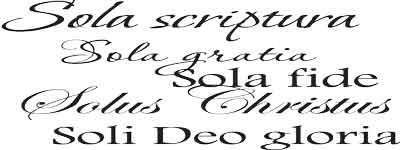
Soli Deo Gloria”Glory To God Alone

Solus Christus”Christ Alone

Sola Scriptura”Scripture Alone

Sola Fide”Faith Alone

Sola Gratia”Grace Alone

May we serve the lord with joy and seek to be forgotten, that those we speak to will remember the Christ of Whom we spoke.

Stuart L. Brogden

Nov 2008.

Papal Contradictions and the Roman Child

by Jesse Johnson

In 1497, Pope Alexander had a crisis of his own making that was threatening to undermine his ability to govern the Catholic Church. A romantic rivalry between two of his sons (he had at least six children) had become a source of intrigue around Rome. In fact, this scandal was so lurid, it was appalling even to those accustomed to flagrant immorality from the papacy. 

The two sons in question were Cesare and Juan, and they were both in love with their sister, Lucrezia. The plot thickened, as the Pope refused to let either of his sons marry his daughter, as he was sleeping with her himself. As the famous biographer and historian William Manchester wrote, “Even for those times, this was scandalous.”

When one of the sons, Juan, turned up murdered, suspicion was split between the father and brother. When Lucrezia turned up pregnant, that same divided suspicion remained. Rome had long been accustomed to assassinations, orgies, and public rioting from the Pope’s family. But this scandal involved all three simultaneously, and even the public was beginning to demand change. Alexander decided he needed to marry his daughter off to a powerful Duke, consolidating the Pope’s power, and ending the scandal.

There were numerous problems with this plan. First, Lucrezia was already married (technically speaking…it was a political alliance thing). No problem, that marriage could be annulled by the Pope. But in order for that to happen, the Pope and a Vatican council had to certify that she was a virgin. This would be impossible to do with a straight face, seeing as how she was known to be the Pope’s lover, was six months pregnant, and visibly showing. So the Vatican council acted without the straight face, and when they declared her a virgin, witnesses said that laughter echoed throughout the Vatican. One poet, Jacopo Sannazaro, wrote a poem commemorating the declaration. Translated from the Latin, it reads:

Here lies Lucrezia, who was really a tart,
The daughter, wife, and daughter in-law of Alexander.

In Latin it rhymed. But regardless, the third obstacle was insurmountable, and the marriage was halted when the groom was murdered by Cesare.

This lead to the uncomfortable development that the Pope’s daughter gave birth to a son, Giovanni, and there was no way of knowing if the father was the Pope’s son or the Pope himself. By the time the child was 3 years old, his mother was 21. It became necessary politically for the Pope to marry her off, and the Pope chose the Duke of Ferrara. The new problem was that Canonical Law forbade the Pope from recognizing his own illegitimate children (only if they were fathered while he was Pope, which in this case was obvious; in fact the public labeled Giovanni “the Roman Child”). That difficulty here was notably compounded by they fact that the mother of his son was also his daughter. But…if the Pope recognized Cesare (his other son and her other lover) as Giovanni’s father, then the Duke of Ferrara would likely not marry Lucrezia for fear of losing his title as Duke.

If that is confusing, here it is simply: The Pope was in a Catch-22. Either the Giovanni was his, or his son’s. One option was permissible legally, the other was possible politically. So what would he do?

First, read/remember yesterday’s post on Papal Infallibility.

Here is his solution, in the words of William Manchester:

The Pope, deciding to legitimatize his daughter’s child, issued two extraordinary bulls September 1, 1501. The first, which was made public, identified the three-year-old boy as the offspring of Cesare and an unmarried woman… The second, a secret bull, acknowledged Giovanni to be the son of the pope and the same woman.

In other words, Giovanni had two fathers. And, don’t loose sight of the fact that he was born only three months after the Vatican and Pope had declared his mother a virgin. That is a truly immaculate conception!

The Bad PopesI was alerted to this story by reading E. R. Chamberlin’s book The Bad Popes. Believe me when I say that this affair is not even in the top five as far as radically immoral acts committed by the Popes of that time. In fact, some of the stories were so graphic and stunning that I paused to ask myself why I was even reading them. The answer is two-fold. First, it is a powerful reminder that Luther’s Reformation was not in a vacuum. Theology has consequences, and bad theology destroys lives. In this case, bad theology had the potential to destroy a continent, which it did. The dark ages were so backwards and perverse, in large part because of the rampant immorality of the Popes.

Secondly, it is a reminder that the strongest argument that Catholic Apologists use today-that the Catholic Church has an unbroken chain of tradition stretching back to the Apostles-is pure fabrication. Not only is it fabrication in the historic sense (because the papacy did not being in any recognizable way until the 400’s), but it is fabrication in the ethical sense. Many Popes, Luther said, “have so often contradicted themselves,” and he did not simply mean on the finer points of theology. When Alexander declared his daughter (whom he had been sleeping with) to be a virgin, only to see her give birth 3 months later, Luther was 16 years old. When Alexander issued official Church Bulls declaring that his son had two fathers, Luther was 19 years-old. He entered the monastery four years later.

It would be another twelve years before he posted his thesis on the church door. From that point forward, it is simply no longer feasible to maintain that Catholics and Protestants essentially believe the same things. There are substantive differences, one of which is the concept of papal authority, and another of which is the claim that the Roman Catholic Church has a glorious and unbroken continuity of being Christ’s seat on Earth.

They may have a tradition, but is neither glorious nor unbroken.

Distributed by http://www.worldviewweekend.com

SOLA SCRIPTURA OUR ONLY FOUNDATION

The following was written by Michael Horton. I agree with him – any departure from the sufficiency of Scripture for all we need for life and godliness will cause us to fall into a ditch. The only source of God’s revealed will is found in holy writ – let the saints of the living God be content with what He has provided us and resist those who call us to listen to “the voice within.”

Many critics of the Reformation have attempted to portray it as the invitation to individualism, as people discover for themselves from the Bible what they will and will not believe. “Never mind the church. Away with creeds and the church’s teaching office! We have the Bible and that’s enough.” But this was not the reformers’ doctrine of sola Scriptura–only Scripture. Luther said of individualistic approaches to the Bible, “That would mean that each man would go to hell in his own way.”

On one side, the reformers faced the Roman Church, which believed its teaching authority to be final and absolute. The Roman Catholics said that tradition can be a form of infallible revelation even in the contemporary church; one needs an infallible Bible and an infallible interpreter of that sacred book. On the other side were the Anabaptist radicals, who believed that they not only did not need the teaching office of the church; they really didn’t seem to need the Bible either, since the Holy Spirit spoke to them–or at least to their leaders–directly. Instead of one Pope, Anabaptism produced numerous “infallible” messengers who heard the voice of God. Against both positions, the Reformation insisted that the Bible was the sole final authority in determining doctrine and life. In interpreting it, the whole church must be included, including the laity, and they must be guided by the teachers in the church. Those teachers, though not infallible, should have considerable interpretive authority. The creeds were binding and the newly reformed Protestant communions quickly drafted confessions of faith that received the assent of the whole church, not merely the teachers.

Today, we are faced with similar challenges even within evangelicalism. On one hand, there is the tendency to say, as Luther characterized the problem, “I go to church, hear what my priest says, and him I believe.” Calvin complained to Cardinal Sadoleto that the sermons before the Reformation were part trivial pursuit, part story-telling. Today, this same process of “dumbing down” has meant that we are, in George Gallup’s words, “a nation of biblical illiterates.” Perhaps we have a high view of the Bible’s inspiration: 80% of adult Americans believe that the Bible is the literal or inspired Word of God. But 30% of the teenagers who attend church regularly do not even know why Easter is celebrated. “The decline in Bible reading,” says Gallup, “is due in part to the widely held conviction that the Bible is inaccessible, and to less emphasis on religious training in the churches.” Just as Rome’s infallibility rested on the belief that the Bible itself was difficult, obscure, and confusing, so today people want the “net breakdown” from the professionals: what does it mean for me and how will it help me and make me happy? But those who read the Bible for more than devotional meditations know how clear it is–at least on the main points it addresses–and how it ends up making religion less confusing and obscure. Again today, the Bible–especially in mainline Protestant churches–is a mysterious book that can only be understood by a small cadre of biblical scholars who are “in the know.”

But we have the other side, too. There is a popular trend in many “evangelical” churches to emphasize direct communication with the Holy Spirit apart from the Word. In these circles, tradition and the teaching ministry of the church through the ages are not only treated as fallible (as the reformers believed), but as objects of mockery. The sentiments of Thomas Muntzer, who complained that Luther was “one of our scribes who wants to send the Holy Ghost off to college,” would find a prime-time spot on the nation’s leading evangelical radio and television broadcasts. Calvin said of these folks, “When the fanatics boast extravagantly of the Spirit, the tendency is always to bury the Word of God so they may make room for their own falsehoods.”

Christianity is not a spirituality, but a religion. Wade Clark Roof and other sociologists have pointed out that evangelicals today are indistinguishable from the general cultural trends, especially when it comes to preferring to think of their relationship to God more in terms of an experience than in terms of a relationship that is mediated through words. Ours is a visual or image-based society, much like the Middle Ages, and yet Christianity can only flourish through words, ideas, beliefs, announcements, arguments. There can be no communication with God apart from the written and living Word. Everything in the Christian faith depends on the spoken and written Word delivered by God to us through the prophets and apostles.

Further, sola Scriptura meant that the Word of God was sufficient. Although Rome believed it was infallible, the official theology was shaped more by the insights of Plato and Aristotle than by Scripture. Similarly today, psychology threatens to reshape the understanding of the self, as even in the evangelical pulpit sin becomes “addiction”; the Fall as an event is replaced with one’s “victim” status; salvation is increasingly communicated as mental health, peace of mind, and self-esteem, and my personal happiness and self-fulfillment are center-stage rather than God’s holiness and mercy, justice and love, glory and compassion. Does the Bible define the human problem and its solution? Or when we really want facts, do we turn somewhere else, to a modern secular authority who will really carry weight in my sermon? Of course, the Bible will be cited to bolster the argument. Political ideology, sociology, marketing, and other secular “authorities” must never be allowed priority in answering questions the Bible addresses. That is, in part, what this affirmation means, and evangelicals today seem as confused on this point as was the medieval church.

Old Mormon vs New Mormon.

I created these videos and posted them on DefCon back in September of 2010. Since then, we’ve received many new readers to the blog that may have missed them. So I’ve decided to dust them off and re-post them here so that our new readers can see what happens when a 19th century Mormon meets a 21st century Mormon.

Enjoy!

Celestial Marriage

The Missouri Prophecies

Free cult flyer and gospel tract download.

Back in 2008, I made a cult flyer/gospel tract combo available to the readers of this blog to download for free. Since then, this flyer/tract combo has undergone refinement and is now in its fifth printing.

This flyer/tract combo was drafted as a way to inform the public about the truths of the Jehovah’s Witnesses and Mormons, and to provide them with the true gospel of Jesus Christ. It was originally designed to hang on doorknobs in the area where I live and was in response to the constant canvasing of neighborhoods by these two cults. But since its inception, this flyer/tract combo has also found its way into the hands of numerous people throughout America and has even found its way to the shores of Africa (with another box full currently en route to Liberia as I write this).

The cult flyer is a single tri-fold (printed on the front and back). The tract comes three to a page (printed on the front and back). Each tract fits nicely inside the cult flyer as an insert.

Please feel free to download, print, and make as many copies of each of these items as you wish to distribute as you see fit. You can even put your church name, website, or other personal information on them to help in your evangelistic contacts if you so desire.

The Great Exchange

Who’s Really Knocking at Your Door?

Losing a child (at any age) is never easy.

The following excerpt is from a blog called 1st Timothy 4:12.

I sincerely hope it is a help and an encouragement to those who have gone (or are currently going) through such a loss.

“No matter whether you have known about the baby only for a day, or if he or she has been born and is a beautiful, mischievous toddler or even older, losing a child is one of the hardest and most heartbreaking experiences for someone to go through. It is one of the experiences that feels most fundamentally unfair in this world. It is like having a piece of your heart ripped out, leaving a hole that will never be filled. For a woman to find out she is pregnant, whether the baby is “wanted” or not, is a huge emotional roller coaster. To suddenly have that taken away, to have only that emptiness where a child once lived, is something no woman can ever forget. You might say ‘who are you to say what it feels like to lose a child? What could you possibly know?’ I don’t pretend to know what it feels like to lose a newborn, a toddler or a teen. I don’t even say I know what it feels like to lose a baby later on in pregnancy. But I do know what it feels like to see those two little pink lines on a pregnancy test, then to see them disappear and soon later to know without a shadow of a doubt that the baby no longer lives.”

You can read the entire article here here.