Pagan Christianity?

I was given the task of reading and reviewing this book as part of a project at my church. Frank Viola is aggressive in defending his perspective; if you want his view you can easily find one or more of his blogs. With that short introduction, here’s my lengthy review.

Pagan Christianty?

By Frank Viola and George Barna

Reviewed by Stuart L. Brogden

The thesis statement of this book is found in the Preface, written by Viola, on page xix: “we intend to show how that organism (the first century church) was devoid of so many things we embrace today” and on page xx: “We are seeking to remove a great deal of debris in order to make room for the Lord Jesus Christ to be the fully functioning head of His church.”

In the Preface, he repeatedly refers to “the contemporary church” as their foil – no doubt most reformed Christians would also take issue with many things done in that name. Reinforcing what I infer as a mystical view of God and Truth revealed in the thesis, Viola tells us, “the New Testament vision of church best represents the dream of God.” and “The normative practices of the first-century church were the natural and spontaneous expression of the divine life that indwelt the early Christians.” (page xix) Their mystical view of the body of Christ is fully spelled out later in the book. Also on page xix, the author’s beloved “organic church” is described thusly: “An organic church is simply a church that is born out of spiritual life instead of constructed by human institutions and held together by religious programs. Organic churches are characterized by Spirit-led, open-participatory meetings and nonhierarchical leadership.” We will see that “Spirit-led” means “everyone doing what seems right in their own eyes”. In the delving Deeper section on page xxxi we are told that their “goal is not to develop a full description of the organic church but only touch on it when necessary.” See – we get explicit wrong-doings by the contemporary and institutional church but only vague and partial descriptions of the proposed answer to those evils.

Viola shows his misunderstanding of the work of the Holy Spirit of God, ascribing (page xix) His actions as “the natural and spontaneous expression of the divine life that indwelt the early Christians”. The Bible is clear that God is a God of order, not chaos; He is not a natural expression of what is in man (Psalms 50:21). He is not “spontaneous” – acting on whimsy; He has planned and has ordered all things to the fulfillment of His plans (Psalms 135:6 and Ephesians 1:11).

In Barna’s Introduction, we discover the authors see themselves – and the Lord Jesus – as Revolutionaries, working to correct the centuries-long trial of errors foisted upon us by religious men. He rightly identifies legitimate problems in many churches (mega-churches, satellite campuses, affinity and age segregated groups, etc.) on page xxvii – and then reveals that this book is our trustworthy guide to find out God’s will for the church. He concludes by telling us that he wants the reader “to think carefully and biblically about how you practice your faith with other Christians.” Barna concludes with, “We pray that this book will help you to do your part in straightening out the crooked path of the contemporary church.” We shall see.

The “Jesus” of the OC is manifested by “open sharing” in all church meetings – this is the normative method that “is completely scriptural”, especially if the only scripture one reads is 1 Corinthians 14:26 – 29. They have an unbiblical view of Jesus Christ and an unbiblical view of the church – which they consider (page xxviii) to be “Himself in a different form. This is the meaning of the phrase “the body of Christ”.” Deep in the appendix, on page 268, we read, “When each member of His body shares his or her portion of Christ, then Christ is assembled.”

Wayne Grudem sheds a better light on this concept on page 858 of his Systematic Theology: “In 1 Corinthians 12 the whole body is taken as a metaphor for the church, because Paul speaks of the “ear” and the “eye” and the “sense of smell” (1 Cor 12:16 – 17). In this metaphor, Christ is not viewed as the head joined to the body, because the individual members are themselves the individual parts of the head. Christ is in the metaphor the Lord who is “outside” of that body that represents the church and is the one whom the church serves and worships.” There are, as Grudem goes to point out, different uses of the word “body” as a metaphor for the church – the context in which each metaphor is used reveals its meaning. Barna and Viola appear to hold to the Roman Catholic view of the church as the “continuing incarnation” of Christ rather than properly viewing Christ as reigning in heaven in addition to dwelling among us. As for the biblical view of the church, one cannot comprehend that unless one studies the Pastoral Epistles – and there’s no indication the authors have even read them.

Consistently in this book, the method of “proving” their case builds on setting up a straw man they call the “institutional church” (IC) – a seemingly equivalent term for the “contemporary church” – and presenting an ill-defined “organic church” (OC) as the only Christ-honoring alternative. This IC straw man is constructed from mostly undocumented sources of history, which reflect the main line record of the Roman Catholic Church. There is no evidence that the remnant of God which did not follow Rome (as in Andrew Miller’s Church History) was ever considered by the authors – for therein one would find local churches without many of the errors that have crept into most churches since ~ 400AD. Too many reformed churches have forgotten “Semper Reformda!”, stagnating in partial reform that still has a lot in common with Rome. These present day vestiges of Rome ought to be critiqued and Protestants should repent and reform to the Biblical model. Some of this book’s critique rightly applies to some churches, but does not warrant the radical, semi-biblical approach advocated.

Continue reading

The more things change, the more they stay the same at the Crystal Cathedral.

From the Christian Post:

The Rev. Robert H. Schuller, founder of the historic Crystal Cathedral Ministries in Garden Grove, Calif., has spoken out about the sale of the church to a Roman Catholic diocese, reassuring concerned observers that the church’s beliefs are not going to suddenly change.

“The Roman Catholic Church isn’t going to change its theologies,” Schuller said in an interview with the Los Angeles Times published Sunday. “I trust them.”

The ministry’s decision to sell the famous building to the Roman Catholic Diocese of Orange County raised some controversy at first. In the Sunday interview, the 85-year-old minister said he has always respected the Roman Catholic faith and considers it the “mother church.”

Read the rest of the article, Robert Schuller Trusts Catholic Church With Crystal Cathedral, here.

What’s in a list of names?

If you are like me, you tend to not pay close attention to lists of names when you come across them in your Bible reading. Yes, those people are important to God, some lists demonstrate important lineages. There is a list which is not an important lineage – in Romans 16. This was the text for the sermon in my church yesterday, and I was (and still am) amazed at the richness of the Bible and the amazing grace and love Christ poured out for His people. May the Word of God dwell richly in you and may you love His people – because of His great love for you. That is the message of Romans 16:3-16.

For the glory of God and the good of His people.


Top 10 reasons to reject the cult of Word of Faith.

I found the following article at Beyond Grace:

Word-Faith (WOF) teaching, identified with Ken Copeland and Ken Hagin, is the foundation for today’s prophetic/apostolic movement. Several years ago Tricia Tillin wrote an article on the Top Ten Reasons for rejecting Word-of-Faith doctrine.

REASON ONE:
It requires ‘revelation knowledge’.

REASON TWO:
It makes the Almighty God and Creator a weak ‘faith-being’ who is at the mercy of His own universal laws.

REASON THREE:
It makes the Divine Son of God into a born-again man who had to die in Hell to pay the price for our treason.

REASON FOUR:
It elevates man to equality with Jesus.

REASON FIVE:
It makes man a god.

REASON SIX:
It makes the redemption into a restoration of dominion for mankind.

REASON SEVEN:
Its goal is the transformation of the earth by spiritual dominion.

REASON EIGHT:
It replaces prayer with confession, and God’s will with the manipulation of ‘forces’.

REASON NINE:
It denies the reality of sin and sickness.

REASON TEN:
It focuses on self and the world instead of God and Heaven.


Quotes (923).

The Roman Catholic Church teaches that infants are forgiven of original sin when a priest pours water over the baby in the sacrament of baptism. There are two serious problems with this practice. First, there is no occurrence of infant baptism in the New Testament, and second, one must believe in Jesus in order to be forgiven. Clearly a baby cannot respond in faith to the Gospel and thus be forgiven.

–          Mike Gendron

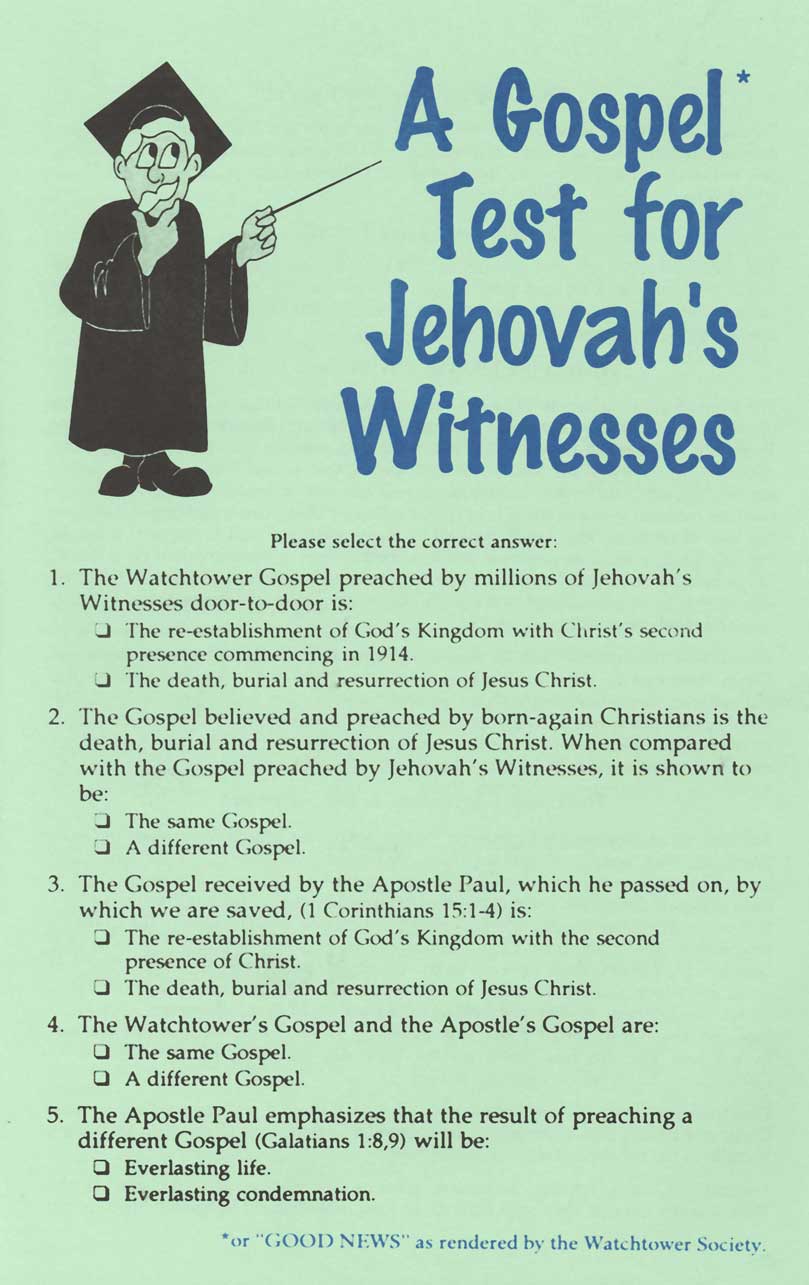
A gospel test for Jehovah’s Witnesses.

The following five questions for Jehovah’s Witnesses, from a tract sold by Personal Freedom Outreach, is a perfect companion to Paul Washer’s witnessing technique to Jehovah’s Witnesses (found here).

Edging even closer to Revelation 13.

My Amillennial friends may not be interested in this, but for the rest of you I thought you’d like to see how much closer we’ve come to Revelation 13.

In his article, Cashless Society: India Implements First Biometric ID Program for all of its 1.2 Billion Residents, Alex Jones writes:

“Over the past few months, I have written several articles dealing with the coming cashless society and the developing technological control grid. I also have written about the surge of government attempts to gain access to and force the use of biometric data for the purposes of identification, tracking, tracing, and surveillance. Unfortunately, the reactions I receive from the general public are almost always the same. While some recognize the danger, most simply deny that governments have the capability or even the desire to create a system in which the population is constantly monitored by virtue of their most private and even biological information. Others, either gripped by apathy or ignorance, cannot believe that the gadgets given to them from the massive tech corporations are designed for anything other than their entertainment and enjoyment.”

Continue reading Jones’ article here.


“And he causes all, the small and the great, and the rich and the poor, and the free men and the slaves, to be given a mark on their right hand or on their forehead, and he provides that no one will be able to buy or to sell, except the one who has the mark, either the name of the beast or the number of his name.  Here is wisdom. Let him who has understanding calculate the number of the beast, for the number is that of a man; and his number is six hundred and sixty-six.”

– Revelation 13:16-18

Walter Martin vs Van Hale debate: “Is Mormonism Christian?”

walter-martin

vs

van-hale

Christian apologist Walter Martin takes on Mormon apologist Van Hale in a debate entitled Is Mormonism Christian? It is another fine job by Walter Martin in defending the faith from those who would seek to pervert it.

Years after this debate, Van Hale publicly announced (in 2005) that he cannot accept the Book of Mormon as real history about real people (see here). I’m not sure if his debate with Dr. Martin helped bring him to that point, but it is an interesting piece of history.

You can download all three parts of this debate here:

Is Mormonism Christian? (Part One)

Is Mormonism Christian? (Part Two)

Is Mormonism Christian? (Part Three)

______________________________________

Check out another great debate between Walter Martin and anti-theist Madalyn Murray O’Hair here.

Sermon of the week: “Payday Someday” by R.G. Lee.

Your sermon of the week is an old-fashioned, southern-style preaching experience by R.G. Lee (1886-1978) entitled, Payday Someday.

I can’t think of a better way to begin 2012 than with this powerful sermon given many years ago, the likes of which are hard to find nowadays coming from pulpits across America.

DefCon reaches 2 million visits.

On December 31, 2011, at approximately 10:00 pm (EST), DefCon received its two-millionth hit.

In the four years and four months that this blog has been active, we’ve published 3,768 posts (counting this one) and accumulated 22,220 comments.

I wanted to thank our writers as well as our many loyal readers, some of whom have been with us for years and some of which are newcomers. I am truly grateful for all that the writers and commenters have contributed to this work, and I am thankful that God has allowed us to do this for so long.

Thank you all, and Happy New year.

Pilgrim

Sermon of the week: “Why We Believe and Others Reject” by John MacArthur

Your sermon of the week by John MacArthur explains Why We Believe and Others Reject.

As a side note, the day that DefCon posts its sermons of the week will change this week. Our sermons of the week will no longer post on Thursday mornings but will now post on Sunday mornings beginning this Sunday, January 1st.

Quotes (921)

Does any Christian reader imagine for a moment that when he or she shall stand before their holy Lord, that they will regret having lived “too strictly” on earth? Is there the slightest danger of His reproving any of His own because they were “too extreme” in “abstaining from fleshly lusts, which war against the soul” (1 Peter 2:11)? We may gain the good will and good works of worldly religionists today, by our compromising on “little points,” but shall we receive His smile and approval on that day? Oh to be more concerned about what He thinks, and less concerned about what perishing mortals think.

– A.W. Pink

1886 – 1952

Quotes (920)

We speak with disdain of politicians not limiting their spending to available revenues. But our national  debt is an extension of the same irresponsible mentality many of us demonstrate in our own lives. Home mortgages, auto loans, and credit cards all seem normal to us . . . . We drive our bank-financed cars, running on credit card gas, to open a department store charge account so we can fill our savings and loan-funded homes with installment-purchased furniture. We’re living a lie and hocking the future to finance it.

– Randy Alcorn

Saturday sermon series: “The Gospel Demands Radical Abandonment (C)” by David Platt.

We conclude our eight-week series on the radical demands of the gospel by David Platt with the final message, The Gospel Demands Radical Abandonment (C).

To obtain the entire series (or watch the videos of these sermons) visit Disciple Making International.

“The more I studied the more evidence of a cover-up I discovered.”

As a follow-up to yesterday’s post (found here), and as a testament to the legacy of Joseph Smith (who was born 206 years ago today), I wanted to direct your attention to the resignation letter of former LDS stake bishop, Steve Bloor.

Here is an excerpt:

“I didn’t realise for instance that Joseph Smith practised polygamy, and was married to 33 women, most under the age of 20, one as young as 14. That some of Joseph’s wives were already married to other men when he married them; a practice called polyandry. All of these facts can be confirmed by a simple look at the church’s own website, familysearch.org. . . . There are many other issues, like; there are several accounts of the First Vision and Joseph Smith’s initial personal journal entry about the First Vision didn’t include seeing God the Father and Jesus Christ, but an angel. Then over the years the story got embellished till it changed to what we have today. Yet I was told it was the most momentous event to occur in this dispensation. Why didn’t Joseph initially record it correctly?  And there are so many other things that have just dissolved my faith to the point I can no longer bear a testimony of the truthfulness of this church or even God. Can you imagine how I now feel? It’s like my whole world is crumbling around me. I no longer know what I believe, or who I can trust. I don’t even know who I am, it is a most frightening experience. At the moment it feels like a death in the family. My death!”

Quotes (919)

The Puritan/Presbyterian wing of the Reformation accomplished a purity in worship not seen since the apostolic church. This purity was attained by making the Scriptures of the Old and New Testaments the only infallible standard and authority in determining worship ordinances. Any ordinances solely based on church tradition or man’s authority were discarded. However, this purity attained by our spiritual forefathers has, with the passage of time, been cast aside. Pragmatism, tradition and human opinion are exalted in determining how God’s people are to worship Him. The attitude among many in church leadership positions is to give the people what they want, rather than to submit to God’s divine revelation. . . . . God has set down in Scripture how He is to be worshiped. Man is not to add to or detract from what God says. . . . .

Brian Schwertley

“If the [Mormon] church is not true would I want to know?”

Steve Bloor penned a letter to his congregation after resigning from his position as Bishop in his LDS stake.

What he did took much courage and I commend him for not only being willing to investigate his organization’s history, but also for acting upon what he discovered and not putting the problems of Mormonism on the proverbial Mormon shelf.

Here’s an excerpt from his letter:

I realise this will shock you. It has truly shocked me how quickly a testimony of the Church can unravel when Joseph Smith’s divine calling as God’s prophet is undermined by learning the truth about him.

I have come to believe over the last month that there are so many inconsistencies and problems with the historicity of the Book of Mormon, as well as the divinity of Joseph Smith’s calling as prophet, that I can no longer, in good faith, fulfill my calling as Bishop of Helston Ward.

You can read his entire letter here.

Sermon of the week: “How to Recognize True Repentance” by Don Green.

It has been awhile (too long) since DefCon last featured Don Green, but now we break that drought with today’s sermon of the week, How to Recognize True Repentance.

Here is an excerpt from this sermon:

“I fear that the strong opposition that you see in the Christian church sometimes to the opposition of society’s sins comes at the expense of real personal concern about our own sins, and that needs to be said. Jesus isn’t calling you to mourn over someone else’s sin, He’s calling you to mourn over your sin.”

I have really benefited from Don Green’s teaching over the years and am happy to feature him again.


Thabiti Anyabwile on multi-site churches.

Something for you to consider (and discuss) from the article, Multi-Site Churches Are from the Devil:

“. . . I think the kind of multi-site churches (realizing there are a few different approaches) that feature one pastor being beamed into several sites around a region—and in some cases around the country or world—is simply idolatry.  It’s certainly cult of personality multiplied and digitized for a consumer audience.  As a brilliant young man remarked to me this morning, ‘The pastor now becomes the new icon in the midst of the Protestant worship service.’  I think that’s well said.  Video multi-site tends to idolatry, pride, and self-promotion—even where the ambition of spreading the gospel is genuine.”

Read the entire article from Thabiti Anyabwile here.