Sermon of the Week: “The Calling of a Preacher” by Albert Mohler.

Albert Mohler was one the key-note speakers at the 2012 Shepherd’s Conference. While there were several excellent speakers throughout the event, this message from Mohler was timely and relevant to me personally – and seemed to resonate with the two or three thousand others gathered there as well. Here is an excerpt from his introduction, full message in video below, mp3 download here (right click and save or click to listen).

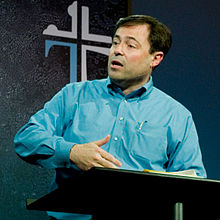
Let’s admit it. There’s a lot of mysteries in the christian life, but one of the greatest mysteries is why God would in His sovereign, omnipotent and omniscient, and wisdom and righteousness, and mercy choose the likes of folks as we… to do this. You might think that if we were orchestrating this, we might have angels doing the preaching. Everybody would listen to an angel, wouldn’t they? Of course,  not American angels. We domesticate little angels, we paint little pictures of cherubs and hang them in the bathroom. It’s a completely different reality. Just remember in the Gospel of Luke, the angelic hosts showed up to the shepherds and the first think they had to say is, “First of all, don’t die” – “Fear not, we bring you tidings of great joy”. Meanwhile, most Americans, in our weirdo, fake, postmodern spirituality think they’re channeling with little cherubs in the bathroom.

But God doesn’t assign angels to do the preaching. He assigned human preachers, men whom He has called because when an angel shows up to preach you don’t ask, “How did God do that?”. But, when we show up to preach you’re looking at me going (saying), “He’s just flesh and blood. He’s nearsighted. He only speaks one language. He’s gonna be hungry soon. He fell asleep during a Greek lecture, thirty something years ago and you’re letting him preach?” Well, it’s as the apostle Paul says, “It’s so that the glory would be all of God’s and not ours. So that the excellence would be His excellence that’s demonstrated and not ours.”

Admit it: you’d love to be doing this, and then admit it: That’s a good thing. And then let’s just admit it together, it’s just a priceless thing that we get to be together for these days and these hours, to preach and to hear preaching and to be encouraged, not only by each other, but by the Holy Spirit of God in this calling that has come to us.

Yet another example of what the gospel is NOT.

Meet Charles L. Worley. He pastors Providence Road Baptist Church in North Carolina and he apparently has no idea what the grace of the gospel of Jesus Christ is.

Mr. Worley, have you forgotten the pit of depravity from which God saved you, or is your lack of mercy a sign that you have yet to receive God’s grace yourself?

There is a striking irony about Mr. Worley’s suggestion during his “sermon” that homosexuals be imprisoned behind fences till they die out (an irony similar to the obnoxious street preacher we featured a few days ago). The irony is that one day in the near future it is very likely that Christians will be imprisoned in America for their faith, and it will be men like these that will have proven to be instrumental in–and the justification for–the passing of legislation needed to criminalize Christianity.

What the gospel is NOT.

Meet James Lyman. He is the man in the below video street preaching (I use the term very loosely as to not bring reproach upon those men out there who actually preach Christ and Him crucified on street corners).

As you’ll see in the video, exactly what Mr. Lyman is preaching is a little hard to pin down, as there seems to be no gospel message. It seems that Law and gospel have taken a backseat to just plain condemnation and ridicule.

If you recall, Mr. Lyman is the man who mocked, ridiculed, and called Rosie O’Donnell names while street preaching at this past year’s Superbowl. He then defended his actions here on DefCon.

How Mr. Lyman treats this woman is heartbreaking, for the message of the gospel is supposed to be the offense, not those who carry the message of the gospel.

For those who are not familiar with the preaching of the gospel, rest assured, this is not it.

Martial law and Romans 13.

How far is Romans 13:1-3 meant to be taken?

There’s no denying that the government’s reach and control grows larger every day, individual  rights continue to erode, and the framework for the persecution of the church is being laid. So, does Romans 13 mean Christians are to unquestionably collude and cooperate with their coming persecutors?

Here is a brief news clip to spur the conversation (debate). I look forward to reading the discussion.

Romans 13:1-3

“Every person is to be in subjection to the governing authorities. For there is no authority except from God, and those which exist are established by God. Therefore whoever resists authority has opposed the ordinance of God; and they who have opposed will receive condemnation upon themselves. For rulers are not a cause of fear for good behavior, but for evil. Do you want to have no fear of authority? Do what is good and you will have praise from the same;”

Church suing former member for defamation.

Seriously.

From KATU news in Oregon:

BEAVERTON, Ore. – A church pastor is suing a mother and daughter for $500,000 because they gave the church bad reviews online.

The family being sued left the church a few years ago and Julie Anne Smith says she and her family were shunned and couldn’t understand why. So she went online and wrote Google and DEX reviews of the church and then started a blog.

“I thought, I’m just going to post a review,” Smith said. “We do it with restaurants and hotels and whatnot, and I thought, why not do it with this church?”

Never did she think Beaverton Grace Bible Church and Pastor Charles O’Neal would slap her with the lawsuit.

“I’m a stay-at-home mom. I teach my kids at home, and this is just not the amount of money that normal moms have.”

When the family left the church, Smith says friends were told to end all contact with her.

“If I went to Costco or any place in town, if I ran into somebody, they would turn their heads and walk the other way,” she said. “All we did was asked questions. We just raised concerns. There’s no sin in that.”

Dissatisfied, she went online to write reviews. Other church members counteracted them with church praise. So Smith started a blog called “Beaverton Grace Bible Church Survivors.”

But the pastor claims in the lawsuit he filed that her words, “creepy,” “cult,” “control tactics,” and “spiritual abuse,” are defamation.

“What somebody does in the church is one thing, but when you get out into society we have the right to free speech, and it may not be what people want to hear, but we absolutely have that right,” Smith said.

The lawsuit didn’t just target Smith. Her daughter and three other commenters are also being sued.

“He can say what he wants in the church and say, don’t talk about this or don’t talk about that, or don’t talk to this person, but when you’re out in the civil world, you don’t do that anymore,” Smith said. “And he’s not my pastor anymore. He does not have that right to keep people from talking.”

The Smiths filed a special free speech motion to dismiss the lawsuit. It goes before a judge later this month.

KATU News called the church, went there, went to the pastor’s home and spoke to his wife. KATU News also called the pastor’s attorney. All of them declined to give their side of the story.

Here’s the video from KATU news and here’s the blog of one of the people being sued.

Quotes (937)

When a congregation is made up of many people whose lives more resemble the works of the flesh than the fruit of the Spirit, the experience of following Christ together, of love and encouragement and spurring on and mutual advocation and accountability, all of this is eroded and cooled and diminished. The church becomes more like the world.

– Mark Dever

Sermon of the week: “Election” by Russ Sukhia.

Russ SukhiaYour Sermon of the Week is Russ Sukhia’s message simply entitled, Election. I spent the majority of my (false conversion) Christian life never hearing about the doctrine of Election in spite of having attended many different churches.

Eventually, however, as my study of the Bible continued, I couldn’t avoid those pesky words that testified of God’s sovereignty; words like “predestination,” “chosen,” and of course, “election.”

In this 40-minute sermon Pastor Sukhia explains this doctrine (and the oppositions and challenges to it) very clearly. I highly recommend it for anyone who is wanting to know more about Election or anyone who is struggling to come to terms with it.

If you enjoy this sermon I also recommend listening to another message by Russ Sukhia’s (featured here) called Recovering the Lost Doctrine of Repentance. Russ Sukhia is uncompromising in his messages and he’s a strong preacher who conveys the Word with clarity and conviction.


Quiz: Are you loving or unloving?

Here’s a quick and simple six-question quiz to determine whether you’re loving (“tolerant”) or unloving (close minded and “intolerant”).

  1). You’re sitting in a coffee shop when a woman at another table gets up–leaving her coffee unattended–to get a napkin. As she does, a man walks by her table, pours a powdered substance into the woman’s coffee and quickly exits the shop. You immediately warn this woman of what just happened. Your reaction is:

A. Loving

B. Unloving. This is none of your business. Quit interfering with other people’s lives.

2). A small child runs toward a bush to retrieve his ball that rolled into it. You know that the bush contains a rattlesnake nest. You yell out for the kid to stop. Your yelling at this child is:

A. Loving

B. Unloving. Who are you to impose your beliefs onto this kid. His parents have a right to raise him how they see fit without your close-minded “snakes are bad” views being forced down his throat.

  3). You are woken to the sounds of fire alarms and the smell of smoke in your apartment complex. As you hastily exit your apartment you notice that no one has alerted your elderly neighbors who are  deaf. You bang on their door (and even kick it in if necessary) to alert them of the pending doom. This action that you’re taking is:

A. Loving.

B. Unloving. Have you considered that perhaps this couple is happy where they are? Why wake them from their slumber? If they’re happy, then leave them be.

4). On a dark and rainy night you observe a family in a car heading home in the direction of a washed-out bridge. You holler and flail your arms, making every effort you can to get their attention to warn them. Your behavior is:

A. Loving

B. Unloving. All roads lead to their house. Who are you to tell them that the road that they’ve chosen to go home will lead to their deaths?

  5). While sitting in your car waiting for your friend in a bank, you observe a man walk into the bank wearing a stocking on his face and carrying a gun. You call 911.This judgment of the man’s intentions is:

A. Loving

B. Unloving. “Judge not lest ye be judged!” Who are you to judge this man’s heart. Maybe his intentions are good and he will do no harm to those inside. You’re always so negative and have no faith in other people. You’ve condemned this man already. Jesus would have never done that, He would have befriended him. You need to be more like Jesus.

6). Your friend is going to die in his sins, and when he wakes up on the other side of eternity, will find himself in Hell. You share with him the fact that his unrepentant sin will condemn him before a holy God and that he deserves God’s wrath (just like everyone else) because he’s transgressed God’s laws. You further explain that any of his attempts to purchase God’s forgiveness by his own obedience to the Law or good works is futile because not only are we saved by faith apart from the works and the Law, but God’s grace is not earned, it is a gift. You share with your friend that through the death of one Man, God has provided forgiveness to sinners, but this unmerited favor for sinners is only found in God’s Son, Jesus Christ, who ransomed us with His own blood. God’s only Son took our sin upon Himself on the cross and, in turn, imputed his perfect righteousness to us. You tell your friend that Jesus became a propitiation for him in order to absorb the wrath of God that he deserves. You urge your friend to repent and put his trust in Jesus Christ alone for salvation. This discussion with your friend is:

A. Loving.

B. Unloving. Insert any of the above “B” answers (or all of them) here: __________.

The two hardest words for a Christian to say.

Anyone who’s been around the church for any length of time will no doubt be able to recall a time when they were hurt by a fellow Christian. It’s not something that we ever expect to happen among those that are called to love even their enemies, but when we’re dealing with fallen human beings it is inevitable.

But what’s more troubling is that there seems to be a vital component in human relationships today that is utterly lost, and sadly, it’s even missing from those relationships within the Body of Christ. What I am speaking of is our inability and unwillingness to say the two hardest words in the human language: “I’m sorry.”

It’s amazing when you think of it. “I’m sorry” struggles violently to be liberated from our mouths while almost anything and everything else we say flows off our tongues without any restraint whatsoever (and is often the impetus behind many of our reasons we need to say sorry).

We are quick to displace blame, justify our actions, or simply ignore the hurt that we’ve caused another, but consider how much progress could be made in our relationships if we would simply bring ourselves to sincerely utter those two humbling words. And oh, how the gospel of Jesus Christ would be beautifully displayed.

The refusal to admit wrong is a burden that both parties have to bear. The wrongdoer for their wrong that has gone unconfessed, and the one wronged who now struggles to remain forgiving toward the wrongdoer and fights vigilantly to prevent animosity and bitterness from taking root in their hearts against the wrongdoer for not only the wrong, but also for the wrongdoer’s refusal to simply say that they’re sorry.

The wrongdoer may be able to sear their conscience enough to move on after the incident as if nothing happened, but the one wronged has to not only forgive the one who wronged them, but will spend a lot of time guarding themselves from the bitterness and resentment that will be ever-creeping at the door of their heart because the one at fault simply will not say, “I’m sorry.”

Ingrid Schlueter wrote a poignant piece on this very subject entitled I’m Sorry. Here’s an excerpt from her blog article (which I highly recommend):

“The words ‘I’m sorry’ when said honestly are the most healing in the human language. It seems sometimes like I spend an inordinate amount of time having to use those words for one reason or another. But I’m not sorry about that. Relations among professing Christians are in a shameful state because so few can bring themselves to say it and mean it. So unresolved issues lie there like rotting corpses, bringing a spiritual stumbling block to the offended, and a hindrance between God and the unrepentant offender.”

Is there someone you have offended or hurt (it does not matter whether they are a fellow believer or not) that you still have not told that you’re sorry or asked forgiveness of? If so, before you do anything else, humble yourself and do what needs to be done.

If you don’t know of anyone you need to ask forgiveness from, then seek the Lord in prayer and ask Him to show you if there is someone that you’ve hurt and didn’t realize it, then go and make it right.

“By this all men will know that you are My disciples, if you have love for one another.” John 13:35

Sermon of the Week: “The Lordship of Christ” by Dr. Adrian Rogers.

This last week I was blessed to hear a sermon once preached by the late Pastor Adrian Rogers on the lordship of Jesus Christ. I found this sermon to be a very powerful reminder that every aspect of my life must be surrendered to Christ, that He is to be Lord over it all. So often I can get prideful because of what I think I am capable of. Yet, God must constantly remind me there is not one thing in my life that is my own. He consistently humbles me and brings me back to the place where I remember I am merely the clay pot He has created and used for his glory. It is my sincere hope that this sermon serves to remind you of that as well.

Please follow the link provided and click on the “play” button to hear this sermon:

The Lordship of Christ

When it comes to sharing the gospel, is there ever a time to be silent?

I wanted to share with the readers of DefCon an article by Bobby Gonzales that raises a good question:

“One of the marks of a Christian is a desire to share the good news of the life-transforming gospel with others. In the words of the apostles, ‘We cannot but speak of what we have seen and heard’ (Acts 4:20). But what if a friend, fellow worker, schoolmate, or family member asks us to desist? Does there come a time when we should refrain from speaking to a person about Jesus and Christianity?”

Continue reading the article here on the It Is Written blog.

Sermon of the Week: “The Bible’s View on Missions – Part 9 (Conclusion)” by Akash Sant Singh

We are pleased to offer the conclusion of this nine part series of messages on biblical missions from Pastor Akash Sant Singh, pastor of Community Bible Church in Reno, Nevada. As a missionary to West Africa, this sermon has spoken to my heart and it will be a blessing to you as well.

It is important to remember that every true believer is actually called to be on a mission for the Most High Sovereign Creator of heaven and earth. May Christ be exalted through the proclamation of His word and to each listening ear.

Church description – “The Bible’s view on missions – part 9 – Conclusion – a Sunday school message by Pastor Akash.”

The Bible’s View of Missions – Part 9

In a nutshell.

A good read from the blog A Nut’s Notes:

Got up this morning.
Watched the morning news.
Read my favorite blogs.
Listened to songs.
Checked my email.

In a nutshell this is what I read and heard….

Celebrating 16 years of life,
university bomb scares, city budgets in crisis,
failure to launch missile,
inconceivableness of God,
political verbal clean-up, journaling, abuse survival,
fire drill notice, relay for life tonight, raising money at NPR,
new student, shopping carts and life,
life jackets for the spiritually needy, crisis web site listings,
pets and hairless rats, foster pets, donkeys in need,
hunger, football coach in trouble, racism, shootings, hate
the love of God, living life after Easter, debt,
pictures from vacation, train trip with sons,
science and God, adults who cut, majestic mountains, art,
and loneliness.

In a nutshell……what I need now………………”Be still and know that I AM GOD.”

Book Review: “Life in the Grey Nunnery at Montreal” by Sarah J. Richardson

 lifegreynunneryWhen one gets a glimpse into the evils of Romanism perpetuated in the name of Jesus throughout history, words are hard to find to express the tempest of emotions roiling within.  Here, the account of Sarah J. Richardson and her years spent in the Grey Nunnery at Montreal are no exception.  Incredulity, shock, grief, loathing and more will flood your heart as you read the incredible account of her years spent imprisoned in this whitewashed sepulcher, which indeed appeared outwardly beautiful, but inwardly was full of all manner of dead men’s bones and uncleanness.

The book starts by providing a little background on Sarah’s earliest years and how her partially intoxicated father, in an act he thought for her best interests, gave his daughter away to the nunnery.  Sarah recalls this painful time of parting from her father by writing:

I am sure my father did not realize what he was doing. Had he waited for a little reflection, he would never have consented to such an arrangement, and my fate would have been quite different. But as it was, he immediately sent for the priest, and gave me to him, to be provided for, as his own child, until I was of age. I was then to be allowed to go out into the world if I chose. To this, Priest Dow consented. … Though I was at that time but six years old, I remember perfectly, all that passed upon that memorable occasion. I did not then comprehend the full meaning of what was said, but I understood enough to fill my heart with sorrow and apprehension.

But reflect on what he was doing was not to be for Sarah’s father, for his mind was made up and for his rashness he would never again see his daughter.  And so Sarah was torn away from her family and the world at large and carried away unto the world of the convent from which the eyes of most are prevented from venturing too deep into its hidden recesses.

From here Sarah begins the recollection of her life and the strict discipline and monastic life she was subjected to.  Something for which Roman Catholics are well known for where self-denial and beating of the body are held in high esteem.  As far as discipline is concerned, the nunnery was marked by it where the slightest infringement of the law of the land could yield the harshest of penalties.  One such law was that the children were not to speak, nay not even to groan or turn on their sides at night lest they cause the least bit of disturbance to the “holy” silence so cherished in convents.

This “holy” silence was to be observed throughout the convent where the nuns had to walk on their tip toes, and upon opening and closing a door had to do so with the utmost of care so as to not disturb the “peace.”  A rule which Sarah found herself mistakenly breaking when one morning in haste, she closed the door much to quickly where “it came together with a loud crash.”  We pick up her story where she writes about what happened next.

On entering the room, I found the Superior waiting for me; in her hand she held a stick about a foot long, to the end of which was attached nine leather strings, some twelve or fifteen inches long, and about the size of a man’s little finger. She bade me come to her, in a voice so cold and stern it sent a thrill of terror through my frame, and I trembled with the apprehension of some impending evil. I had no idea that she was about to punish me, for I was not aware that I had done anything to deserve it; but her looks frightened me, and I feared,–I know not what. She took hold of my arm, and without saying a word, gave me ten or twelve strokes over the head and shoulders with this miniature cat-o’-nine-tails. … But when I began to cry, and beg to go to my father, she sternly bade me stop crying at once, for I could not go to my father. I must stay there, she said, and learn to remember all her commands and obey then. She then taught me the following verse:

   I am a little nun,
The sisters I will mind;
When I am pretty and learn,
Then they will use me kind.
I must not be so noisy
When I go about the house,
I’ll close the doors so softly
They’ll think I am a mouse.

And so began the life of Sarah in the convent.  A life which would be filled with torments and griefs that far surpassed her beating for closing the door too loudly.  Beatings not for her alone though but for all within its walls who dared to violate the orders of the Superior and priests, not matter how inane or petty they were.

More can be said but the reader of this post is encouraged to take the time and read this book for themselves.  In posting this I know many will outright dismiss Sarah’s account as the ravings of a lunatic or the ramblings of yet another anti-Catholic conspirator. To this charge the reader would be well advised to study the history of Rome before making such a hasty verdict.  For we only need to look back a few years to recall the horrors and abject wickedness of Romanism brought into the light as the “sex scandal” became headline news.  Horrors that if protested against before this story broke, would have met with the same denial, incredulity and ridicule.

Or, one should peer back a little into history at the time of the inquisitions to find that men were of such hardened hearts that they could inflict the most horrible of terrors upon those who would not submit to the Papacy.  All of which that Rome would assiduously deny until there was so much proof she could do nothing but slink back into her corner.