
Expository Moments
The Significance of Baptism
The following is from chapter 2 of my book, Captive to the Word of God, a Baptist look at theology and life in the local church. This is the last section on baptism.
The Significance. What does baptism mean? This is the reason we cannot compromise on the previous points, demands the most from our attention, and requires a redeemed mind to properly comprehend. The main reason baptism is given in Scripture is to point to the death and resurrection of Jesus. He said of His baptism I have a baptism to be baptized with, and how great is my distress until it is accomplished! (Luke 12:50) By this, Jesus was not referring to John’s baptism of Him in the Jordan, though that is a type and shadow of the spiritual truth of what Jesus speaks of in Luke 12. The Lord’s true baptism was His punishment on the tree for our sins. This baptism is what caused the Lord of glory to be in great distress. Thinking forward to His punishment on the cross, suffering the spiritual punishment due us for our sins; this is what caused the King of kings to sweat drops of blood in the garden. No mortal man can stand where Jesus did, cursed by God for the sins of others. He laid His life down for us, knowing He would pick it back up again. Death could not contain Him, for Jesus, unlike the priests of Moses’ time, had no sin of His own. He saw beyond the cross to His glorification, knowing His Father was faithful and would vindicate His death by raising Him up to a glory surpassing that which He had from eternity past. His resurrection is what gives us the hope to not grow weary in well doing (1 Cor 15:20-28). When we baptize believers, we read from Romans 6:4, We were buried therefore with him by baptism into death, in order that, just as Christ was raised from the dead by the glory of the Father, we too might walk in newness of life. This gives us a picture of what has been done (spiritually) to us, that as the Lord Jesus was put to death and raised up, so were we – spiritually. This is an important truth that we must never forget.
But I hope to open our eyes to the greater meaning of this simple ordinance and pray that we see together what a glorious picture has been given to us by our great and gracious Lord. The Lord’s life, death, and resurrection are the keystones of our faith.
Much support and insight for what follows was drawn from a small book by Baptist Pastor Hal Brunson, titled The Rickety Bridge and the Broken Mirror, a book of parables about baptism.
The baptism in Romans 6:4 gives us the active or present reality of the meaning of Christ’s death, and refers directly to the reality of the first resurrection, when we die to sin and are raised to new life in Christ. But this verse and the act of baptism also point back historically to His death and prophetically forward to the physical resurrection of all the saints when Christ returns to judge all flesh. Baptism is a multifaceted word picture that ought to remind us of far more than the glorious change wrought in the life of the redeemed sinner. One aspect of baptism that baby sprinklers cannot lay claim to is baptism as a picture of submersion into great waters, portraying the great waters of Divine judgment. We do see in Scripture several passages where great waters are graphic symbols of God’s judgment and wrath against sin – which Christ took upon His body as the Lamb sacrificed for our sin. He was submersed into the ocean of God’s wrath on our account, and raised up on the third day. We will look to God’s Word to learn more about this rich teaching on this simple ordinance, graphically presented in four word pictures:
- The flood of Noah.
- The sorrows of David, described as “great waters”.
- Jonah being cast into the sea.
- Jesus’ understanding of His death.
First, the flood as a picture of the death of Christ is portrayed in baptism. The Apostle Peter points to this great flood of the entire earth as a vivid picture of the believer’s baptism as well as a figure or type pointing to the suffering of Christ. In proclaiming (1 Peter 3:18) that Christ also suffered once for sins, the righteous for the unrighteous, that he might bring us to God, being put to death in the flesh but made alive in the spirit, Peter then alludes to the flood and how only eight persons were saved in the ark, brought through the great waters of God’s judgment against sin. And Peter goes on in his first letter (3:21) to tell us that baptism corresponds to this – the flood of Noah, the outpouring of God’s wrath in judgment and the only refuge being in the ark which is Christ. Both the great flood and our baptism are types which point to the death of our Lord and His provision for our safety. In 2 Peter 2:6, the flood is listed with another well-known symbol of God’s wrath against sin: Sodom and Gomorrah. God’s wrath against sin is real, it is certain, it is final. We need a Savior, One Who can bear up under this wrath, One Who has no sin of His own to atone for. Not only did Christ provide refuge for the redeemed from God’s wrath, He was buried in God’s judgment as payment for sin – our sin. He is worthy of our praise.
The messianic prophet Isaiah, who told of the suffering servant who was crushed for our iniquities, brings us back to the flood in describing the covenant of peace the Messiah, the Holy One of Israel is your Redeemer (Isaiah 54:8) will bring.. This is the promise to all who are called, not a promise to the nation-state of Israel. Jesus, the Holy One of Israel, saves all who have been appointed unto eternal life, from every nation, tribe, and tongue. This redemption is as the waters of Noah to me, says the Lord of Hosts (vs 9). Brunson says:
this points backwards, not merely to the language and theology of the slaughtered and speechless Lamb, but even to the very moment at which God would impute the transgressions of His people to their Savior and His righteousness to them. “This”, God says, “is as the waters of Noah to me” – “this” – His being “despised and rejected of men”; “this is as the waters of Noah – His identity as “a man of sorrows, and acquainted with grief”; His “bearing our griefs and carrying our sorrows”; the Savior “stricken, smitten of God, and afflicted … wounded for our transgressions, bruised for our iniquities, chastised for our peace, and striped for our healing” – “This is as the waters of Noah to me” – His oppression, His affliction, His slaughtering, His substitutionary imprisonment within the iron bars of injustice, His burial with the wicked in the grave of hell’s billows: “This”, says the Almighty, “is as the waters of Noah to me.8
And who is Noah other than a type for all who have found refuge in Christ? What is the ark other than a type of the everlasting covenant of redemption whereby God’s people rise above the waters of judgment? The flood of Noah is God’s judgment against sin. It portrays the suffering of Christ in payment for sin, securing the redemption of those chosen by God the Father. None but those so chosen and called could enter in the ark; God Himself shut the door to secure Noah and his family in and to keep all others out. None but those chosen were shielded from the wrath of God. The flood of Noah shows us how great the price our redemption, how great the Father’s wrath on sin; how helpless we are to secure that safety.
Briefly, let us talk about the ark, made of earthy things: wood and pitch. Christ, the second person of the Godhead came to us wrapped in earthy things: flesh and blood. The ark and the cross, both made of wood. Both signs of judgment and redemption. The ark covered with pitch, to waterproof it, just as in the day when baby Moses, like Noah, would ride upon dangerous waters in a vessel covered with pitch. This pitch was flammable and used as fuel, used by Isaiah as a metaphor for God’s judgment: For the LORD has a day of vengeance, a year of recompense for the cause of Zion. And the streams of Edom shall be turned into pitch, and her soil into sulfur; her land shall become burning pitch (Isaiah 34:8-9). The Hebrew term for pitch, kaphar, is usually translated not as pitch but is overwhelmingly interpreted as to atone, to purge, to reconcile, to forgive, to cover, and to propitiate. Can you see the glorious scene of how grand the picture is painted by the baptism of a child of God? Again, from Brunson: “The captain of our salvation may have gone to the depths for the salvation of His people, but the old ship of Zion rides the waves with linen sails unfurled, impervious to raging winds and roaring waves, speeding safely upon the scarlet billows of judgment to the soul’s desired haven.”9 We get a glimpse of what the Lord Jesus meant when He told the disciples that Moses and the prophets had written about Himself, and how glorious is this glimpse!
That is but a portion of what the great flood of Noah teaches us about baptism, but we must press on and look at what we are taught by the sorrows of David. This man after God’s own heart knew of his own sin and the despair of trusting in any mortal man for reconciliation with Holy God. David and other Psalmists described their deep sorrows as a kind of burial beneath the billows and waves of the Almighty. In Psalm 42:5 & 7 we read, Why are you cast down, O my soul, and why are you in turmoil within me? In this sorrowful lament with his soul, he describes his afflictions in terms that point to baptism – Deep calls to deep at the roar of your waterfalls; all your breakers and your waves have gone over me. Three images of water: waterfalls, breakers, and waves; all communicate the idea of a cascading waterfall pummeling the poet, with the brutal breakers and waves of an angry ocean violently washing over his head. These terrifying metaphors of his torment and anguish wash over him, drowning him in his sorrows. Carried along by the Spirit of God to write these things, perhaps the Psalmist knew not that he prophesied of the promised Messiah, but his words were given to him by God’s Spirit and anticipate the predestined sufferings and death of Christ as a kind of baptism. The word for deep in the psalm is used as a synonym for sheol, connecting to the death of Christ as a submersion into the deepest waters of the place of the dead. And the water metaphors in this psalm undoubtedly describe the suffering servant of God – As with a deadly wound in my bones, my adversaries taunt me, while they say to me all the day long, “Where is your God?” (Psalm 42:10) This is widely recognized as prophecy of the Lord’s sword-pierced side and the cruel mockery of those who blasphemed while He hung on the cross.
David’s description of his soul’s suffering in deep water takes us more deeply into the sufferings of Jesus. “Like the high priest of Israel, we pass through the first veil, the holy place of Christ’s impeccable flesh, and gaze upon the physical sufferings of Christ; and then through the second veil into the holy of holies, to the very heart of Christ, where we gaze upon the innermost secrets of the Savior’s suffering soul”10 as He was put under the rod of God’s wrath. In Psalm 18 David wrote about his persecution at the hand of Saul; but the eternal message of redemption contained throughout Scripture portrays here the Savior’s passion, not merely David’s sorrow; death and hell as the persecutor of Christ, not merely Saul’s pursuit of David. The king of Israel describes his trials which have human and divine causes, in terms of sorrow, death, and hell; stark images of his soul’s baptism into the lesser sea of man’s wrath and the greater ocean of God’s wrath. David is immersed in human wrath; Saul’s rage is real. David’s words tell of God’s judgment on sin and care for His people:
Then the earth reeled and rocked; the foundations also of the mountains trembled and quaked, because he was angry. Smoke went up from his nostrils, and devouring fire from his mouth; glowing coals flamed forth from him. He bowed the heavens and came down; thick darkness was under his feet. He rode on a cherub and flew; he came swiftly on the wings of the wind. He made darkness his covering, his canopy around him, thick clouds dark with water. Out of the brightness before him hailstones and coals of fire broke through his clouds. The LORD also thundered in the heavens, and the Most High uttered his voice, hailstones and coals of fire. And he sent out his arrows and scattered them; he flashed forth lightnings and routed them. Then the channels of the sea were seen, and the foundations of the world were laid bare at your rebuke, O LORD, at the blast of the breath of your nostrils. He sent from on high, he took me; he drew me out of many waters. He rescued me from my strong enemy and from those who hated me, for they were too mighty for me. (Psalm 18:7-17)
Like the pitch on Noah’s ark, God’s judgment here invokes images of fire and water. But as God did not leave David’s soul in torment, neither would He suffer His Holy One to see corruption. Christ was not left buried beneath the sea of God’s wrath and the ocean of His judgment. As David cried out in his distress and called upon the Lord from beneath the deep waters of his sufferings, so also the Savior, as it were, from beneath the burning waters of the cross, Jesus cried out with a loud voice, saying, “Eli, Eli, lema sabachthani?” that is, “My God, my God, why have you forsaken me?” (Matthew 27:46) As deep calls to deep, the Almighty heard the voices of David and David’s seed, and thus He bowed the heavens and came down, riding on a cherub and flying on the wings of the wind; God answered the cry of His Son and sent from above and drew Him out of many waters.
The sorrows of David and other psalmists resonate with all who suffer, but they ultimately point us to the One Who suffered what we deserve, to bring many sons and daughters to glory. The love of God for His elect caused the Son of God, David’s promised seed, to submit to the baptism of His Father’s wrath, so we who are called by His name would be reconciled to our Father and not left to our just deserts.
Let us now look at what we are taught by the casting of Jonah into the sea. This one is specifically called out by the Lord Himself as a type pointing to His death. Then some of the scribes and Pharisees answered him, saying, “Teacher, we wish to see a sign from you.” But he answered them, “An evil and adulterous generation seeks for a sign, but no sign will be given to it except the sign of the prophet Jonah.” (Matthew 12:38-39) Two symbols of Jonah’s experience point to the death of Christ, and to baptism. The terrifying great fish and the deep waters – both of which swallowed up Jonah, and both of which point to baptism by immersion as the proper sign of Christ’s death, burial, and resurrection. Consider what the prophet said from the belly of the fish: Then Jonah prayed to the LORD his God from the belly of the fish, [quoting the 18th Psalm] saying, “I called out to the LORD, out of my distress, and he answered me; out of the belly of Sheol I cried, and you heard my voice. For you cast me into the deep, into the heart of the seas, and the flood surrounded me; all your waves and your billows passed over me. Then I said, ‘I am driven away from your sight; yet I shall again look upon your holy temple.’ The waters closed in over me to take my life; the deep surrounded me; weeds were wrapped about my head at the roots of the mountains. I went down to the land whose bars closed upon me forever; yet you brought up my life from the pit, O LORD my God.” (Jonah 2:1-6) Like David, Jonah testifies not only to his personal experience; he also prophesies of the death of Christ as a kind of submersion into deep waters. Like Jonah, our Lord was swallowed up by the jaws of death, buried in the heart of the earth, at the bottom of death’s sea. As by the decree of God the great fish could not hold Jonah, it was not possible that death should hold the Son of God. So baptism is not only of immersion but also of emersion – a coming out from the deep waters. Thus Jonah and the Son of God were not only submerged into the belly of the fish and the deep waters of death, they also emerged from leviathan’s jaws and the ocean’s depths. How can the sprinkling of a baby rightly convey this message? When the child of God is baptized by immersion, the testimony is not only the vicarious submersion with Christ into His death, but also our emersion from death by virtue of His resurrection.
Finally, we look to what the Lord Jesus understood about His death as an apocalyptic baptism, interpreting Scripture with Scripture. No tradition or imagination of man can bring us the light and truth that God has given us in His Word.
In the short gospel penned by Mark, we have this response from the Lord Jesus to the request from James and John to sit on either side of Him in glory. Jesus said to them, “You do not know what you are asking. Are you able to drink the cup that I drink, or to be baptized with the baptism with which I am baptized?” And they said to him, “We are able.” And Jesus said to them, “The cup that I drink you will drink, and with the baptism with which I am baptized, you will be baptized.” (Mark 10:38-39). Other than the ten being indignant at these two, what might they have thought about the cup and the baptism? They would soon learn that this cup the Lord spoke of was not the cup of communion nor a water baptism. Jesus had spoken in terms that left his disciples uncertain, but we know from the record of Scripture that what He was speaking about was the cup of wrath and the baptism of death that awaited Him; of which He lamented: I have a baptism to be baptized with, and how great is my distress until it is accomplished! (Luke 12:50) The disciples would be able to drink of His cup and be baptized with His baptism vicariously through Him. No mortal man can stand where Jesus did: cursed by God for the sins of others and lay His life down knowing He would pick it back up again. When we take communion, we are not drinking His cup, but we drink in remembrance of what He did – to cut the New Covenant in His blood to reconcile sinners to Holy God. When we are baptized, it is not merely following His example when John baptized Him in the Jordan. Paul asks, Do you not know that all of us who have been baptized into Christ Jesus were baptized into his death? (Romans 6:3) And further he tells us, (1 Corinthians 12:13) For in one Spirit we were all baptized into one body—Jews or Greeks, slaves or free—and all were made to drink of one Spirit. We were baptized into Christ’s death, the death He died for us, to break down what separates us from God and one another, to make one people that will bring honor and glory to His name.
Oh, the Savior’s love for His Father and all those He chose to redeem in Christ! Baptism: it’s an ordinance which shows how spiritually dead people have been raised to new life in Christ. But, oh my dear brothers and sisters, it is much, much more than that. I pray you have glimpsed a better, if incomplete, picture of the grand and glorious sacrifice of our Lord and Savior as prophesied and portrayed in various ways as a baptism into God the Father’s judgment. The price He paid and the suffering He took as He drank the cup of wrath due us, summed up the submersion and emersion as one is plunged beneath the waters of baptism and raised up from the deep as was our Savior. Let us never see baptism as the mere sprinkling of water over a little one who knows nothing and fears not the wrath of God, nor see it as only the celebration of a new-born brother in Christ. Let us always remember the One Who was baptized in a way you and I could never survive. Christ paid the price we could not pay. He drank the cup and underwent the baptism that we could not. Every time we see this ordinance, let us think on His sacrifice, His obedience, His submission. And let us be thankful we have a faithful God Who did not allow His Holy One to see corruption – that we would have the firm hope of life eternal. We were buried therefore with him by baptism into death, in order that, just as Christ was raised from the dead by the glory of the Father, we too might walk in newness of life (Romans 6:4). Water baptism is a glorious picture of our Redeemer and a reminder of the spiritual baptism mentioned here, when we were raised up to walk in Christ!
The Story of Calvinism
While no individual is going to fully agree with another on every single point of doctrine, this was a good video that is clear and concise.
Guest Post: Do Not Be Like the Gentiles
I touched on this topic when teaching in Romans 8:
Romans 8:26-27 In the same way the Spirit also joins to help in our weakness, because we do not know what to pray for as we should, but the Spirit Himself intercedes for us with unspoken groanings. And He who searches the hearts knows the Spirit’s mind-set, because He intercedes for the saints according to the will of God. Note how this couplet starts out – in the same way the Spirit also joins to help. In what same way does the Spirit help us? In verse 26 we read that He helps us when we are too weak and ignorant to know how to pray. This opening phrase must refer to what was just previously written, so we can rightly conclude that the Spirit of God helps to wait eagerly with patience. If we think we can do those things, we think too highly of ourselves and forget the flat teaching of Jesus – that apart from Him we can do NOTHING. There is no wiggle room in that statement. This goes hand-in-hand with the familiar verse in Philippians 2:13 – for it is God who works in you, both to will and to work for his good pleasure.
As the Holy Spirit helps us in our weakness to eagerly look for the return of Christ while waiting patiently for Him, He helps us pray – because we do not know what to pray for as we should. There are various translations of this phrase and the most agreement is that we do not what we should pray for – we lack the wisdom to know what we should pray for. Now I submit that far too often we are simply lazy. I tell you it grieves my soul that so many churches pray for one another in trite ways (bless those on the prayer list for you know their needs) for many secondary things (99% of all prayers are for physical needs). It is NOT wrong to pray for another’s physical needs, but are there no spiritual needs in the lives of God’s children? Have we all arrived and have no impatience or rebellion in our hearts? Do we not care enough for people we know who are suffering in myriad ways to actually go before God with their names on our lips? These are things about which we know to pray. The Spirit helps with what we do not know. And when we are truly at the end of ourselves and know not what to pray, then the Holy Spirit intercedes for us with unspoken groaning that we do not comprehend. There will always be times we know not what to pray for, we will always be dependent upon God for grace in this age. When are we not faced with the infinite distance between us and God?This brother sheds more light on the topic. Very good read.

This is a guest post from our dear friend Michael Coughlin.
Matthew 7:1 (and other passages) instructs Christians to judge with righteous judgment and not hypocritically. The essence is this – be careful as you point out sin in another making sure you yourself are not committing the same error.
View original post 778 more words
Beginning With Moses
Our family sat together this evening and found this gracious message from Dr. Steve Lawson. What an incredible testimony of the grace of God that points clearly and unequivocally to the centrality of the Lord Jesus Christ in the entire Scriptures.
Devotional with Charles Spurgeon
February 2
“Without the shedding of blood is no remission.” — Heb 9:22
This is the voice of unalterable truth. In none of the Jewish ceremonies were sins, even typically, removed without blood-shedding. In no case, by no means can sin be pardoned without atonement. It is clear, then, that there is no hope for me out of Christ; for there is no other blood-shedding which is worth a thought as an atonement for sin.
Am I, then, believing in him? Is the blood of his atonement truly applied to my soul? All men are on a level as to their need of him. If we be never so moral, generous, amiable, or patriotic, the rule will not be altered to make an exception for us. Sin will yield to nothing less potent than the blood of him whom God hath set forth as a propitiation. What a blessing that there is the one way of pardon! Why should we seek another?
Persons of merely formal religion cannot understand how we can rejoice that all our sins are forgiven us for Christ’s sake. Their works, and prayers, and ceremonies, give them very poor comfort; and well may they be uneasy, for they are neglecting the one great salvation, and endeavouring to get remission without blood.
My soul, sit down, and behold the justice of God as bound to punish sin; see that punishment all executed upon thy Lord Jesus, and fall down in humble joy, and kiss the dear feet of him whose blood has made atonement for thee. It is in vain when conscience is aroused to fly to feelings and evidences for comfort: this is a habit which we learned in the Egypt of our legal bondage. The only restorative for a guilty conscience is a sight of Jesus suffering on the cross. “The blood is the life thereof,” says the Levitical law, and let us rest assured that it is the life of faith and joy and every other holy grace.
“Oh! how sweet to view the flowing
Of my Saviour’s precious blood;
With divine assurance knowing
He has made my peace with God.”
Billy Graham’s Gospel
Many people have benefited from Billy Graham and many of those never examined what Graham has been teaching these many decades. We read in the Word of God this brutal judgment:
I am astonished that you are so quickly deserting him who called you in the grace of Christ and are turning to a different gospel— not that there is another one, but there are some who trouble you and want to distort the gospel of Christ. But even if we or an angel from heaven should preach to you a gospel contrary to the one we preached to you, let him be accursed. As we have said before, so now I say again: If anyone is preaching to you a gospel contrary to the one you received, let him be accursed.
Here is a 40 minute review of Billy Graham’s gospel and how it compares to the biblical gospel. Contrary to those who consider Billy Graham to be their pope, may this sermon open your eyes. (Note – the preacher errs in thinking law is part of the biblical gospel – that is as wrong as Graham’s gospel.) http://www.sermonaudio.com/playpopup.asp?SID=86111517593
Faith Comes by Hearing
What Must I Do To Be Saved?
Soteriology is the doctrine of salvation – how does one get reconciled to God? It is my desire to show you how essential it is to grasp this doctrine rightly and how humbling and wonderful it is to comprehend what the Lord God has done in redeeming people. 
While there are many religions in this world, with myriad differences, they all have a few things in common and many differences. But no matter the religion, no matter the salvation, no matter the god, all systems of religion, including biblical Christianity, are based on salvation by works. All systems of religion are based on salvation by works. The differences lie beneath that truth. All but one system bases salvation on the works of those who need to be saved. The sole exception is based on men being saved by the finished work of another, a particular man who had no sin of His own to pay for. A man who is God and paid the price for others. The Lawgiver became the Law keeper for Law breakers. This exception, as I’m sure you already know, is our faith – biblical Christianity, based on the work of the God-man, Jesus.
Among professing Christian groups, many variants and shades exist, with most falling into self-saving works of the creature. These views are known as Pelagianism, Semi-Pelagianism, Arminianism, Universalism, etc. All of these are variations of synergistic modes of salvation – systems in which creator God is at best a co-pilot in redeeming people. The Scriptures, which are our only rule for truth and faith and godliness, depict God as the One Who created and sustains all things, directing the paths of kings and storm clouds, saints and Satan. Properly understood, the Word of God reveals a monergistic mode of salvation – children of God are born not of blood nor of the will of the flesh nor of the will of man, but of God alone (John 1:13). Since Scripture cannot be broken, monergistic salvation and synergistic salvation cannot both be true. The passages that appear to contradict each other do not. Our understanding and comprehension are limited and twisted by sin – the Word of God is perfect and by it the Lord searches out our intentions and thoughts. To rightly understand this doctrine of how sinners are made right with holy God, we must humbly submit to the Word of God and cry out for wisdom from the Spirit of God.
This dispute over how a sinner is reconciled to Holy God has been raging among men since Cain’s offering was refused. In the early 17th century a protest was filed with the ruling church court in the Netherlands by activist disciples of Jacob Arminius. Here are the five articles contained in the protest presented to the Council of Dort:
- God elects or reproves on the basis of foreseen faith or unbelief.
- Christ died for all men and for every man, although only believers are saved.
- Man is so depraved that divine grace is necessary unto faith or any good deed.
- This grace may be resisted.
- Whether all who are truly regenerate will certainly persevere in the faith is a point which needs further investigation.
Only the third point reflects biblical truth and was later denied by many of this view. The bedrock of the Arminian objection to monergistic salvation is the notion that divine sovereignty is not compatible with human freedom and that ability limits obligation. This is complementary to the Pelagian view that God would never command man to do that which man was incapable of doing. However, the Scriptures are replete with commands from God to the creature to do that which nobody but God can do, such as be ye perfect, and love God with all your heart, soul, mind and strength. These commands are meant to drive self-righteousness from us and draw us to Christ. The Arminians claim God gives every human the ability to believe on Jesus, and that God will never refuse anyone who exercises that ability and comes to Him in the faith that God gives to everyone; but only some exercise it and are saved. If this is the case, who gets the credit for the sinner’s salvation? And what do we do with 2 Thess 3:2 which tells us not all men have this faith?
Most professing Christians hold to Arminianism, having never heard anything else because most churches do not teach the whole counsel of God’s Word. I personally believe that all Christians are born spiritually as Arminians because we are only accustomed to what our natural senses can discern. And when one is born again, the first thing he is aware of is that he chose Christ; without yet knowing that Christ first chose and first loved him. The Arminian system makes sense to the natural mind, confirmed by natural senses. It shows up in our language: when we say someone “accepted Christ” we imply the person needing salvation decided to get saved. But Scripture denies this. This is why it is of utmost importance that evangelism be firmly connected to and rooted in discipleship. A new-born child of God must be shown and taught the Bible – what he was before he was raised from the dead and what soil preparation the gardener performed to make the seed take root.
In understanding what it means for anyone to be redeemed, to have been reconciled to Holy God, to be made into a new creature, we must grab hold of the biblical reality of our union with Christ. Ephesians 1:3 tells us we were blessed with every spiritual blessing by God the Father – that these spiritual blessings are in the heavenly places and they are in Christ. We mortal sinners get no heavenly, spiritual blessings apart from being in union with Christ, in communion with Christ.
There are several terms that describe what happens when a person is raised from spiritual death, referred to as the order of salvation:
- Predestination: Rom. 8:29 & 30; Eph. 1:3-6 & 11-14
- Effectual Calling (Regeneration): John 1:12 & 13; 6:44, 63-65; Eph. 2:1-5
- Faith/Repentance:
(Faith) – Eph. 2:8,9; Acts 13:48, 16:14
(Repentance) – 2 Cor. 7:9 & 10 - Justification (Legal Declaration): Rom. 5:1 & 2; 2 Cor. 5:21; Gal. 2:16
- Adoption: Rom. 8:15-17, 23-25; Gal. 4:4-7
- Definitive Sanctification: Rom. 6:1 & 2; I Cor. 1:2; 6:9-11
- Progressive Sanctification: Eph. 4:11-16; Phil 2:1-4, 13-15
(Preservation of the Saints) – John 6:37-40; 10:27-30; Phil. 1:6 - Glorification: Matt 25:31-34; 2 Cor. 5:1-8; Phil. 1:21-23; 3:20 & 21
The first of these, predestination, took place before the foundation of the world. Ephesians 1:3-4 Blessed be the God and Father of our Lord Jesus Christ, who has blessed us in Christ with every spiritual blessing in the heavenly places, even as he chose us in him before the foundation of the world, that we should be holy and blameless before him. Predestination is not a reaction to The Fall. God has no “Plan B”. Predestination is “Plan A”. The balance of the steps in this process take place in time, although regeneration, faith, repentance, and justification cannot be separated; we know that they happen in this order but are unable to plot them out, they are so tightly connected. But notice – regeneration comes before faith and repentance. That which is dead cannot develop root nor produce fruit. The soil must be prepared before the seed can sprout. If we do not properly understand this, we are vulnerable of being drawn aside into the Arminian camp, who claim that the spiritually dead sinner exercising faith in Christ causes regeneration. It is this level of attention that is required to discern between good and evil, as we are told in Hebrews 5:14 – But solid food is for the mature, for those who have their powers of discernment trained by constant practice to distinguish good from evil. We have the same fine degree of difference with the Roman Catholic doctrine of “salvation”, wherein the sinner is infused with grace and thereby enabled to be holy and pleasing to God, but never arriving at any assurance of having been saved. The Scriptures teach that sinners are imputed the righteousness of Christ and are thereby justified by grace that is apprehended by the faith that was itself a gift to us – lest anyone boast in anything other than the cross of Christ! Nothing in my hand I bring, only to the cross I cling – this is how we all come to saving faith, no matter what our senses or churches tell us.
Kevin DeYoung, in Chap 7 of his book, The Hole in Our Holiness exhorts us: “… it’s appropriate … to talk about an “order of salvation”, whereby we are called by the Spirit of God, born again, moved to faith and repentance. Justified, adopted, sanctified, preserved, and glorified, we must never separate these benefits from the Benefactor. Every blessing in the order of salvation flows from our union with Christ.” John Murray is quoted as saying, “Union with Christ is really the central truth of the whole doctrine of salvation, not only in its application but also in its once-for-all accomplishment in the finished work of Christ.” We often talk about gifts we get from God – provision in things of this world, for the most part – and need to remind ourselves to not confuse the gift with the Giver. So it is with this greatest gift of all; while we will not truly understand the depth and richness of God’s saving grace towards elect sinners, we must not get so fixed on that spiritual blessing that we lose sight of the One in Whom we have that blessing. If we be not in Christ, we are not His and we vainly imagine that the blessings of redemption and reconciliation are ours. Contrary to what the pope said, sincere belief in whatever god you have chosen is not going to reconcile any sinner to holy God. Responding to a list of questions published in a newspaper, Pope Francis wrote: “You ask me if the God of the Christians forgives those who don’t believe and who don’t seek the faith. I start by saying – and this is the fundamental thing – that God’s mercy has no limits if you go to him with a sincere and contrite heart. The issue for those who do not believe in God is to obey their conscience. Sin, even for those who have no faith, exists when people disobey their conscience.”
Sin is not the failure of a creature to obey his conscience! Sin is not a bad habit, a hurtful hangup, or “something less than God’s best” – as a couple of well-known preachers have called it (referring specifically to homosexuality). An inadequate understanding of sin necessarily results in an inadequate understanding of grace, redemption, reconciliation, and a number of other orthodox doctrines of the Christian faith. Sin is a moral act, word, or thought that contradicts the expressed will of God for human beings. In other words, it is a covenantal breach with the Divine covenant maker. It is not limited to the will, the intellect, or the emotion. Sin involves the whole person.
What is the practical aspect of getting this doctrine – how is one saved? – correct? There are many examples from church history, but this one is my favorite. If you have read any history of the church, you should be aware that the Church of England went through an extended period (after their separation from Rome) wherein they had difficulty finding regenerate pastors. Wesley and Whitefield and Spurgeon all rubbed up against this. In fact, both Wesley and Whitefield came to saving faith in college, after they each had spent themselves in trying to make themselves pleasing to God; following the doctrine of salvation of the Church of England. One pastor in the Church of England discovered this in a rather unique way.
William Haslam was an English country parson who was a hireling of the state, a warm body to fill the pulpit in small country church. One Sunday in 1851 following a period of deep conviction of sin, Haslam ascended into the pulpit with the intention of telling his congregation that he would not preach again to them until he was saved and to ask them to pray for his conversion.
He began to preach on the text ‘What think ye of Christ’ (Matt 22:42), taken from gospel passage handed down from the mother church. As he read about the Jewish leaders who did not see Christ as the Messiah, he saw himself as one of them – a Pharisee who did not recognize that Jesus was the Christ, the Son of God. Haslam said, “I do not remember all I said, but I felt a wonderful light and joy coming into my soul, and I was beginning to see what the Pharisees did not.” At that moment, the Holy Spirit breathed new life into him and the effect was so obvious and marked that a local preacher who was present stood up and shouted ‘the Parson is converted, the parson is converted! Hallelujah!’ and the people rejoiced loudly and with much commotion.
If one fails to see the dire consequences of sin, the hideous nature thereof; if he fails to see Holy God as the judge who weighs the universe in His hands; if he doesn’t see rightly the King of glory Who paid the price for sin that man could never pay – he will die in his sin and be lost forever.
The doctrine of soteriology is not a dry theological construct that has no relation to how we live. It is the very core of the identity we as Christians have – that of being found in Christ. The jailer asked, “What must I do to be saved?” So they (Paul and Silas) said, “Believe on the Lord Jesus and you will be saved.” It is simple in one aspect – believe on the Lord Jesus. But oh how deep and rich is the salvation we have in Christ Jesus! We are found by Him, secured in Him, preserved in Him, saved and sanctified in Him. We walk in Christ, labor in Christ, obey in Christ. We live and die in Christ; and we conquer and overcome death and hell in Christ!
The Apostle Paul fought against false doctrines that taught justification by any other means. It is an essential doctrine upon which our faith rests. All other systems of salvation rest on self-worth and deny the depth of man’s sin and the sufficiency of Christ’s finished work.
Praise the God and Father of our Lord Jesus Christ. According to His great mercy, He has given us a new birth into a living hope through the resurrection of Jesus Christ from the dead and into an inheritance that is imperishable, uncorrupted, and unfading, kept in heaven for you. You are being protected by God’s power through faith for a salvation that is ready to be revealed in the last time. (1 Pete 1:3-5)
If Pelagius was right, Christ died for no purpose. If Scripture is right, and we were dead in our sins and trespasses, our life and worth depends on the death of Christ – in our place, to placate the wrath of God the Father.
Soteriology? It’s a matter of life and death.
Who is Jesus?
Glad you asked.
Romans 2 teaches NCT
Romans 2:12-16 For all who have sinned without the law will also perish without the law,  and all who have sinned under the law will be judged by the law. For it is not the hearers of the law who are righteous before God, but the doers of the law who will be justified. For when Gentiles, who do not have the law, by nature do what the law requires, they are a law to themselves, even though they do not have the law. They show that the work of the law is written on their hearts, while their conscience also bears witness, and their conflicting thoughts accuse or even excuse them on that day when, according to my gospel, God judges the secrets of men by Christ Jesus.
(Note: what follows is not a complete exegesis of this passage; it is a focused review of the stated topic.)
A casual read of this paragraph has caused many to get confused about Paul’s use of the term “the law;” it requires careful thought and analysis of what he is saying here and what is revealed elsewhere. Much of Paul’s use of “the law” is clearly meant to refer to the Mosaic Covenant and the Law of Moses. Those without the law are Gentiles: everyone who was not a Jew in Paul’s day, and includes all people in all ages who were not part of national Israel. It was clearly Paul’s kinsmen of the flesh who had “the law” in this paragraph.
Lost Gentiles are not without a law; God’s universal law convicts them of certain truths. We in the New Covenant are not without law; but we are not within the Law of Moses.
James gives the same counsel as Paul: But be doers of the word, and not hearers only, deceiving yourselves. For if anyone is a hearer of the word and not a doer, he is like a man who looks intently at his natural face in a mirror. For he looks at himself and goes away and at once forgets what he was like. But the one who looks into the perfect law, the law of liberty, and perseveres, being no hearer who forgets but a doer who acts, he will be blessed in his doing. (James 1:22-25) We see reference to a different law than that of Moses; one that is given to the church, not national Israel. He picks this up again in chapter two, My brothers, do not show favoritism as you hold on to the faith in our glorious Lord Jesus Christ. (James 2:1) Indeed, if you keep the royal law prescribed in the Scripture, Love your neighbor as yourself, you are doing well. But if you show favoritism, you commit sin and are convicted by the law as transgressors. (James 2:8-9) This phrase, love your neighbor as yourself, is the second great command, taken from Lev 19:18. It is the other side of the coin which also conveys the greatest command: You shall love the LORD your God with all your heart and with all your soul and with all your might, cited from Deuteronomy 6:5. On these two commands, neither taken from the Decalogue, hang the Law and the prophets – all the scripture then in hands of man. This shows us that while the Law of Moses is not our master, certain truths that apply to all of God’s people are found in his books. Jesus draws out two and declares them to be supreme to the Old Covenant, the essence of the New Covenant – love for God and one another; love as defined and portrayed in the Bible, not as our culture as deceitfully defined it these past few centuries.
Paul clarifies this in his letter to the Galatians, wherein he gives another term for the perfect law, the law of liberty, the royal law. These are not different laws we must figure out, they are different terms for the same divine concept, in simplicity for those in Christ, contrasted to the endlessly complex scheme developed by the nation of Israel. The New Covenant is contrasted with the Old Covenant in several places, the most familiar one being in Hebrews 8 where the old covenant is described as obsolete and ready to vanish. In Galatians 4 the old covenant is described as earthly Jerusalem and represents slavery while the new covenant is heavenly new Jerusalem wherein lies liberty. We, brothers, like Isaac, are children of promise, children of the free woman. And our apostle gives us clear counsel on how to keep this law. Brothers, if anyone is caught in any transgression, you who are spiritual should restore him in a spirit of gentleness. Keep watch on yourself, lest you too be tempted. Bear one another’s burdens, and so fulfill the law of Christ. (Galatians 6:1-2) This is the love of God expressed in the body of Christ – we love Him by loving one another, and this is an example of biblical love – confronting a brother caught in sin. Not exactly what the world presents as love, is it?
While only the redeemed truly love God, even we are unable to love Him with all that is within us, as the first commandment requires. In the age to come, unstained and not tempted by sin, we will be able to fulfill this law. We can, however, love one another because Christ first loved us. This must be a deliberate focus as our fleshly desires will work against us. There can be no fatalistic “let go and let God” into our lives for He tells us to work out our own salvation (here meaning the present tense “being saved” that characterizes our daily walk) with fear and trembling. As one preacher put it years ago, “The path of least resistance makes both man and rivers crooked.” Seek after the Lord – He will make your pathway straight!
You will hear simple rules such as “if it’s not repeated in the NT it doesn’t apply” and its corollary, “if it’s not repealed by the NT it applies.” These are easy to remember but not at all accurate. Tithing is seen before the Mosaic Covenant and required during it, including those Jews who lived in last century of that covenant, during Paul’s time. Such activity is taken note of the NT but not once is tithing taught by word or example as a New Covenant rule. Without understanding the rule of covenants, one cannot comprehend what rules apply. As Martin Luther summed it up, we follow Christ Jesus, not Moses – and Moses stands with us, accusing those who think their feeble attempts at keeping the Law of Moses will merit favor with YHWH (John 5:45).
The ancient preacher agrees with his New Testament brothers. He gave this advice as the sum of all he had written: The end of the matter; all has been heard. Fear God and keep his commandments, for this is the whole duty of man. For God will bring every deed into judgment, with every secret thing, whether good or evil. (Ecclesiastes 12:13-14)
Jesus said the same thing: “When the Son of Man comes in his glory, and all the angels with him, then he will sit on his glorious throne. Before him will be gathered all the nations, and he will separate people one from another as a shepherd separates the sheep from the goats. And he will place the sheep on his right, but the goats on the left. Then the King will say to those on his right, ‘Come, you who are blessed by my Father, inherit the kingdom prepared for you from the foundation of the world. For I was hungry and you gave me food, I was thirsty and you gave me drink, I was a stranger and you welcomed me, I was naked and you clothed me, I was sick and you visited me, I was in prison and you came to me.’ Then the righteous will answer him, saying, ‘Lord, when did we see you hungry and feed you, or thirsty and give you drink? And when did we see you a stranger and welcome you, or naked and clothe you? And when did we see you sick or in prison and visit you?’ And the King will answer them, ‘Truly, I say to you, as you did it to one of the least of these my brothers, you did it to me.’ “Then he will say to those on his left, ‘Depart from me, you cursed, into the eternal fire prepared for the devil and his angels. For I was hungry and you gave me no food, I was thirsty and you gave me no drink, I was a stranger and you did not welcome me, naked and you did not clothe me, sick and in prison and you did not visit me.’ Then they also will answer, saying, ‘Lord, when did we see you hungry or thirsty or a stranger or naked or sick or in prison, and did not minister to you?’ Then he will answer them, saying, ‘Truly, I say to you, as you did not do it to one of the least of these, you did not do it to me.’ And these will go away into eternal punishment, but the righteous into eternal life.” (Matthew 25:31-46)
Note these tangible actions of loving one another in Christ. This is fulfilling the law of Christ, the law of liberty, the royal law – the focus being on truly loving one another within the body of Christ in response to being loved by Him. This is the same thing Paul, James, and Peter have taught.
After feeding the five thousand, many followed after Him because He fed them. Seek after the food that leads to eternal life, He told them. They then asked Him What must we do to be doing the works of God? (John 6:29) Jesus answered them, “This is the work of God, that you believe in him whom he has sent.” This is the law of Christ – believe in Him, love Him, love one another.
Many Christians are struggling to keep the Law of Moses, having a faulty guide for interpreting Scripture. The right view of man and his need of Christ, with the biblical record of the faithfulness and sufficiency of Christ Jesus will provide the guardrails we need to keep from thinking the heavy yoke of the Old Covenant is ours. Acts 15:10 has Peter rebuking Jewish Christians who taught this: Now, therefore, why are you putting God to the test by placing a yoke on the neck of the disciples that neither our fathers nor we have been able to bear? Jesus, on the other hand, said Come to me, all who labor and are heavy laden, and I will give you rest. Take my yoke upon you, and learn from me, for I am gentle and lowly in heart, and you will find rest for your souls. For my yoke is easy, and my burden is light.” (Matthew 11:28-30)
There is an old covenant, and old law, and a heavy yoke that was given on stone tablets to a people with stone hearts who worshipped in a stone temple. There is a new covenant with an easy yoke, a spiritual law written on tablets of flesh, given to people with hearts of flesh who worship as a spiritual temple; our Savior bids us find our rest in Him.
All will be made plain on the day of judgment, when God brings this age to its end.
Defective Views Of The Church
This article was written decades ago; much more is this counsel needed in our day.
Charles D. Alexander
All By Grace
Sola Christus
 Sola Scriptura Sola Gratia Sola Fida Soli Deo Gloria
Defective views of the Church lie at the root of most prophetical errors, and have played havoc with the holy art of Bible exposition. “Dispensations” have been invented to account for the insertion of the Age of the Christian Church where the kingdom of earthly Israel should have been established according to the literal interpretation of prophecy. So convinced are the dispensationalists that all prophecy is for the nation of Israel that they have introduced the extraordinary theory that the Church as such is nowhere envisaged in OT prophecy, but is hidden from the view of the prophets. This despite the fact that the Day of Pentecost was the subject of the main prophecy of Joel, as Peter asserts in his great Pentecostal sermon and James’s subsequent verdict at the council of the Church at Jerusalem that the calling of the gentiles into the Church was the subject of the prophecy of Amos in his ninth chapter (see Acts 15:13 18). Paul teaches the Ephesians that the Church, so far from being an unexpected event in history was all along that to which God was working from before the foundation of the world, as the means by which He should make known to all creation His manifold wisdom (Ephesians 3:9 10).
In Galatians Paul makes it plain that the Church in her NT form is the continuity of the Israel of the OT and the inheritor, as of rights, of the promises made to Abraham (Galatians 3:26 4.7).
There has been but one Church from the foundation of the world, and one faith (which Paul describes in its continuity from Abel down to his own day, and from then on to the end of time see Hebrews 11). Faith does not change either as to its nature or its object. The object of faith is the promise of life in Christ Jesus, first made in the Garden in the presence of our first parents, around from the beginning. The priesthood of Abel anticipated the sacrifice of Christ. Enoch’s translation was an assurance to the antediluvian world that immortality was pledged in the promise death would be overcome. Abraham’s faith was sealed by the same anticipatory sacrifice as was Abel’s. Paul assures us that so far from the promise to Abraham ‘and his seed’ being the exclusive preserve of the natural seed of Abraham, it was in fact the promise of life to all who believe, be they Jew or gentile. Abraham’s altered name was a pledge of this – “The Father of Many Nations”. “They who are of faith are blest with faithful Abraham”, declares Paul. (Galatians 3:9)
The promise of life, made to Abraham, was not to be the prerogative of an earthly people who throughout their history thrust it from them, but was something which only faith could grasp. Hence “It is of faith, that it might be by grace, to the end the promise might be sure to all the seed; not to that only which is of the law, but to that also which is of the faith of Abraham, who is the father of us all”. (Romans 4:16)
Abraham’s seed was Christ: “Now to Abraham and his seed were the promises made. He saith not, And to seeds, as of many, but as of one: And to thy seed, which is Christ” (Galatians 3:16). So the natural seed of Abraham was never the subject of the promise only that spiritual seed which by faith and the new birth partake of the new life in Christ. This is the only Israel which inherits the promises, and it is an Israel of Jew and gentile, on terms of absolute equality and right, indifferent as to ancestry, a people of faith and repentance.
This Church will continue unchanged as to its calling and nature, till the end of time. No assembly of the Jewish people in Palestine can be regarded as the fulfillment of any promise to Abraham. The land of Canaan was not in itself the fulfillment of the promise, but only a temporal pledge until the seed should come to whom the promise was made, even Christ. Any restoration of the nation of Israel to its ancient privileges would be a reversal of the divine order by which the temporal only foreshadows the spiritual. All the prophecies under the figure of the land of Palestine have been fulfilled in the Church, and are intended to be spiritually understood. The literal interpretation requires that the temple be rebuilt and a ‘most favoured nation’ be established; Christ must vacate His eternal throne to come down to earth as a temporal monarch at Jerusalem. The New Testament knows nothing of this and the New Testament is the sole interpreter of the Old Testament not the reverse.
Our readers should not be startled by the present Jewish occupation of Palestine. It may or may not be permanent, but it is certainly not the fulfillment of any prophecy as understood according to the New Testament. The only ‘nation’ to which the kingdom of God is given is one which brings forth the fruits thereof (Matthew 21:43). To avoid the force of this verse Dr. Scofield introduces a distinction between the kingdom of God and the kingdom of heaven a distinction which does not exist in Holy Scripture.
Literalism has sealed up large tracts of the Divine Word from any relevance to the people of God, and lies at the root of much ineffective preaching today. It also lies at the root of much commercialism in the writing and sale on an enormous scale, of books which purport to foretell the future and read current events in terms of Bible prophecies. It is for this reason that we press on without hope of earthly reward, in our task of presenting our thesis REVELATION SPIRITUALLY UNDERSTOOD.
Note: While this article was written over thirty years ago it is as timely as the current [2006] conflict between “Israel” and Lebanon.
Faith and Justification

There was a man who had made his way in the world. He lived by himself, for himself; spent much of his time in his nice condominium on the 5th floor of a nice building, away from the fray and cares of the world. One day a fire broke out in his building, on his floor. By the time he noticed the danger, the way out was impassible. Fire was breaking into his condo, causing the roaches and other vermin that had lived out of sight to seek escape in the open rooms. Desperation was setting in on the man, as he was seeing the stuff of his life consumed and his hidden companions revealed.
Through the open window he heard people yelling. On the ground below he saw men from the fire department, holding a net and yelling for him to jump. But jumping would not save him unless the firemen caught him. If he missed the net, if the net failed, if the men couldn’t hold it or cruelly moved out of the way; he would die. His jump would not save him. The fire had revealed the passing nature of his life trophies and the hidden pests he had been sharing his home with. But the fire could not save him – it only revealed the condition he was in and threatened his safety.
Do you see the spiritual lesson? The fire represents law, which reveals sin. While we Gentiles were never under the Mosaic Law, we were a law unto ourselves before Christ saved us and we were convicted by our own consciences that we were guilty. Unless we are made aware of this danger, we won’t notice it – man is naturally blind to spiritual truth. Jumping represents faith, a necessary component of our salvation, but not the entire scope. Faith in the firemen and their net wouldn’t save our man but it would get him to the safety they could provide. The firemen called the man, he jumped, the net held. Creator God calls men to Himself, (just as He did Lazarus) and they come to Him and are saved. Far more trustworthy than mere men and their net, our Savior is certain to save His elect. Our anchor holds!
Let’s take a closer look at faith and its part in our salvation. Ephesians 2:8 tells us, by grace you have been saved through faith. And this is not your own doing; it is the gift of God. As a footnote, I want to remind us that this faith is itself a gift from God, not something we contribute. Salvation is monergistic – all God and none of man. We also know that without faith no man can please God (Hebrews 11:6) and that not all men have such faith (2 Thessalonians 3:2). And lastly, we know that demons have some sort of faith which does not save them (James 2:19). This faith that God gives so that we can answer His call to “repent and believe” is special, necessary, and always present in the Christian’s life. This faith is not present in the lost person and the lack thereof keeps him from knowing and loving Christ Jesus.
1 Corinthians 2:14 The natural person does not accept the things of the Spirit of God, for they are folly to him, and he is not able to understand them because they are spiritually discerned.
This verse describes people who do not have the Spirit and do not believe in Christ: “the natural man.” This question must be asked: What work of the Holy Spirit is lacking? Does the unbeliever simply need a non-saving form of illumination (which would support faith preceding regeneration) or does he need regeneration itself (which would demand regeneration preceding faith) to overcome his deficiency? Stated plainly, can one who is classified as dead in sins and trespasses be illumined, given faith, without being regenerated?
Natural or unregenerate man is darkened in his understanding (Eph 4:17), hostile to God (Rom 8:7), incapable of pleasing or trusting God (Rom 8:7–8), and dead (Eph 2:1–5; Col 2:13). This is his nature, and he always discerns, evaluates, and chooses in keeping with this nature. The only satisfactory solution to this condition is for him to be given a new nature and become a spiritual man, a man with the indwelling Spirit—he must be regenerated before he can be illuminated with spiritual understanding that comes with faith. (Mark A. Snoeberger)
As important as faith is, to rightly comprehend its meaning and use, we must understand its role in our salvation. For how a man gets saved is the most important thing we can comprehend.
While faith is important, it is not most important. Faith is not what turns away the wrath of God, the blood of Christ does that. Although by faith we have peace with God, faith does not save us; the finished work of Christ dos that. We cannot be saved without faith, but faith cannot save us. And while the righteousness of God comes to us by faith (Romans 3:22), it is Christ’s righteousness that grants us God’s favor: For our sake he made him to be sin who knew no sin, so that in him we might become the righteousness of God. (2 Cor 5:21) Reconciliation with holy God is possible because we become His righteousness by having been bought by the blood of His Son.
Therefore, in everything we do; Bible study, evangelism, personal devotions, discipleship; Christ Jesus and His glory is to be our focus. The gospel is the proclamation of His sinless life and atoning death. The redemptive plan of God is revealed as the core theme of Scripture from Genesis to Revelation. Once we are born again by the Holy Spirit, we are no longer the carnal human we used to be – drawn and driven by the sinful desires of our flesh; we are new creatures in Christ, no longer regarding one another “in the flesh” but seeing all things through spiritual eyes of faith.
If we have been saved, we walk by faith and not by sight. We are no longer hostile towards God but anxious to know and please Him. While some would tell us sin is no big deal – we’ve been forgiven! – Scripture tells us that if one’s mind is set on the flesh, he is a dead man:
For those who live according to the flesh set their minds on the things of the flesh, but those who live according to the Spirit set their minds on the things of the Spirit. 6 For to set the mind on the flesh is death, but to set the mind on the Spirit is life and peace. 7 For the mind that is set on the flesh is hostile to God, for it does not submit to God’s law; indeed, it cannot. 8 Those who are in the flesh cannot please God. 9 You, however, are not in the flesh but in the Spirit, if in fact the Spirit of God dwells in you. (Romans 8:5-9)
If you and I have been redeemed by the blood of the Lamb, His Spirit does dwell in us and we are pleasing to God for the righteousness of Christ is imputed to us; we are justified by his grace as a gift, through the redemption that is in Christ Jesus, whom God put forward as a propitiation by his blood, to be received by faith. (Romans 3:24 & 25) We are justified and redeemed, by grace alone received by faith alone in Christ alone.
Some teach that justified means “just as if I’d never sinned.” If you say it just right, it sounds really cool. But that catchy phrase does not begin to describe the depth of our need nor the scope of Christ’s provision. The truth of our situation is that we were dead in sins and trespasses and Christ died for us while we were His enemies. A Man of sorrows, He stood in our place, having no sin of His own. His blood paid the price we could not pay. We were great sinners who were even more greatly forgiven by our great and holy God. We are forgiven, redeemed, ransomed, and reconciled – by the blood of Christ; to be shielded from the wrath of God and the Lamb on that great Day of Judgment. Are we to consider ourselves as if we’d never sinned? God forbid! Such a view does violence to the cross and the ongoing intercession our Lord provides. Our sin debt was not merely dismissed as a bad grade on an elementary school report card. Jesus hung on the cross and suffered the wrath of God on our account and there is now no condemnation for those who are in Christ Jesus!
The haunting lyrics of Matthew Smith’s rendition of “All I Owe” portrays how the sinner praises Christ for His sacrifice:
And all I owe you paid for me
From all I owe I’ve been set free
And all I owe proves your great mercy to me
We were bought at a price, we do not belong to ourselves any longer. The Spirit of the living God dwells within us, so we are to glorify God in our bodies (1 Cor 6:20). Paul went on to tell us (Gal 5:16-25) to walk by the Spirit, and you will not gratify the desires of the flesh. He contrasts the fruit of the natural man with the fruit of the spiritual man and finishes with an exhortation: And those who belong to Christ Jesus have crucified the flesh with its passions and desires. If we live by the Spirit, let us also keep in step with the Spirit. This is a life of faith; we struggle against sin, take measures to avoid sin, keep our focus on the unseen realm where we are seated with Christ. We are to be heavenly minded so we can be of earthly good. We won’t walk perfectly, for the flesh will always be tempted and sin too often; which is why no flesh can inherit the kingdom of God. But we have not been left to walk this path alone. We have the Holy Spirit within us, working in us to will and to do that which pleases Him (Phil 2:13). And we have an advocate, the Lord Jesus, Who is ever interceding on our behalf!
Walking in Spirit means we are sensitive to the sinful desires of our flesh and repent from those things that grieve Him (Ephesians 4:30). It also means our focus is to cooperate with Him and do, speak, and think things that please Him. We have been translated from the kingdom of death to the kingdom of life!
Justification and Regeneration, Charles Leiter
Page 34 – 35: There is nothing in man that causes God to justify him, including his repentance and faith. Repentance does not pay for sin. A criminal’s remorse for his crimes does not satisfy the just demands of the law. Neither does faith pay for sin! Only the blood of Jesus can pay for sin! Justification is based on the blood of Christ.
This explains why a person can have a very weak faith and still be justified. Imagine two bridges crossing a chasm: One is very weak and untrustworthy; the other is very strong. A man may have a very strong faith in the weak bridge and confidently step out onto it. His strong faith will not keep him from plunging to his death. On the other hand, a man may have a very weak faith strong bridge and only barely manage with fear and trembling to venture forth upon it. The bridge will hold him securely, regardless of his weak faith. All that is necessary is for him to have enough faith to get him onto the bridge! When someone told Hudson Taylor that he must be a man of great faith, he replied, “No, I am a man of very little faith in a very great God.”
This little snippet reveal something else about faith that we must understand. The object of our faith is what is important. As the strong bridge in the story was essential, so the right Jesus for us. This is why the Roman Catholic Church is a synagogue of Satan: they have an unbiblical Jesus who cannot save. One can have all the faith in the world in a false savior and be certain of doom. As 1 Corinthians 15 declares, Christ Jesus dies for our sins according to the Scriptures; was crucified according to the Scriptures; He was resurrected according to the Scriptures. The Jesus Who saves is the Jesus of the Scriptures, not of man’s imagination!
Colossians 3:1-3 (ESV) If then you have been raised with Christ, seek the things that are above, where Christ is, seated at the right hand of God. Set your minds on things that are above, not on things that are on earth. For you have died, and your life is hidden with Christ in God.
Beloved, we who have been bought by the blood of Christ have died to self and this world, our life is hidden from the world because we are in Christ and they cannot see Him unless they are born again (John 3:3). Our citizenship is in heaven (Phil 3:20), we are seated with Christ in the heavenly places (Eph 2:6), crucified to the world (Gal 6:14). It is only our mortal body, our flesh, which has not been redeemed; that and our mission of reconciliation is all that ties us here. We are to put to death our members that are upon the earth (Col 3:5) and present our bodies as a living sacrifice unto our God (Rom 12:1). We are to resist being conformed into the pattern of the world and instead be transformed by the renewing of our minds on the word of God so we will know discern that which pleases Him (Rom 12:2).
This is the life of faith! Having been raised to new life in Christ, we are able and will want to be people who bring honor and glory to Him. He alone is worthy of all praise and we are those living stones He raise up to be His temple and to sing His praises now and throughout eternity!
John’s apocalyptic view of the end of this age (Revelation 5:1-9):
Then I saw in the right hand of him who was seated on the throne a scroll written within and on the back, sealed with seven seals. And I saw a mighty angel proclaiming with a loud voice, “Who is worthy to open the scroll and break its seals?” And no one in heaven or on earth or under the earth was able to open the scroll or to look into it, and I began to weep loudly because no one was found worthy to open the scroll or to look into it. And one of the elders said to me, “Weep no more; behold, the Lion of the tribe of Judah, the Root of David, has conquered, so that he can open the scroll and its seven seals.”
And between the throne and the four living creatures and among the elders I saw a Lamb standing, as though it had been slain, with seven horns and with seven eyes, which are the seven spirits of God sent out into all the earth. And he went and took the scroll from the right hand of him who was seated on the throne. And when he had taken the scroll, the four living creatures and the twenty-four elders fell down before the Lamb, each holding a harp, and golden bowls full of incense, which are the prayers of the saints. And they sang a new song, saying,
“Worthy are you to take the scroll
and to open its seals,
for you were slain, and by your blood you ransomed people for God
from every tribe and language and people and nation,
and you have made them a kingdom and priests to our God,and they shall reign on the earth.”
What a glorious Lord and Savior is Christ Jesus! He conquered hell and death and sin; He is the author of life and holds the keys of David. By His obedient life He earned the privilege to open the scrolls that spell out God’s consummation of history. The Lamb Who suffered and died, rules all of creation and will judge the quick and the dead. He is worthy of our praise, our devotion, our lives. And He is faithful even when we are faithless and tempted by the devil.
When Satan tempts me to despair
And tell me of the guilt within,
Upward I look and see Him there
Who made an end of all my sin.
Because the sinless Savior died
My sinful soul is counted free,
For God, the Just, is satisfied
To look on Him and pardon me.
(Charitie L. Bancroft)
Thinking About Free Will

Fifty Years in the Chuch of Rome
Most magisterial reformers took only a half-step from Rome. Much of what protestant churches hold to was learnt from Rome. Certain doctrines and practices clung to men like the sin that so easily entangles us. The following is from Charles Chiniquy’s book, Fifty Years in the Church of Rome, chapter 30; published in 1886.
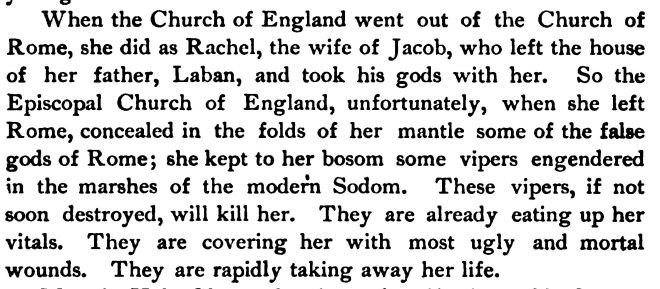
Later in the book, after describing the horrors women experienced in having their most secret sins pried from them by expertly crafted questions, the author reveals one of the vipers mentioned above.

Biblical Covenants – Baptist Perspective

The diagram above is my attempt to show the relationship between the various covenants between God and man discussed below. The covenants with Adam and Noah were with mankind and all the created order. Adam fell and we all are dead in him, our federal head; so too all of creation was cursed because of Adam’s sin.
From the dust of men, YHWH called out a people for Himself, to be custodians of His Word, to shine forth His glories in the wicked world, and to preserve the promised seed as it was carried through the generations from Adam to Christ Jesus. National Israel inhabited what is shown as the Old Covenant. Gentiles are not in the Old Covenant.
If all men are not in Adam’s Covenant, then all men could not die in Adam. But since all men die in Adam, we must see those that God formed into the Hebrew nation were born dead in Adam. The covenant of circumcision and the Mosaic covenant applied to them as God’s temporal people, but in Adam they all died. Some of them were redeemed by faith in the promised Christ and were bought out of the Adamic covenant into the covenant of redemption, to be sealed in Christ in the fullness of time. While they lived in the flesh, they were in the Mosaic Covenant as God’s temporal people. So all national Israel was at all times members of two covenants – one determining their spiritual condition (in Adam or in Christ), the other identifying them as God’s temporal people.
The eternal covenant called out in Hebrews 13 was a prelapsarian agreement within the holy trinity. It was revealed progressively until it was fulfilled by Christ and the issuing of the New Covenant. What the eternal covenant does is provide redemption for sinners (Ephesians 1 and others). 2 Timothy 1 shows us that our redemption was effected before the foundation of the world. I consider this covenant to be the guardian for the elect through redemptive history, until the New Covenant was issued, as was the Old Covenant for national Israel. Hebrews tells us the Old Testament saints waited until Christ came to get their full reward – while saved looking forward to the promised seed, “they did not receive that which was promised (temporal rest), since God had provided something better for us, so that they would not be made perfect without us.”
Both the Hebrew people and Gentiles have Adam as their spiritual father; only by being given new life in the last Adam do we become children of Abraham according to the promise. This gives us standing with Creator God as His children through the adoption of sons.
The covenant with Noah is outside the redemptive chain, as it is an unconditional promise of God to provide for man and beast seedtime and harvest, cold and heat, summer and winter, day and night until the end of the age. It is included to remind us of God’s kind provision even to those whose best life is now. It mitigates the wrath of God for those in Adam while this age winds down. The shaded oval is labeled “Old Covenant” and represents God’s relationship to national Israel. It includes the three major covenants contained therein, although the Abrahamic Covenant has only one side in this arena. This line of covenants began as YHWH called people from Adam’s line to form His temporal people, and began to close with the Davidic Covenant, coming to a final close when the son of David who was his Lord fulfilled all the requirements of Moses and the prophets and cut the New Covenant (Galatians 3:24). The Covenant of Promise was revealed to man as God cursed the serpent, recorded in Genesis 3:15 and fulfilled in the New Covenant, being revealed with increasing clarity as redemptive history unfolded.
The Adamic Covenant runs parallel to the Old Covenant, and does not expire until the end of the age. All people in history are ruled by this covenant, with God’s universal law at work in the nations; the works of which are written on the hearts of these people (Romans 2:12-16). Those who are in the First Adam remain in this covenant unless, in time, God redeems them. From God’s covenant with Abraham come children of the flesh (being held captive by the Law of Moses – Galatians 4:21 – 25) and children of promise (being set free by faith in the promised seed – Galatians 3:29 & 4:26 – 31). This ever-increasing family gathers members from all races, creeds, and covenants. Sons of Adam who are redeemed have Abraham as their spiritual father (Galatians 3:29) Jesus is the promised son of David (Acts 2:22 – 39), being born under the law and its curse (Galatians 3:10 – 14), and giving Himself as a ransom to buy the elect (John 6:37 – 40). His work of redemption fulfilled the demands of the Old Covenant and all the types that pointed to His coming. This work made the Old Covenant obsolete and introduced the New Covenant which displays the glories of Christ in the lives of the redeemed (Hebrews 8).
With Noah as our federal head, we have so-called common grace from our Creator, both man and creation. The curse of Adam remains throughout this age, conquered but not eliminated, as we wait for the age to come; so the blessings through Noah remain throughout this age, to be made all the more glorious in the age to come.
The Pastor – Chapter 8, Conclusion
If you have listened to this book, you know the author desires only to please YHWH and help  equip His people so we will not be tossed about by the whimsy of man. Here’s his wrap for the last chapter:
Having published this book, I know I shall be accused of denigrating both the biblical work of the gospel minister, and the man himself. Indeed, I knew it before I began. But I didn’t agree with it then, and I don’t agree with it now. Yet, if such a critique of an unscriptural title really has undermined what many regard as ‘the ministry ’, then something is seriously wrong with what we think of as ‘the ministry ’. And the sooner we find it out the better. In the 16th century, men like Thomas Cartwright and Robert Browne came to realise that the warrant to preach does not depend on a magistrate’s licence, and they had the courage to destroy the noxious bits of paper which pretended to make a man into a minister. We must show the same courage and the same spirit in our day. If an elder’s authority depends on the invention of an office, on Humpty Dumpty’s misuse of biblical words, or on the use of a title, we ought to recognise where we are – and the consequences of it. To accommodate the words of the Independent, Henry Jacob: A teacher in Christ’s church has a far ‘better original’ than calling him ‘Pastor’; or ought to have! Of course, we must honour all men to whom honour is due (Rom. 13:7). In particular, as I have repeatedly stressed, we should ‘respect’ our elders ‘who work hard among [us], who are over [us] in the Lord and who admonish [us]’, and we should ‘hold them in the highest regard in love
because of their work’ (1 Thess. 5:12-13), but this does not mean we should give them a title.
While we must not undervalue the gifts of Christ to his church, pastor-teachers among them, neither must we make little popes of them! Or big!
The Pastor – Chapter 7, The All-Body Ministry
What is meant by “the priesthood of believers?” Does the Bible show “the pastor” as being the ruler of all that goes on within the local church? Here’s a note from the author on this chapter:
As we have seen, church rule and care has been ruined, twisted into a monstrosity. In tandem – the one feeding off the other – the priesthood of all believers has been allowed to dwindle into practical neglect, so that it has become the poor relation of the Christian religion, rarely discussed, let alone thought about, least of all acted upon. And for those who do have some concept of it, too frequently they think of it as an individual thing, a personal thing – I can go directly to God for my self. A wonderful truth, of course, but one that fails to exhaust the breadth and depth of meaning of this priesthood.
The Pastor – Chapter 6, The Use of Titles
How men love titles! Does your “pastor” like to be called “doctor” or even “pastor”? Are such titles biblical for the gathered people of God? The author gives this peek into today’s message:
Now to grasp another nettle. Titles. The New Testament never uses any title for any man in the church. What is more, it categorically forbids it. Nowadays, however, most Christians do use titles – or one in particular – and do so without turning a hair, even though it contradicts Christ’s plain command. Complaining of the scribes and Pharisees who loved ‘to be greeted in the marketplaces and to have men call them “Rabbi”’, Christ said: But you are not to be called ‘Rabbi’, for you have only one Master and you are all brothers. And do not call any one on earth ‘father’, for you have one Father, and he is in heaven. Nor are you to be called ‘teacher’, for you have one Teacher, the Christ. The greatest among you will be your servant. For whoever exalts himself will be humbled, and whoever humbles himself will be exalted (Matt. 23:1-12). But you, do not be called ‘Rabbi’; for one is your Teacher, the Christ, and you are all brethren. Do not call any one on earth your father… And do not be called teachers… But he who is greatest among you shall be your servant. And whoever exalts himself will be humbled, and he who humbles himself will be exalted (NKJV).
The Pastor – Chapter 5, Four NT Words Misused
Note from the author:
I closed the previous chapter by saying that the widespread corruption of the New Testament system of church care and government has come about, in part at least, because believers have taken four New Testament words and changed – warped – their meaning. The words in question are pastor, minister, clergy and ordain. I realise several other words have been contaminated beyond recognition – ‘bishop’ among them – but I am trying to get to the root of the problem as it exists among Reformed and evangelical churches – dissenters in the main; in other words, nonepiscopalians. ‘Bishop’ does not seem to be a problem in such churches. But ‘pastor’, ‘minister’, ‘clergy ’ and ‘ordain’ are.
Chapter 5 is found here: http://www.sermonaudio.com/sermoninfo.asp?SID=11614140241
Chapter 4 is here: http://defendingcontending.com/2015/12/06/the-pastor-chapter-4-attempted-recovery/
 Christ Alone Wyoming