The Sufficiency of Christ

Brian Hedges’ book, Christ All Sufficient, an Exposition of Colossians, is a welcomed book in 9781633421219any Christian’s library. It is widely recognized that Colossians is perhaps the most Christocentric book in the Bible; every preacher loves to preach from this text. Hedges’ book adds a rich tapestry of theology and doctrine to our understanding of this epistle that will cause the reader to rejoice and be in awe of his Savior.

Ten concise chapters bring out various themes from this letter in a consistent focus on our main goal in life – to glorify our God and King. Our author covers the gospel from three perspectives – the power of the gospel, the ministry of the gospel, and the mission of the gospel; all it very well presented and founded on the epistle being examined.

What thrills my soul the most and what ought to stir any saint to desire a deeper walk with Christ is the study of the nature and work of the Lord Jesus. In his chapter titled The Supremacy of Christ, Hedges reminds us that Jesus is “not only reveals to us God’s character and nature, he also perfectly bears the imago Dei as the Adam. He shows us what it means to be truly human.” (page 52) Since the first Adam, each of us has born the image of God in a twisted, marred manner as we were marked by sin from conception and every thought that followed. Jesus is the perfect image and He will be among us on the new earth. Hedges also reminds us of Jesus’ role in creation and in holding things together, as all things were created by Him and for Him. “The implications of this for believers is astounding … believers should never live in fear …” (page 54)

As Col 1:20 tells us Christ brings peace with the Father, our author rightly tells us “Peace is more than just a cease-fire in the conflict between God and humanity: it is the restoration of cosmic and relational harmony under the supreme lordship of Jesus Christ across all domains of existence.” (pages 57 & 58) There is nothing to fear in this life where all they can do is kill the body. Our refuge, our security is eternal and is more secure than anything all the armies of this age could provide.

In chapter V on the Sufficiency of Christ, we are encouraged to walk in obedience to our Lord with thanksgiving. We are complete in Christ, united with Him who is the fullness of God. Paul wrote that the ordinances against us were nailed to the His cross, a vivid word picture that communicates the imputation of sin onto Jesus. Horatio Spafford put this in lyrics that Hedges quotes and every Christian ought to love:

My sin, O the bliss of this glorious thought!

My sin, not in part, but the whole,

Is nailed to the cross, and I bear it no more,

Praise the Lord, praise the Lord, O my soul!

Addressing Col 2:15, Hedges tells us, “Paul here alludes to the victory parade following a Roman victory, an image also appearing in 2 Corinthians 2:14.” (page 86) and follows up with “The powers of darkness thus have no claim and can pose no threat to those who are in Christ.” (page 87” I think our author was channeling Martin Luther:

And though this world, with devils filled,

Should threaten to undo us,

We will not fear, for God hath willed

His truth to triumph through us.

The Prince of Darkness grim,

We tremble not for him.

His rage we can endure,

For lo, his doom is sure.

One little word shall fell him.

That one word, of course, is the person of Christ – none other. Confidence in Him, the one in whom there is salvation; that is what this book builds up. Colossians is God’s Word about the person and work of God’s Son. Brian Hedges’ book gives the reader an excellent look into some of the deeper, richer meanings of what the Spirit spoke through the apostle.

Two Kingdoms

It saddens me to see so many Christians get wrapped up in politics. We have virtually no sense of history (the early days of what used to 26822be a representative republic were far wilder than the current election cycle) and seem to have lost sight of the two kingdoms in play. Augustine likened them to Two Cities.

The Bible is clear – God created three units of government for this age: the family, the state, and the church. We do not read of any of the apostles nor the Lord trying to overthrow the Roman government, although that is the charge brought against Jesus by the Jewish leaders.

We are not selecting a theologian-in-chief this year. We have not had a solid Christian man in the White House in the past 100 years; all of them have put politics above Truth for the most part. We play into the hands of the world when we try make this country into the mold we imagine for it. But no matter how much we desire a secure temporal future under a God-fearing government, that is not where our security lies.

The best thing for this country would be political leaders who cling to the Constitution, just as the best thing for our local churches are men who cling to the Scripture.

The political machinery in D.C. all works together to consolidate power at the national level (the Whig Party lives in the policies of both current parties). No matter if your favorite President was Woodrow Wilson, Ronald Reagan, GW Bush, or Bill Clinton (all professing Christians) – none of those men were able to put this country on the foundation of Scripture. That is not the job of the President.

If your view is that you must vote for a truly godly person as President, how is your position different from the Jews who clamored for a king like the pagan nations had, discontent with having YHWH as their King?

A President who will work against the status-quo and try to push the national government back to it charter document will do this country good, no matter what you or I think of his theology.

The Shepherd and His Sheepdogs

The Shepherd and His Sheepdogs

One of the things I am passionate about is closing the gap between Evangelists, Pastors, and Teachers within the body of Christ. We have become so segregated in our roles that it is almost as if they never overlap. The Pastor is in charge of the sheep, and the Evangelist is in charge of bringing the lost sheep into the fold. My dear readers, this is wrong! Just as equally wrong is the idea that the Evangelist is incapable of preaching on any other topic other than evangelism, that the burden of biblical counseling should only be left upon the head Pastor, or that Eldership belongs only to the pastors or teachers of the congregation. In accordance with Ephesians 4:11-15, I would encourage all of us to view the roles/gifts these kind of men bring to our local congregations and the universal body of Christ.

I remember an illustration a famous preacher gave one time about how the sheepdog is like the Evangelist that barks at the sheep and the sheep run into the sheepfold. Meanwhile, the sheep are taken care of by the pastor(s) of the flock. I submit to you that I have a better illustration. The Evangelist and the Pastors and Teachers are all sheepdogs. And whether they hold to the office of Elder within a particular church or not, they are going to be called by God to gather the lost sheep, rally the sheep, guide the sheep, discipline the sheep, and keep the sheep bonded in the unity and fellowship of the Holy Spirit. But you know what, they do it all underneath the command of The Shepherd! Don’t miss this point. The Shepherd guides and gives commands to the sheepdogs as to what He wants, in accordance with His will. Let me further explain what I mean.

When I visited a farm in Washington, they were having a Scottish Border Collie demonstration. They showed how these dogs rally the sheep and guide them into the sheepfold underneath the command of the shepherd. The shepherd would whistle and call out commands that would inform the dog to run, lie down, or walk at a specific pace or in a certain direction. It is really a sight to see. I wanted to upload the video I captured, but my phone crashed before I could. So I could only find this video to give some visual illustration of what I am talking about. If you watched the video, you will notice that even though the dog may have some natural instinct on what to do, the sheepdog, nevertheless, must still be underneath the guidance and direction of the shepherd. And this is where Ephesians 4:11-16 comes in.

In the work of the ministry, all those who are gifts to the body as Ephesians says overlap in some way concerning their work among the sheep. I hope to write a book about how the Evangelist needs to be reclaimed and reintegrated back into our local churches, but for now, understand that true Evangelists are not lone wolves. They are sheepdogs, just like the pastors and teachers, among the body that listen to the voice of The Good Shepherd, my Lord Jesus. Although there can be street preachers who may not necessarily be Evangelists in accordance with Ephesians 4 (which isn’t a bad thing), and there may be some who claim to be Evangelists but preach a false gospel and disdain the body of Christ (which is a bad thing), an Evangelist called by God will fulfill their ministry not just by calling the lost to repentance and bringing people into the fold, but by building up the body, perfecting the saints, teaching sound doctrine, and many other things that seem to be only “the pastors job.”

If you think about this, this is one of the reasons why the plurality of Elders is not just biblical, but essential wisdom. I strongly assert that Evangelists are an essential piece on God’s chess board. Even if it was just one man in a small congregation, he should nevertheless do the work of an evangelist (2 Tim 4:5). Also, even though an Evangelist may be typified by church planting, missionary work (local or overseas), and/or proclaiming the gospel among the heathen in the local area, the pastors and teachers among us should be doing some of the very same things! And if you’re thinking consistently about the Great Commission, every Christian is called to do their part in the work of making disciples. But regarding our ministerial duty to the body, as sheepdogs, we are called as a team that heeds the voice of our Shepherd to do the joyous labor of serving the body while we endeavor in the very same mission. And whether it is building up the body by adding to the church, or by edifying and perfecting those already added, Evangelists, Pastors, and Teachers must rally together more than ever underneath the sound of Jesus’ voice to protect, guide, unify, and edify His sheep.

I am pleading with those of you who are leaders to stop putting Evangelists in the evangelistic sand box to play outside the church as if that is their sole domain.  We can do better than this! There are many Evangelists who are fit to lead and exegete the Scriptures and can provide relief to their fellow sheepdogs. Their heart may lie in a passion for lost souls, but that doesn’t mean they don’t have a passion for God’s people either. We may differ in personalities, strengths, and abilities, but so do the many of pastors and teachers in our congregations. Evangelists are no different. We desire to train and build up and lead the sheep just as much as any of the others who are called to the work.

One thing I remember about my time at that farm was all the sheepdogs on the sidelines, chained to the fence, aching to get in the field and work among the sheep. They were zealous, eager, knowledgeable, and would jump up and down while they watched their fellow sheepdogs do the work they were also bred for. But when they were let loose, they all attentively obeyed the voice of the Shepherd. And if either them stepped out of line, or did not obey, they would be disciplined just as much as the sheep. And this applies to all sheepdogs! Some of us have been standing on the sidelines waiting for our local congregations to let us join in on the work for too long. Although anyone called by God will fulfill their calling whether blind leaders recognize it or not, they nevertheless desire to work hand in hand with other sheepdogs. The problem is, we have too many wolves in the pulpits who desire to devour the sheep and not obey the voice of the Shepherd. And unfortunately, there are too many goats that don’t mind serving themselves up on their plate every Sunday.

But that aside, if you are reading this, and you are a leader/elder/pastor among your congregation, I plead with you to join arms with your fellow sheepdog, the Evangelist. I’d love to help you on how you can best approach this. You can contact me here, and we can correspond through email. Or if you are reading this and you feel like you are called as an Evangelist, I would love to help you to study thoroughly what that means and equip you to know how you can support and approach your local church. You can also contact me here. Keep in mind, though, that in some churches, their ecclesiastical government may require that you submit underneath the Eldership. In other congregations, the Evangelist may be appointed as one of the Elders. But whatever government your church may have, one thing remains true – there are sheepdogs that are eager and called to do the work of the ministry within the body of Christ. Some are already obeying the voice of their Heavenly Shepherd. As a church, as leader, as a Christian, will you do the same?

-Until we go home

Rethinking Conditionalism (Part 3) – Eternal Punishment

Rethinking Conditionalism (Part 3) – Eternal Punishment

(Notice: the blog series has moved to Rethinking Conditionalism on Our Common Salvation)

The distance that certain conditionalists will go to deny the obvious linguistic nature of eternal conscious torment is very disturbing. While I have already revealed in Part 2a why the fire is categorically different and in and of itself eternal, AND how it is semantically linked as the instrument and reason why those that are in it will continually endure eternal punishment (since it is indicative of God’s wrath, read Part 2b), the twisting of Scripture continues. The basic premise is that eternal punishment is not an eternal “punishING” but one of eternal “punishMENT.” In essence, what is proposed is that the eternal punishment that Jesus speaks of in Matthew does not refer to the process of being punished for an eternity, but that Jesus’ administration of the punishment (in their case the punishment is death/annihilation brought about by fire) is what is meant by eternal punishment. Therefore, that punishment which He administers lasts forever.

There are several personal observations that I must bring to the forefront before I address the linguistic/scriptural issue of this argument. 1) Language is messy business. It is one thing that I learned from studying linguistics is that many of what we take for granted everyday can often be arbitrary and ambiguous. Many of the points conditionalists make, from a linguistic standpoint, are notable nuances, but too often are exploited for their benefit. In other words, they capitalize on the ambiguities of language. This is to not say that I or anyone else is not guilty of doing such a thing, but they do it so often with clearly understandable texts like Matthew 25 that I have no choice but to assume deception (which is once again, what we are accused of). 2). A dictionary is not meant to regulate language. I know it is a habit for some to use dictionary definitions of words because it is an easy reference, but this wonderful tool simply records how the language can be used in any given context, not regulate how is should be used. In other words, it describes not prescribes. It tells you how words have been used and are conventionally used (that means by agreement) depending on the kind of dictionary you have. But they do not always capture every nuance. However, internet is changing that. So whenever we go to our dictionaries, remember that it is good to have an general understanding of what a word entails, but syntax, grammatical structuring, discourse structuring, and even idioms can break the “rules.” Therefore we are to be cautious how we bring dictionaries to make our points. Look up lexicography if you care to know more. It really is a fascinating field of linguistics. Now, unto my arguments.

Here is the first problem I see. In my last post, I mentioned how conditionalists believe that the result of the punishment is eternal. I wrote it this way because whether it is Chris Date in his podcasts/debates, or recently William Tinksley (a contributing author to Rethinking Hell), I am told something along the lines that this is not what they believe. Their correction to my statement is that they too believe in “eternal punishment,” and I am apparently wrong for saying that they believe in the results of the punishment. But then they go on to say (perhaps not all of them) that the punishment is the result of Jesus’ punishing action, or it is the duration of the punishment inflicted once which is eternal (the example given is capital punishment). So what we have here is an example of saying the same thing, just differently. By asserting that eternal punishment refers to “the result of Jesus’ punishing action” is to say, in essence, that you believe that eternal punishment in Matt 25 is implying the result, not the process. So to be corrected by saying that conditionalists do not believe that the results of the punishment is eternal is being semantically illusive. They are very good at making distinctions without making any difference, as well as proving their point without proving their position (which I’m sure I will be accused of doing).

Here’s the second problem. In order to prove their point, conditionalist compare the words redemption (using Hebrews 9:12 as an example) and punishment. Since redemption can refer to a one time act, or can refer to the results (there’s that word again) of an act, they say that this is a comparable example to the punishment administered by Christ in Matt 25. From a linguistic perspective, this is a notable nuance in any given context. Even though conditionalists are correct that punishment and redemption both can refer to a single act or a result of an act, they overlooked the very same Scripture tells us what exactly that punishment is (eternal fire), and they assume we will be burned up. But they also don’t realize that the suffixes of both punishment and redemption can imply a state or condition. Before I go to Matt 25, here is a quick breakdown of suffix usage.

The suffix -ment can refer to a state or condition. It is a way to “noun” a verb (notice I just verbed the word noun because how I placed it in the sentence. This kind of syntax is key when having these sorts of discussions. Not just how words are defined, but how they are used in any given utterance or text). For the word redemption, the suffix -tion does the same.  In both words, the suffix can imply a state or condition. In Jesus’ case, He went into the Holy place to obtain eternal redemption for us. In this case, eternal punishment refers to the state or condition of being punished. In other words, while Jesus’s obtaining the state of condition of eternal redemption for us is accomplished by the one time act of enduring the wrath of God and death, we experience the state or condition of punishment by being in eternal torment by the one time act of being thrown there (we I will explain below). But also in this case, if you are given a punishment, depending on the punishment, it can be temporary or eternal based off of how or by what means it is being administered. The effects can last even after the infliction has has passed (just like the death penalty), or you can remain in a state of condition of being punished (like a lifetime in prison). The downfall in our case is that any punishment that is meant to endure can only endure in our lifetime. And, if it does endure throughout our lifetime, it can be a punishment that is consistently being administered or undergone by an instrument or agent, or it can simply leave a lasting result (sort of like a physical scar, although emotional “scaring” is not outside the realm of semantics).  In Matthew 25, eternal punishment into eternal fire is a state or condition that the wicked find themselves in forever, eternal punishment being another way of appositionally (see Part 2b again to remember what I’m talking about here) describing that state.

Now, lest you think this can also sway in the conditionalist favor, one must understand that verbal nouns like punishment keep some semantic value of the verbal form, although they do not function as a verb. I can get pretty technical at this point, but I will save that for other posts or conversations that I may have with conditionalists. For now, punishment always has the sufferer in mind. That is, whatever the means, whatever the outcome, punishment always has the person receiving it as its focus. Seeing that the fire mentioned earlier in Matthew is eternal, and is the instrument that will forever administer the punishment, and since that fire is indicative of God’s wrath and judgment, if the fire is eternal, then the one who is experiencing that fire is in that state or condition for an eternity.

It is clear that any punishment administered in this life that is administered by man or by God, even physical death, is not eternal. The first death we experience is not forever. We will one day be resurrected. Jesus came to save us from the power of the first death (Rev 20:6; 1 cor 15:54), which by natural consequence saves us from second death. But the first death is not like the second in nature. And Scripture clearly demonstrates, at the very least in Matthew 25, as making the day of judgement and final judgment different by saying that out of all the punishments, this one will last forever. If death is the punishment as conditionalists make it out to be, then why would God have to resurrect them to only do the same thing again? This question cannot be redirected at us who believe in eternal conscious torment because while we may die, we have yet to face the wrath of God that Jesus took upon Himself on the cross before He died. And we can’t, because we would die in our current state. And if conditionalists continue to assert that the eternal fire in Jude 7 is equivalent to the eternal fire in Matthew 25 (in the sense of how they use it) then if Sodom and Gomorrah suffered punishment by eternal fire, why resurrect them and do it all over again? Eternal conscious torment is consistent in that the only thing that the wicked have not yet faced is God’s full wrath in the body. This is something Jesus did. And He doesn’t need to suffer eternally like we do to do it. Which is the reason why we need a resurrected body designed for such an occasion.  Because if we use the Old Testament as an example, which  Sodom and Gomorrah is just a taste of, then there is a reason why that body would have to be a body fit for eternal punishment. Because the current one we have will whittle away.

But guess what, in one sense, the conditionalists are right! When you read verses 41 and 46 of Matthew 25 which reveal that the wicked “go away into” eternal punishment while the righteous to eternal life, it is a one time act of sending them to their respective locations. And when they arrive, they will experience the bliss or the pain of what God has in store for them there, and they will experience that state or condition for an eternity. So to say that the punishment can be a one time act, or the result of the act really makes no difference seeing that the punished will experience their state of punishment eternally, just as the natural understanding of the text is to be interpreted. So even if this is what it means to be punished, this one time act of being thrown into the fire indeed has an eternity behind it, and those that are there will be in a state of eternal punishment. In other words, how conditionalists argue their points still doesn’t prove their position, nor does it prove that those that are thrown into the fire will be eventually annihilated.

But what of the words “eternal destruction” in 2 Thessalonians 1:9 and the parts in Scripture where Jesus uses parables to describe what happens to the wicked when they are judged? Like in Luke 13:40 where the Greek word katakiaw is used to illustrate the wicked being “burned up”? What about those? Those will be dealt with later on in upcoming articles. For now, remember to take all these article as a collective whole. What I mean is, each article is designed to build off of one another. It may be difficult to process all this, but I know many of you reading the New Testament understand the implications of eternal fire and punishment and that it lasts forever. It is something our Church Fathers understood (something I will prove as well), and it is something that has been easily understood by many generations, except for those that have an agenda (whether they realize it or not) to prove otherwise.

-Until we go home

Rethinking Conditionalism (Part 2b) – Eternal Fire

Rethinking Conditionalism (Part 2b) – Eternal Fire

(Notice: the blog series has moved to Rethinking Conditionalism on Our Common Salvation)

Since I have written part 2a, there has been an attempt to dilute the argument concerning the article-noun-article-adjective construction (called the second attributive) in Matthew 25. But the attempt is, once again, a linguistic game that seems to be the trend amongst conditionalists. In essence, what is being stated is that there is no special emphasis placed upon this kind of construction in Greek, and that the other kinds of constructions, that are like this one, are used just as much, if not more, in the New Testament, and they too have the same attributive meaning. In other words, there are other grammatical constructions that are used in the New Testament with adjectives that can express the same kind of attribution, but doesn’t give the special emphasis that I claim it makes.

For instance, if you remember from my previous article, “the fire, the eternal one” would be the somewhat literal but awkward translation of this fire. Now, whether the Greek uses another type of adjectival construction (first or third attributive as they are called) to describe eternal fire or not, is something that can be debated. But it doesn’t do away with the fact that the Greek language makes the fire categorically different from all other fires. This is something I mentioned in 2a of this series. Since the Scripture references this fire as a separate location also makes a significant difference. But, what is being rebutted is the fact that the construction I pointed out is no more significant than any other construction. And then, an appeal to multiple resources that point out that there isn’t any difference is how the diffusion is attempted (don’t be fooled). To this I will say a few things before we move forward.

1. There are at least three resources that show the construction I pointed out in 2a are significant. Dan Wallace’s Greek Grammar Beyond the Basics, A.T. Robertson’s, GRAMMAR OF THE GREEK NEW TESTAMENT (which Wallace draws from), and Deeper Greek. These resources come from scholars who have practically spent their whole lives studying the Greek Language. However, the other respected scholars affirm that there are no differences in meaning. But it is no surprise to me that linguists would emphasis or not emphasis certain nuances within a language. Language is often complex, fluid, and nuanced. So even if there is a disagreement (which we can’t be sure if the authors are even aware that there is even a contention) concerning the kind of emphasis the word “eternal” places on the fire in Matt 25, there is one thing that is for sure – the adjective describes the fire in and of itself as eternal. An inescapable truth that is still being twisted.

2. Making a case that there are no differences in meaning between the types of constructions ignores the most fundamental thing that adjectives do to nouns. In language, adjectives describe, limit, modify or expound upon the noun and can attribute special characteristics depending on the context. It is clear, even in the English, that the noun (fire) is modified by the adjective (eternal), making the fire in and of itself eternal. This is especially significant since, as I said in 2a, that the fire is indicative of God’s wrath. So if you have a fiery wrath that burns forever, but no one is there to burn against it since they are consumed, you have a huge (perhaps heretical) problem. And yes, the fire exists because the wicked exist. One attempt was made to say that because no one is in the fire even while it is burning means that the fire does not need people to burn against. Once again, this is an attempt to deflect the obvious.

3. There is one other thing about these Greek constructions with adjectives that most people who do not study linguistics may not  know about that other languages demonstrate. It is called apposition. What apposition is is a phrase, word, or description that further expounds upon  another word, phrase, or description. A simple way of explaining this would be like saying, “Ricky, the tall dude over there, likes to eat…” The emphasized portion is the apposition. In our case of eternal fire, the way the Greek is constructed, even if one disagrees with the significance of grammar, the fact that the fire is appositionally described as “eternal” further makes the case that this fire is indeed categorically different than other fires. Therefore, if even some linguists of Greek see no difference in meaning between constructions, at base level, they are appositional. In laymans terms, eternal fire means that it will burn forever.

The next thing to point out is the attempt to say that the fire is eternal in the sense that it is from God. Since God is a consuming fire, then the eternal fire is just another way to point out that it is God doing the punishment of annihilation or consumption of the wicked. There may be nuances as to how this is argued, but the general attempt is to sweep away the obvious. The fire in which Satan, his angels, and the wicked are thrown into is going to be a fire that burns forever. And in Matt 25:46, the fire is semantically linked to eternal punishment (as well as unquenchable fire). This punishment is going to be eternal because, quite simply, the fire is eternal. If an attempt is made to say that the fire is only simply God, of God, or from God (something I wouldn’t holistically disagree with), that is ignoring the fact that the language portrays that this fire is still categorically different. It is created and located somewhere for a specific purpose. And, if it is God who is partaking of this burning, yet the wicked are eventually consumed, then who is He burning against if they are supposed to be eventually annihilated?

There is more to this, and this series will go on for quite some time I assume. But the main gist to grasp from this is that the language is clear in that it makes a distinction  that eternal fire is just that, eternal. I only made this article less technical in the attempts to reach mass amounts of readers. There are more linguistic evidences and arguments that could be made. The only word of advice to the reader I have at this time is this. If you think that the wicked are not going to face eternal conscious torment, whether you realize it or not, it will affect your view of the atonement. This is something I plan to address in detail in the future, but for now, please know that some in the conditionalist camps have defended abhorrent theology like Evangelical Universalism, and there are others that seemingly reject the penal substitutionary atonement of Jesus Christ. As you read further articles, I pray more connections would be made plain.

-Until we go home

The Confession Alone: The 6th Sola

The Confession Alone: The 6th Sola

Confessions and formalized creeds have been an edifying edition to the Christian faith. Since the beginning of the New Covenant (and even further back since the dawn of teaching), mankind has formalized and rehearsed many sayings, creeds, idioms, and other phrases that have refreshed our minds about a how we ought to think or understand life. Within Christendom, there are certain flavors of creeds and confessions that we Reformed folks hold to very dearly. Assuming that you understand which confessions exist, I seek to make my point quickly. If you have never read a creed, confession, or catechism, I highly suggest you do some research and learn from them.

Having said all that, there is an authoritative flaw in our Reformed circles. I call it he Sixth Sola: Confession Alone. It is this idea that if it is not a part of your confession, it cannot (or in some cases should not) be taught or even considered as biblical. Or, practically speaking, although we do not verbally admit this, when we are discussing Scripture with someone, and the first thing that comes out of their mouth is “X confession says…” when making their case, it is making the confession the ultimate authority in the conversation (unless they are just using the confession as a springboard to talk about Scripture). I am aware that this last statement may have ruffled more feathers than the first, but understand what I am actually saying and do not misinterpret my words. If your first or final authoritative response in any discussion about theology or what the Bible teaches concerning what you believe and why is “the confession says” you have turned a guidepost into a destination.

Most, if not all, creeds, confession, and catechisms are reactive. That is, they are written and formed based off of some other creed or confession that is in opposition, and those forming it wish to distinguish themselves for the opposing party. It can be in response to false teaching (or perceived false teaching), or it can be simply trying to make a stand about a certain belief within a specific community that affirms X belief(s). As I already said, this is not inherently wrong. These are great ways to find out where your stand in your faith. i would argue that it is impossible to say anything without it being “creedle” in some way. But if you do not study the Scriptures and seek to understand why you believe what you believe, and whether or not you think you can agree with these confessions, you are placing the cart before horse. The confessions can point you in a specific direction (guidepost), but they are not the final authority (destination). Our first response in any discussion should be Sola Scriptura, not Sola Confessio (Latin check). Yet, time after time, when I dive into the Scriptures with particular pastors, preachers, and believers who ascribe heavily to confessions and creeds, whenever there are any disagreements or whenever I make my points from Scripture, I am faced with “but the Confession says…” How can this be within a Reformed world whose foundational mindset is supposed to be Scripture Alone?

There can be many reasons why one authoritatively appeals to the a confession more than Scripture. But I think I have narrowed them down to two main roots: Traditionalism and laziness. There is nothing wrong with tradition. Every denomination and person has them. It is when that tradition begins to have authority over Scripture that we have a huge problem. Some people find great joy in holding to the long standing tradition that some of our creeds and confessions teach. Nothing wrong with that if you understand what you believe and why. But it seems that this is not the case with many. By proxy, if you are a traditionalist in this area, you will quote the confession better than you can quote Scripture because you are relying on the confession to approve yourself before God (or men). Unless for whatever reason you don’t have any access to Scripture, or in some way you are only able to memorize Scripture by categorizing them via the confession, there should be no reason why you cannot study for yourself what the Bible teaches within the pages that the confessions are pointing to. Which brings me to my next point.

I find that it is easier to quote a saying, phrase, creed, etc., in place of actually making a verbal argument concerning what you actually believe and why. Nothing wrong with summarizing what you believe, or repeating a summarization of something you would affirm. But If I believe that the reason why man exists is to glorify God and enjoy Him forever, why? Because the confession says so? Or because the Scripture quoted in the confessions says so? Have I looked at the listed Scriptures? Have I taken the time to study and reform my thinking in light of the Scriptures that a confession teaches? Will I be courageous to practice Semper Reformanda if I discover some nuance in the Scriptures? Or will I be taking the confession at face value because my community of believers/churches do? Or because the men before me were theological giants who were totally incapable of error even in the minutia? Laziness is what causes us to use the confessions as they were not meant to be used. These are guideposts, not destinations.

Notice, I am not challenging the confessions. Nor am I exhorting anyone to cast away the didactic luxury that they bring to our lives. I am challenging how we think concerning them. We all have a tendency to elevate anything good over God. That is evident in Scripture and in our daily lives. If we find ourselves running to the confessions and creeds as our primary authoritative source for understanding and assurance of our faith in Christ, and we can quote and explain a confession easier than we can explain Scripture and the gospel, we must immediately eject ourselves from the seat of traditionalism and laziness, and we must diligently seek God through the Scriptures for our assurance and understanding. This doesn’t mean we cannot use the confessions to help us in this direction. But once again, where does your affection, affirmation, and assurance of your faith lie? In Scripture Alone, or in the Confession Alone? Is it because the confession says so that you believe X, Y, Z, or is it because you have studied and affirmed that the Scriptures teach it?

One last time, I am not bashing any confession, or the use of them in discussion. But I am standing against any form of authoritative proclamation or behavior that insists that the confession is the first and final say so in any biblical discussion and practice. If your “go-to” argument and assurance of your belief is “the confession says,” you’ve lost all credibility. And if the confession is your main source for approving yourself before God, your credibility may not be the only thing that is lost.

-Until we go home

What Must I Do To Be Saved?

Soteriology is the doctrine of salvation – how does one get reconciled to God? It is my desire to show you how essential it is to grasp this doctrine rightly and how humbling and wonderful it is to comprehend what the Lord God has done in redeeming people. salvation

While there are many religions in this world, with myriad differences, they all have a few things in common and many differences. But no matter the religion, no matter the salvation, no matter the god, all systems of religion, including biblical Christianity, are based on salvation by works. All systems of religion are based on salvation by works. The differences lie beneath that truth. All but one system bases salvation on the works of those who need to be saved. The sole exception is based on men being saved by the finished work of another, a particular man who had no sin of His own to pay for. A man who is God and paid the price for others. The Lawgiver became the Law keeper for Law breakers. This exception, as I’m sure you already know, is our faith – biblical Christianity, based on the work of the God-man, Jesus.

Among professing Christian groups, many variants and shades exist, with most falling into self-saving works of the creature. These views are known as Pelagianism, Semi-Pelagianism, Arminianism, Universalism, etc. All of these are variations of synergistic modes of salvation – systems in which creator God is at best a co-pilot in redeeming people. The Scriptures, which are our only rule for truth and faith and godliness, depict God as the One Who created and sustains all things, directing the paths of kings and storm clouds, saints and Satan. Properly understood, the Word of God reveals a monergistic mode of salvation – children of God are born not of blood nor of the will of the flesh nor of the will of man, but of God alone (John 1:13). Since Scripture cannot be broken, monergistic salvation and synergistic salvation cannot both be true. The passages that appear to contradict each other do not. Our understanding and comprehension are limited and twisted by sin – the Word of God is perfect and by it the Lord searches out our intentions and thoughts. To rightly understand this doctrine of how sinners are made right with holy God, we must humbly submit to the Word of God and cry out for wisdom from the Spirit of God.

This dispute over how a sinner is reconciled to Holy God has been raging among men since Cain’s offering was refused. In the early 17th century a protest was filed with the ruling church court in the Netherlands by activist disciples of Jacob Arminius. Here are the five articles contained in the protest presented to the Council of Dort:

  1. God elects or reproves on the basis of foreseen faith or unbelief.
  2. Christ died for all men and for every man, although only believers are saved.
  3. Man is so depraved that divine grace is necessary unto faith or any good deed.
  4. This grace may be resisted.
  5. Whether all who are truly regenerate will certainly persevere in the faith is a point which needs further investigation.

Only the third point reflects biblical truth and was later denied by many of this view. The bedrock of the Arminian objection to monergistic salvation is the notion that divine sovereignty is not compatible with human freedom and that ability limits obligation. This is complementary to the Pelagian view that God would never command man to do that which man was incapable of doing. However, the Scriptures are replete with commands from God to the creature to do that which nobody but God can do, such as be ye perfect, and love God with all your heart, soul, mind and strength. These commands are meant to drive self-righteousness from us and draw us to Christ. The Arminians claim God gives every human the ability to believe on Jesus, and that God will never refuse anyone who exercises that ability and comes to Him in the faith that God gives to everyone; but only some exercise it and are saved. If this is the case, who gets the credit for the sinner’s salvation? And what do we do with 2 Thess 3:2 which tells us not all men have this faith?

Most professing Christians hold to Arminianism, having never heard anything else because most churches do not teach the whole counsel of God’s Word. I personally believe that all Christians are born spiritually as Arminians because we are only accustomed to what our natural senses can discern. And when one is born again, the first thing he is aware of is that he chose Christ; without yet knowing that Christ first chose and first loved him. The Arminian system makes sense to the natural mind, confirmed by natural senses. It shows up in our language: when we say someone “accepted Christ” we imply the person needing salvation decided to get saved. But Scripture denies this. This is why it is of utmost importance that evangelism be firmly connected to and rooted in discipleship. A new-born child of God must be shown and taught the Bible – what he was before he was raised from the dead and what soil preparation the gardener performed to make the seed take root.

In understanding what it means for anyone to be redeemed, to have been reconciled to Holy God, to be made into a new creature, we must grab hold of the biblical reality of our union with Christ. Ephesians 1:3 tells us we were blessed with every spiritual blessing by God the Father – that these spiritual blessings are in the heavenly places and they are in Christ. We mortal sinners get no heavenly, spiritual blessings apart from being in union with Christ, in communion with Christ.

There are several terms that describe what happens when a person is raised from spiritual death, referred to as the order of salvation:

  1. Predestination: Rom. 8:29 & 30; Eph. 1:3-6 & 11-14
  2. Effectual Calling (Regeneration): John 1:12 & 13; 6:44, 63-65; Eph. 2:1-5
  3. Faith/Repentance:
    (Faith) – Eph. 2:8,9; Acts 13:48, 16:14
    (Repentance) – 2 Cor. 7:9 & 10
  4. Justification (Legal Declaration): Rom. 5:1 & 2; 2 Cor. 5:21; Gal. 2:16
  5. Adoption: Rom. 8:15-17, 23-25; Gal. 4:4-7
  6. Definitive Sanctification: Rom. 6:1 & 2; I Cor. 1:2; 6:9-11
  7. Progressive Sanctification: Eph. 4:11-16; Phil 2:1-4, 13-15
    (Preservation of the Saints) – John 6:37-40; 10:27-30; Phil. 1:6
  8. Glorification: Matt 25:31-34; 2 Cor. 5:1-8; Phil. 1:21-23; 3:20 & 21

The first of these, predestination, took place before the foundation of the world. Ephesians 1:3-4 Blessed be the God and Father of our Lord Jesus Christ, who has blessed us in Christ with every spiritual blessing in the heavenly places, even as he chose us in him before the foundation of the world, that we should be holy and blameless before him. Predestination is not a reaction to The Fall. God has no “Plan B”. Predestination is “Plan A”. The balance of the steps in this process take place in time, although regeneration, faith, repentance, and justification cannot be separated; we know that they happen in this order but are unable to plot them out, they are so tightly connected. But notice – regeneration comes before faith and repentance. That which is dead cannot develop root nor produce fruit. The soil must be prepared before the seed can sprout. If we do not properly understand this, we are vulnerable of being drawn aside into the Arminian camp, who claim that the spiritually dead sinner exercising faith in Christ causes regeneration. It is this level of attention that is required to discern between good and evil, as we are told in Hebrews 5:14 – But solid food is for the mature, for those who have their powers of discernment trained by constant practice to distinguish good from evil. We have the same fine degree of difference with the Roman Catholic doctrine of “salvation”, wherein the sinner is infused with grace and thereby enabled to be holy and pleasing to God, but never arriving at any assurance of having been saved. The Scriptures teach that sinners are imputed the righteousness of Christ and are thereby justified by grace that is apprehended by the faith that was itself a gift to us – lest anyone boast in anything other than the cross of Christ! Nothing in my hand I bring, only to the cross I cling – this is how we all come to saving faith, no matter what our senses or churches tell us.

Kevin DeYoung, in Chap 7 of his book, The Hole in Our Holiness exhorts us: “… it’s appropriate … to talk about an “order of salvation”, whereby we are called by the Spirit of God, born again, moved to faith and repentance. Justified, adopted, sanctified, preserved, and glorified, we must never separate these benefits from the Benefactor. Every blessing in the order of salvation flows from our union with Christ.” John Murray is quoted as saying, “Union with Christ is really the central truth of the whole doctrine of salvation, not only in its application but also in its once-for-all accomplishment in the finished work of Christ.” We often talk about gifts we get from God – provision in things of this world, for the most part – and need to remind ourselves to not confuse the gift with the Giver. So it is with this greatest gift of all; while we will not truly understand the depth and richness of God’s saving grace towards elect sinners, we must not get so fixed on that spiritual blessing that we lose sight of the One in Whom we have that blessing. If we be not in Christ, we are not His and we vainly imagine that the blessings of redemption and reconciliation are ours. Contrary to what the pope said, sincere belief in whatever god you have chosen is not going to reconcile any sinner to holy God. Responding to a list of questions published in a newspaper, Pope Francis wrote: “You ask me if the God of the Christians forgives those who don’t believe and who don’t seek the faith. I start by saying – and this is the fundamental thing – that God’s mercy has no limits if you go to him with a sincere and contrite heart. The issue for those who do not believe in God is to obey their conscience. Sin, even for those who have no faith, exists when people disobey their conscience.”

Sin is not the failure of a creature to obey his conscience! Sin is not a bad habit, a hurtful hangup, or “something less than God’s best” – as a couple of well-known preachers have called it (referring specifically to homosexuality). An inadequate understanding of sin necessarily results in an inadequate understanding of grace, redemption, reconciliation, and a number of other orthodox doctrines of the Christian faith. Sin is a moral act, word, or thought that contradicts the expressed will of God for human beings. In other words, it is a covenantal breach with the Divine covenant maker. It is not limited to the will, the intellect, or the emotion. Sin involves the whole person.

What is the practical aspect of getting this doctrine – how is one saved? – correct? There are many examples from church history, but this one is my favorite. If you have read any history of the church, you should be aware that the Church of England went through an extended period (after their separation from Rome) wherein they had difficulty finding regenerate pastors. Wesley and Whitefield and Spurgeon all rubbed up against this. In fact, both Wesley and Whitefield came to saving faith in college, after they each had spent themselves in trying to make themselves pleasing to God; following the doctrine of salvation of the Church of England. One pastor in the Church of England discovered this in a rather unique way.

William Haslam was an English country parson who was a hireling of the state, a warm body to fill the pulpit in small country church. One Sunday in 1851 following a period of deep conviction of sin, Haslam ascended into the pulpit with the intention of telling his congregation that he would not preach again to them until he was saved and to ask them to pray for his conversion.

He began to preach on the text ‘What think ye of Christ’ (Matt 22:42), taken from gospel passage handed down from the mother church. As he read about the Jewish leaders who did not see Christ as the Messiah, he saw himself as one of them – a Pharisee who did not recognize that Jesus was the Christ, the Son of God. Haslam said, “I do not remember all I said, but I felt a wonderful light and joy coming into my soul, and I was beginning to see what the Pharisees did not.” At that moment, the Holy Spirit breathed new life into him and the effect was so obvious and marked that a local preacher who was present stood up and shouted ‘the Parson is converted, the parson is converted! Hallelujah!’ and the people rejoiced loudly and with much commotion.

If one fails to see the dire consequences of sin, the hideous nature thereof; if he fails to see Holy God as the judge who weighs the universe in His hands; if he doesn’t see rightly the King of glory Who paid the price for sin that man could never pay – he will die in his sin and be lost forever.

The doctrine of soteriology is not a dry theological construct that has no relation to how we live. It is the very core of the identity we as Christians have – that of being found in Christ. The jailer asked, “What must I do to be saved?” So they (Paul and Silas) said, “Believe on the Lord Jesus and you will be saved.” It is simple in one aspect – believe on the Lord Jesus. But oh how deep and rich is the salvation we have in Christ Jesus! We are found by Him, secured in Him, preserved in Him, saved and sanctified in Him. We walk in Christ, labor in Christ, obey in Christ. We live and die in Christ; and we conquer and overcome death and hell in Christ!

The Apostle Paul fought against false doctrines that taught justification by any other means. It is an essential doctrine upon which our faith rests. All other systems of salvation rest on self-worth and deny the depth of man’s sin and the sufficiency of Christ’s finished work.

Praise the God and Father of our Lord Jesus Christ. According to His great mercy, He has given us a new birth into a living hope through the resurrection of Jesus Christ from the dead and into an inheritance that is imperishable, uncorrupted, and unfading, kept in heaven for you. You are being protected by God’s power through faith for a salvation that is ready to be revealed in the last time.  (1 Pete 1:3-5)

If Pelagius was right, Christ died for no purpose. If Scripture is right, and we were dead in our sins and trespasses, our life and worth depends on the death of Christ – in our place, to placate the wrath of God the Father.

Soteriology? It’s a matter of life and death.

Rethinking Conditionalism (Part 2a) – Eternal Fire

Rethinking Conditionalism (Part 2a) – Eternal Fire

(Notice: the blog series has moved to Rethinking Conditionalism on Our Common Salvation)

It can be difficult for some people to digest large chucks of complex information. It is even harder for people to pick up on subtle nuances that certain teachers use in order to make their case. What’s even more difficult is the fact that not many Christians read the New Testament with a systematic and linguistic lens that is trained to detect and digest all these subtle nuances that certain teachers use to deceive them. But I have good news! You do not need to know all of how Greek works to understand what I am about to show you. As hopefully some of my readers already know, I like getting to the point. So in this particular article, I will challenge the idea from certain conditionalists that believe hell’s fires are only temporary. Or, to be accurate, the fire is only eternal in the fact that the effect of the punishment they provide the wicked endures forever. If you haven’t picked up on that subtle nuance already, some who believe in conditional immortality believe that the fires of hell are meant to eventually “consume” the person. They contend that this is what Jesus meant by “unquenchable.” That is, the fire cannot be “put out” rather than “die out,” and that it will not stop until the adversaries are totally consumed (or in their case annihilated).

Before I show from Scripture why this isn’t the case, here is the only difficulty I have, or anyone has, who wishes to make a case in writing. This isn’t conversation. In conversation you can investigate and probe in ways that writing cannot. In live debate and cross-examination, you can publically show why a person’s position in a particular area is in error. In blog posts, all people do is write in response to opposing blog posts, and will carefully pick and choose what they will or will not respond to, or write something in such a way that seems like a legitimate response, but it is not. Of course, anyone can use my previous sentence against me, and I should expect that. But the reason I went through all the trouble to write this paragraph is so that the reader is aware that what I am about to deal with in this article is so specific and easy to understand, it would take a linguistic twisting so incredible, that it would have to deny how certain grammars of Greek work. And while some opponents of eternal conscious torment believe this is “insignificant” in comparison to the stacks of evidence that seems to support conditional immortality (CI) or annihilationism, this is just one of the many semantic proofs that will be the proverbial snow ball that rolls down the mountain.

One of the text used by CI folks is Matthew 25:46 when Jesus says:

“And these will go away into eternal punishment, but the righteous into eternal life.”

I will deal with how the words “eternal punishment” does not mean that the results of the punishment lasts forever as CI presents it. But for now, let’s look at this Scripture in context. The first thing we have to see is that this whole chapter deals with Jesus and His judgment on the wicked at His return. Starting in verse 31 of chapter 25, He begins a discourse about those who will inherit the kingdom prepared for them from the foundation of the world, and those that are wicked will be cast into eternal fire prepared for the devil and his angels. Other than the fact that some CI and annihilationists think that Satan and his angels will also be “consumed” by this fire, some others insist that this “eternal fire” is eternal in the sense that it is from God (because He is eternal), or that its punishment upon the wicked has eternal consequence, but not the fire itself. Don’t run, here comes the easy-to-understand-Greek-grammar that I mentioned earlier.

In Greek, you will sometimes have an article-noun-article-adjective construction. Don’t run. If I lost you, you will get it in a second. It would like literally writing, in Matt 25:41,  “the fire, the eternal one.” Adjectives describe or limit nouns. If I say I have a house. That’s the noun. If I have a yellow house. That adjective describes the noun. If I further mention that my house is eternal, then I have added another element to the noun, but it still describes or limits the noun in some way. If I say, “Hey, look at that house.” And you ask “which one?” It is probably because there is more than one house around and you seek to know which one I am looking at. If I reply, “The yellow one” I am implying that not only is the yellow house significantly different than all the other houses around it, but I am also saying that this one is a certain kind of house in context of all the other houses. In this Scripture, starting in verse 41, Jesus turns to the wicked and says:

“Then he will say to those on his left, ‘Depart from me, you cursed, into the eternal fire prepared for the devil and his angels.”

This is what it looks like in Greek. I will highlight the words you need to pay attention to in order to understand my illustration above.

ότε ἐρεῖ καὶ τοῖς ἐξ εὐωνύμων πορεύεσθε ἀπ’ ἐμοῦ οἱ κατηραμένοι εἰς τὸ πῦρ τὸ αἰώνιον τὸ ἡτοιμασμένον τῷ διαβόλῳ καὶ τοῖς ἀγγέλοις αὐτοῦ

Notice that εἰς  means “into” and τὸ (article) πῦρ (noun), which means “the fire.” But not just any fire, but τὸ (article) αἰώνιον (adjective) – “the eternal one.” In essence, what this Scripture is making clear is that unlike all the fires that die out and/or are eventually put out, this fire that the wicked will be cast into, with the Devil and his angels, is itself eternal. This is not dealing with the consequences or results. The fire itself is of an eternal nature meant to burn for eternity. Despite what some opponents may say about this, this carries huge implications. Because what Jesus is saying that we will be cast into the fire, the eternal one, when we are judged. And here is the kicker. The eternal punishment mentioned in verse 46 sits within the context of this eternal fire that awaits us. This means that the fire that burns forever dictates how eternal punishment in this context is to be understood. No linguistic tricks attached. Even though the word “punishment” by itself can ambiguously represent the result of it dished out, in this particular text, it clearly illustrates that the punishment will be itself eternal. And that the fire, which burns eternally, will be the instrument used to carry out the sentence.

But wait there’s more!

In Matthew 18:8, Jesus uses this same Greek construction (article-noun-article-adjective) to illustrate our reaction toward sin. He says:

“And if your hand or your foot causes you to sin, cut it off and throw it away. It is better for you to enter life crippled or lame than with two hands or two feet to be thrown into the eternal fire.”

This is what it looks like in the Greek.

εἰ δὲ χείρ σου πούς σου σκανδαλίζει σε ἔκκοψον αὐτὸν καὶ βάλε ἀπὸ σοῦ καλόν σοί ἐστιν εἰσελθεῖν εἰς τὴν ζωὴν κυλλὸν χωλόν δύο χεῖρας δύο πόδας ἔχοντα βληθῆναι εἰς τὸ πῦρ τὸ αἰώνιον

Look familiar? It should. It is as Matthew 25 says, “the fire, the eternal one.” And Jesus not only says that the fire is itself eternal, but he parallels this with the next verse by saying:

“And if your eye causes you to sin, tear it out and throw it away. It is better for you to enter life with one eye than with two eyes to be thrown into the hell of fire.”

Another way to put this verse is fiery hell. The word hell used here is “Gehenna” which is the book of Revelation equivalent to the lake of fire. And Jesus spoke about Gehenna differently throughout the gospels then He did about Hades, which just generally meant the place of the dead. But CI and annihilationists want you to believe that this fire is not going to burn those in it forever, but that they will eventually be consumed. However, in this Scripture, Jesus semantically links the two – Gehenna and “the fire, the eternal one” – equally to make His point about what will happen to those who don’t take sin seriously and are not born again.

Hang in there, although I can go on, there is only one more thing I want to show you.

Just like in Matthew 18 where Jesus parabolically encourages you to slice your hand off in comparison to being thrown in hell, Mark 9:43 provides a parallel passage that describes the same teaching. But notice how the eternal fire is mentioned here.

“And if your hand causes you to sin, cut it off. It is better for you to enter life crippled than with two hands to go to hell, to the unquenchable fire.”

Here is how it looks in the Greek:

kαὶ ἐὰν σκανδαλίζῃ σε χείρ σου ἀπόκοψον αὐτήν καλόν ἐστίν σε κυλλὸν εἰσελθεῖν εἰς τὴν ζωὴν τὰς δύο χεῖρας ἔχοντα ἀπελθεῖν εἰς τὴν γέενναν εἰς τὸ πῦρ τὸ ἄσβεστον

Do you notice something familiar about this verse? I bolded it for you so you can recognize it. Do you recognize the grammar/construction? You should. It is the art-noun-art-adj construction we’ve been talking about. Except we have a new word introduced. It is ἄσβεστον (asbeston) which means to be “unquenchable” in English. And it is only used three times in the New Testament (Matt. 3:12; Mark 9:43; Luke 3:17). It literally means that it cannot be extinguished, put out, or die out. In essence, what this verse is saying is people will go “into Gehenna, into the fire, the unquenchable (inextinguishable) one.” It’s a bit awkward sounding in English, but Gehenna, fire, and eternal burning are all interconnected ideas.

The proponents of CI like to say that unquenchable means that the fire can’t be “put out,” not that it won’t “die out.” This is a subtle nuance, and I find it manipulative and trite. But it is a nuance nevertheless. The difference is illustrated by knowing when I light a fire, it will either die out on its own, or I can snuff it out, extinguish it, or quench it with my fingers, water, blowing it out, etc. This isn’t an entirely bad case to make, because God’s eternal wrath cannot be quenched against those who are His enemies (except by atonement). The difference is that conditionalists believe that this only means that the fire will not be quenched until it has entirely consumed the wicked. In other words, it can’t be put out until it has finished consuming. But as we already learned from these other passages above, the fire itself is indeed eternal. So whether it cannot be extinguished or put out or die out, really makes no difference seeing that the fire will burn perpetually. Even if it meant that it can’t be “put out,” the point is the fire will not stop burning, ever! But perhaps the Scripture means what it has always meant for the majority who read it, and the Greek scholars who interpret it. That is, the fire burns forever because those in that place of punishment, as Matthew 25 implies, are there forever. Unquenchable means it can’t be put out, extinguished, or die out because God is the only one who can do it! And even if it is taken from Isaiah 66, and various other passages in the Old Testament that have similar semantic value, it does not negate Jesus’ exegesis that the fire will remain and so will those who are in it.

Although more could be said, for the sake of brevity, I will close with this. In a future article, I will deal with “unquenchable” fire and arguments that proponents of CI and annihilationists make to justify their reasoning as to why the fire is a “consuming” fire and not an eternal one. But for now, ponder the grammatical construction and think about how the fire could burn for eternity, and yet there will be nothing left to burn? A predictable rebuttal will be that God Himself is a (or The) consuming fire. I agree. But that is not what the Greek is implying. This fire resides within the “place” where the Devil, his angels, and all those who are wicked will go. It is its own fire. It is categorically different than other fires that burn. That is what the grammar reveals. Of course, it is a fire that comes from God, is kindled by God, and can only be put out by God. And, It is God administering the punishment, and it is God who is present within the fire. But if the persons are eventually consumed, why would the wrathful anger of God burn forever against an enemy that no longer remains? Therefore, the fire cannot be simply from God, because the implications are not as simple to deal with, and the grammar doesn’t point in that direction.

-Until we go home

*For more information on Greek grammar, I recommend getting a copy of Dan Wallace’s book “Greek Grammar: Beyond the Basics” which verifies this grammar and many other constructions.

Rethinking Conditionalism (Part 1) – Intro

Rethinking Conditionalism (Part 1) – Intro

(Notice: the blog series has moved to Rethinking Conditionalism on Our Common Salvation)

The subject of hell for many is very uncomfortable. Even trying to deal with this subject as a topic of apologetics seems very shallow. After all, if there is any kind of punishment after death, since it is from God, it will be terrible regardless of how we try to magnify or mitigate the sentence. Whether we are annihilated immediately after we are resurrected, suffer conscious torment in the intermediate state only to be resurrected and continue in that state of suffering, or we suffer for a time and then are annihilated, why should it matter? Does it matter? Well, yes and no. Yes, in the sense that if we are going to look at what happens to people who are not saved and their punishment, we inevitably will view the atonement and God through a particular lens. No, in the sense that if a person believes only that hell is not eternal conscious torment, and this is their only variation, they aren’t fundamentally saying something that could be considered damnably heretical. However, they certainly do raise eyebrows of concern, especially in the area of the atoning sacrifice of Christ. Because one thing you must always be aware of is that every major doctrine is interconnected. Hell and Heaven are major because they inevitably affect one’s view of what the atonement accomplishes. Alter the state of either destination, you must inevitably shift your view, however subtle, concerning the cross of Christ. Some shifts are damnably heretical (or at least can lead there). Meanwhile other shifts are inconsistent and concerning, but may not be.

For the ministry of Rethinkinghell.com, there are a number of contributors that propose the idea that immortality is not for the wicked, but only reserved for the saved. That is, immortality is conditional upon salvation in Jesus Christ (the doctrine of conditional immortality – CI). As for the wicked, they do not receive immortality as the righteous do. They are doomed for punishment that is eternal, but it is not the process of being punished that is eternal, but the results of the punishment that is eternal. The Scriptures that mention eternal punishment, eternal fire, eternal destruction, according to this position, are semantically pointing to the eternal result of annihilation (or “death” as they put it) that comes from God, not the fact that the punishment or the fire itself will last forever.

In the future posts, I will deal will various arguments that some of the contributors of Rethinking Hell make. I will seek to also clarify and strengthen why I believe the experience of the wicked in hell will be eternal conscious torment. I don’t want to be petty and trite when I discuss this seeing that I view this doctrine as major. However, what needs to be stated is that while I strongly disagree with those that believe this doctrine, I cannot confidently affirm at this time that such a doctrine is damnably heretical. At first I did. I have throttled back some. Seeking to err on the side of caution. I still have a wide suspicion, though, about this doctrine not only because of some of the contributors’ position on penal substitution, but also the theological implication this has on the atonement of Christ (even though the contributors of CI say there are none). Nevertheless, there is proof that this doctrine is indeed a gateway doctrine to heresy and heretical company. And that will be made apparent as well.

These points will be discussed in later posts in detail. But for now, just know that the doctrine of conditional immortality is gaining much notoriety among certain evangelical circles, and everyone within Christendom will have to deal with the subject sooner than later. I have been following Rethinking Hell for about 3-4 years now, and have seen notable attention. This is not to start a theological mob, but to create awareness that discussion is now necessary, and there will be many who will divide, yet again, over something like this. As you read the following parts to this series, remember that while some people say this is not a major doctrine, I believe that it is. To what degree that this will affect/change fundamental truths of Christianity is too soon to be seen. But there are major concerns that I hope people will notice and address as it grows. If you are not familiar with the ministry, you can go to Rethinkinghell.com and read for yourself some of the articles and podcasts put forth by this ministry.

-Until we go home

Jesus’ Punishment Not Like Ours

Jesus’ Punishment Not Like Ours

There are certain denominations that don’t believe in the eternal conscious torment of the sinner, even among professing evangelical circles. I will deal with this in future articles, but they often bring up the inequality of punishment that Christ receives as a substitution for sinners. Someone like me who believes that hell is eternal conscious torment is often accused of not seeing the cross in just terms because Christ didn’t suffer eternally. There are some opponents who are inevitably annihilationist that will admit, however, that Jesus also was not annihilated. So in either case, Jesus’ punishment does not equally demonstrate the punishment of the wicked. Yet some within this camp further affirm that Jesus dying was the punishment. In other words, because Jesus died, that is how He was able to equally take our punishment because we die. And He rose again, defeating death on our behalf so that the righteous can have immortality. In essence, the moment that Jesus died is when Jesus took the punishment and only in dying, therefore, can we justly say He took our place, since death is the punishment.

While I do not holistically disagree with the conclusion, I also do not fully agree with the premise. Jesus’ experienced God’s wrath for us on the cross. The punishment was not solely death, but suffering God’s wrath because sin was laid upon Him. Death is the result of sin, and Jesus should have died long before He hung on that cross because of the way He was beaten. But because He was sinless, and had not yet had sin placed upon Him (which was a picture of the day of atonement), the body He had was not yet ready to die. It was only after sin was laid upon Him, and God’s wrath poured upon Him that He could cry, “It is finished!” This is penal substitution which some who reject eternal conscious torment love to also subtly (and boldly) deny. They also do this by not explicitly affirming it with plain speech. They rather affirm some type of substitution, but not penal substitution. But I digress. The point is how do we reconcile the fact that Jesus was able to endure sufficiently and efficaciously God’s wrath that He will forever pour out on sinners? If the annihilationist position is true, why would Jesus have to experience the Father’s wrath if the punishment is truly realized in His death as some teach?

These are questions that seem weighty, but can be answered easily. Let’s make this plain. Jesus did not suffer punishment the same way that we will suffer punishment. Whether you believe annihilationism (in any form) or eternal conscious torment, one truth about Christ’s atonement will remain the same. Jesus suffered more for sinners than any sinner will ever suffer for their own sin. Why? Because of who He was! Listen, we are not just talking about a regular Joe Schmoe. We are talking about the precious Lamb of God! God of very God. The Holiest of Holies. The High and Mighty Son. The Prince of Peace. He humbled Himself, was born of a virgin, lived a sinless life, was ridiculed, mocked, and beaten by His own creation who He could have crushed like grasshoppers. Yet, He endured suffering in obedience to the Father to fulfill all that was written concerning Him. In one sense, He did not need to hang for hours. He didn’t need to continue bearing with the mocking and jeering that He did on behalf of sinners. But He chose to. And whether God chose to do it with a paper cut, or He chose to do with all of His eternal might, because of who Jesus was, just one tiny drop of blood spilled from an open wound inflicted upon Him would have been sufficient to save infinite legions of depraved sinners. But because dying is a part of the punishment, He could have just had His throat slit like the lambs of the Old Testament. He could have had a swifter execution. But instead He chose one of the most excruciating and humiliating ways to die. And endured God’s wrath as He bore it all!

I pray you don’t miss this. The punishment of Jesus will never match the punishment we receive because Jesus should not have been punished. If it were not for the grace of God, the punishment of Jesus would never have happened. If it were not for the justice of God, the punishment of Jesus would not be necessary. So in one sense, I agree with those who are opponents of eternal conscious torment that the punishment on Jesus doesn’t seem fair and equal. Because it wasn’t! What’s fair is that >>>> I <<<< should have been slaughtered! I should have experienced God’s wrath for all eternity without mercy and grace. Jesus enduring even a millisecond of God’s wrath on my behalf and in my place is infinitely more grace than I will EVER deserve. So when I hear from certain circles concerning their rejection of penal substitution and eternal conscious torment on how it seems cruel, I agree. Jesus should have wiped us all out! It’s seems cruel that it took the matchless, priceless, and spotless God-Man in order for wicked and depraved sinners like us to be free. That Jesus, in His willingness and obedience, stepped into time, clothed Himself in sinless flesh, and subjected Himself to something worse than an everyday criminal’s death. It was one of the most tortuously notorious executions invented by man. A punishment reserved for the worse of the worst. Yet He suffered more than just a criminal’s death so that criminals like me can be saved. Why would He do such a thing?! It is more than cruel, it should not have happened! God would have been perfectly justified in giving us what we deserve, and never thinking twice about it. And in light of what the Father did to Jesus, eternal conscious punishment in Hell seems like an act of mercy in comparison to what Jesus endured for us. But the Triune God, by His mercy and grace, had an eternally bigger plan to save sinners from their sin, and to separate a people unto Himself, so that they can enjoy the greatest blessing ever to receive –Himself.

Jesus was more than a substitute. He was THE Surpassing Substitute. He was more than what you could expect a substitute to ever be. Sacrifices in the Old Testament typified substitution, but Jesus outshines them all! But Jesus wasn’t just a substitute, He was THE Perfect Penal Substitute. He didn’t just suffer a little of God’s wrath, but endured as much as was necessary to appease and satisfy His justice as a propitiation for our sins. And this was still infinitely more than He deserved. He endure more suffering, more pain, more sorrow, more agony not because of how long He was on the cross, but because He was on the cross! I cannot stress this enough.

Jesus is more valuable and more beautiful than any being in the universe because He was God. He gave Himself for our sins. The punishment was not exactly what we should have received in its duration. But it was way more than we’ll ever experience, because He was innocent. This finite duration of punishment was of infinite value. If we can grasp this, when we look at Jesus on the cross, we should no longer wonder how He could sufficiently endure God’s eternal wrath in such a finite amount of time, but wonder why He was on the cross in the first place. We should no longer ponder how does the punishment match the crime, but the fact that He had to be punished in the first place. We should be more offended at Christ having to take such a punishment than the eternal conscious torment of the wicked. Because if we value Jesus as He should be valued, it should be no surprise that God would eternally pour out His wrath on those that choose their sin over Him.

Jesus’ punishment is by far a greater offense than sinners suffering in Hell forever (although paradoxically, it is a glorious grace because of Him who regenerated me because of it). I am more humbled and broken about my sin when I see the Lamb of God crushed by the Father, than by millions of souls weeping and gnashing in Hell. Jesus shouldn’t have suffered and died on that cross. But praise God He did. For it was the only way I would see Jesus as preciously and magnificently as I do today (and it grows daily). And even still, this article falls miserably short in comparison to the glory and majesty of who He is and what He has accomplished for those of us who have repented and believed His glorious gospel.

One final word. While I get what people say when they sing or read that “it should have been us upon that cross,” I can no longer say that this is fully the case for me. I don’t seek to undo thousands of pages that say something to this effect, because, for the most part, I don’t disagree. I should have experienced my punishment for my own sin. And it is from this sentiment that this understanding springs forth. So when people say this, I don’t fret. But I have recently come to appreciate the crucifixion of Christ in a way that has become exceptionally humbling for me, and I sought to share it with all. I pray that this article brings you to the same place it has brought me. To a place of deeper reverence, worship, obedience, and understanding concerning what Jesus accomplished on our behalf.

-Until we go home

Truth or Tradition?

Tevye, Jewish patriarch in Fiddler on the Roof… truth or tradition

It’s a very busy, tedious, hard-scratch life in Anatevka. And how do we keep our balance? That I can tell you in one word!             Tradition!

Because of our traditions, we’ve kept our balance for many, many years. Here in Anatevka, we have traditions for everything. How to sleep. How to eat. How to work. How to wear clothes. For instance, we always keep our heads covered, and always wear a little prayer shawl. This shows our constant devotion to God.

You may ask, how did this tradition get started? I’ll tell you. I don’t know.

But it’s a tradition. And because of our traditions, every one of us knows who he is and what God expects him to do. Without our traditions, our lives would be as shaky as,   As…  As a fiddler on the roof!

As his family responds to the various circumstances of life, they each tear apart Tevye’s sacred traditions bit by bit. His traditions were not transcendent; their foundation was uncertain.

What can we learn from this movie?

Most Baptists recognize that a major part of the errors embraced by Roman Catholicism are enshrined in extra-biblical traditions that are held up as church dogma. While it’s easy to see this in the Roman religion, do we carefully examine our own walk – as individuals and churches – to see if we are guilty as well? I am quite sure we all know the teaching of Scripture on this topic, as Christ quoted Isaiah in saying to the Jews, in vain do they worship me, teaching as doctrines the commandments of men.’  You leave the commandment of God and hold to the tradition of men.” And he said to them, “You have a fine way of rejecting the commandment of God in order to establish your tradition!” Are we Baptist excluded from this rebuke? My personal experience indicates otherwise. I pray these things are not true of you!

When I was first called as a deacon, it took 6 months of discussion to agree that tithing was not a requirement of that office. I was thankful the other deacons were willing to study this topic rather than merely throw me out. When I was in a seeker sensitive church I was ridiculed because I questioned this teaching, not seeing evangelism as inviting lost people to church, as I studied the Bible.

Baptists have traditions and, like Tevye, we often do not know or care where they came from.

While in a 1689 LBC church, I saw how traditions were to be supported without question, and I was looked down upon for not taking these positions on blind faith. The Decalogue is God’s moral law – why would anyone ask where that is taught in Scripture? The “Christian Sabbath” is binding on all people – why would anyone ask where in the Bible this is found?

In the two years since moving to SE Oklahoma, I’ve been exposed to several local Baptist churches and been intrigued by the extra-biblical traditions they embrace. Just as the other groups of Baptists, they are tenacious in the blind faith they have in their sacred traditions. It’s as if, as one church-man said about his “altar call” – “It’s the most important part of the worship service!” And it’s nowhere found in God’s Holy Word. What’s more, there is no altar in the New Covenant church other than the Lord Jesus Himself. Similar attachments are tied to children’s church (unsaved people have their own worship service!) and children parading through the gathered saints, begging for money to put in an offering plate, being applauded by the adults. I couldn’t help but think of Matthew 6:1-4:

Beware of practicing your righteousness before other people in order to be seen by them, for then you will have no reward from your Father who is in heaven. “Thus, when you give to the needy, sound no trumpet before you, as the hypocrites do in the synagogues and in the streets, that they may be praised by others. Truly, I say to you, they have received their reward. But when you give to the needy, do not let your left hand know what your right hand is doing, so that your giving may be in secret. And your Father who sees in secret will reward you.

In this passage we see that the praise of men is the only reward hypocrites have for their giving; it is not accepted by God as are the gifts from the saints on behalf of the saints (Philippians 4:14-18). The parading children played the part of the hypocrites in the passage cited above, with the adults playing the part of the “others” who praised the hypocrites. As with other acts of worship, giving as worship cannot be performed by those who are not clothed in the righteousness of Christ (Proverbs 21:27) and the money earned by sin should not be offered to God (Deuteronomy 23:18).

Celebration of birthdays and wedding anniversaries of all present in a worship service are the norm. Mothers and fathers are honored on those days so identified by the greeting card industry. Veterans and firemen, et al. are honored on Memorial Day as if these men are why we gather. I’ve seen the inside of a Baptist church building virtually clothed in American flags on July 4th weekend.

All of these practices displace the worship of God with lesser things, making man and his domain the focus of at least part of the time God’s people gather to supposedly worship Him.

The standard Baptist membership covenant from the 19th century requires members “abstain from the sale and use of intoxicating drinks as a beverage.” The Bible forbids getting drunk and warns about “strong wine” but does not prohibit the sale or use of alcohol for any but a few, such as Nazarites (Numbers 6:1-7). At the end of the time of his vow, the Nazarite was permitted to drink wine (Numbers 6:13-20).

Baptists call the church building “the house of God,” forgetting one lesson from John 4 – that in the New Covenant there are no sacred spaces and that the Bible clearly declares we are the house of God! The church building is not a sanctuary, it is, as an Anglican from New Zealand put it, a rain shelter. Our sanctuary is in heaven where our altar is – Christ Jesus is our all in all!

Baptist churches have sole “pastors,” “senior pastors,” “administrative pastors,” “executive pastors,” “worship pastors,” and the list goes on. All the while the Bible shows a plurality and equality of elders (“Pastor” not being a title found anywhere in Scripture).  Having two or more men who preach and teach provides several benefits, in addition to aligning with the examples and teachings from Scripture (Acts 11:27-30; 14:21-23; 20:7; Titus 1:5; James 5:14; et al.). Two or more men can sharpen one another and hold each other accountable, while the church sees the true Shepherd more clearly when they see Him work through more than one man. The church will see strengths and weaknesses in each man and those men will have the opportunity to be examples of how to serve in unity without letting egos derail the ministry. As they seek to identify others and train them for this service, more men will have opportunity to serve the saints in myriad ways. This is part of life in the body of Christ that is vital and often ignored or undervalued.

Each of these groups, and I pray, none of us, are what I call “white space theologians,” people who build their doctrine and practice on the white spaces in the Bible rather than the words God put there.

Many of these local churches have no statement of faith declaring to their members and interested saints what they believe; they accumulate their traditions along the way and new members find out by experience what’s important. This can be like walking through an unmarked minefield, and just as deadly.

We who are not of Rome tend to cling to our traditions as tightly as do the Roman Catholics. How can we defend this while rightly decrying their practice? Oh how I wish that Baptists would see the danger of our own traditions that are not based on Scripture and cry out for repentance! We were, once upon a time, called “people of the Book” for our tenacious grip on the Word of God. That name cannot, in good conscience, be applied to Baptists at large.

We protest, “Our traditions are not as bad as following Baal!” Yet search the Scriptures and see if you find any commendation for drifting away from God’s instruction in favor of any teaching of man.

My prayer is that each of us here would recognize the need we have to examine ourselves and our traditions – to see if there be any wicked ways therein. If we worship God according to our personal preferences rather than asking how does Scripture advise us to do so, we are in danger of drifting towards the black hole of Charles Finney.

D’Aubigne, in his History of the Reformation, observed, “Nothing terrifies the defenders of human traditions so much as the word of God.” He further recorded a scene in which a Cambridge professor named Bilney in the 16th century was tormented about his salvation and took the advice of Roman Catholic priests – abasing himself in myriad ways to make himself pleasing to God. He grew weak and wondered if the priests were more interested in themselves than in his salvation. He found a copy of the newly available Greek New Testament; he took it up and read 1 Tim 1:15 – The saying is trustworthy and deserving of full acceptance, that Christ Jesus came into the world to save sinners, of whom I am the foremost. He realized that Christ saves sinners and he was a great sinner who needed salvation. With joy in his soul he rose up from the Book and declared that Christ had cleansed and redeemed him, eliminating all doubt and despair. “I see it all,” said Bilney; “my vigils, my fasts, my pilgrimages, my purchase of masses and indulgences were destroying instead of saving me. All these efforts were, as St. Augustine says, a hasty running out of the right way.”

This is what traditions do, if they are not of God and are pressed down on people as if they are required in order to please Him or build up His people. It’s as Paul said, the letter kills but the Spirit gives life! Unhealthy traditions are a burden that many know not they carry; but they weigh down on them more and more until they lose sight of Christ all together, so consumed in seeing to it their sacred traditions are upheld.

God help us so this may NOT be said of us! Let us remember our Lord’s words: Let not the wise man boast in his wisdom, let not the mighty man boast in his might, let not the rich man boast in his riches, but let him who boasts boast in this, that he understands and knows me, that I am the LORD who practices steadfast love, justice, and righteousness in the earth. For in these things I delight, declares the LORD.” (Jer 9:24 & 25)

The Absurdity of Rome

In all the discussions I’ve tried to have with papists, I can count on one finger those who were willing to discuss the issues rather than merely put up a defensive shield constructed of Romish fables. One thing I try to do us show them from friendly sources how bizarre some of their beliefs are. They cannot see the truth unless YHWH opens their eyes. May He use the foolishness of His gospel and the outrageous errors of Satan to do so.

There is no peace with God other than by grace alone by faith alone in Christ alone. For He has told us there is no other name under heaven or on earth that can save men and there is only ONE mediator between God and man – the God-man Jesus Christ! There is no room for you or me – or for Mary.

Even IF she could undo all the knots.

Here are their words from the web site Mary Undoer of Knots.

This Novena is known around the world…..and can change your life.

Why a Novena? Why nine days? novena-booklet

Mary stayed during nine days surrounded by the apostles in the cenacle, praying for the presence of the Holy Spirit.
In this persevering type prayer, She taught us the constancy and ardour of faith, so that we do not get discouraged when direct a petition to God. The Mother of God prayed and gave courage to the apostles to pray for the duration of nine days, in order to receive the most important and precious treasure for human life – The Holy Spirit.

We need to learn to persevere because it is written in Ecclesiasticus 2,15-16, “Woe to them that are fainthearted, who believe not God; Woe to them that have lost patience” and James says, “But ask in faith, never doubting, for the one who doubts is like a wave of the sea driven and tossed by the wind; for the doubter, being double-minded and unstable in every way, must not expect to receive anything from the Lord.”
( James 1,6-8).

Prayer is man’s strenght which shakes the heart of God because “nothing is more powerful than a man who prays” (St. John Chrisostomus) for they are participating in God’s power.
James tells us again, “You ask and do not receive, because you ask wrongly” (James 4,3) and St. Basil says, “If you have asked and did not receive, is because you have asked wrongly, with no faith or superficially or you asked something you did not need or because you have abandoned the prayer.”
“All graces we desire need to be asked through Mary, She provides everything we need” (St. Alphonsus Ligori). “All gifts, virtues and graces are dispensed by Her hands to whom She wants, when She wants and how She wants” (St. Bernardin of Siena).

Look at the picture of Mary Undoer of Knots!

In this angelic court, two angels stand out. One of them holds on to a ribbon, the ribbon of our life, which is full of knots big and small, loose and tight. They are the knots of our life, the knots of anguish and despair of separated couples, the dissolution of the family, the knots of a drug addict son or daughter, sick or separated from home or God, knots of alcoholism, the practice of abortion, depression, unemployment, fear, solitude, etc.

The good hearted angel looks to our Queen and holding onto the ribbon of our life, presents to Mary, the Undoer of Knots and says, “We trust you, Mother; You can help us. Undo, then, the knots of this life!”
Then, Mary takes our life into Her compassionate hands and with her long fingers of mercy goes on to undo each knot, one after the other. Look at Her. Feel the attention, love and tenderness with which She does this, hearing our plea, the supplication of a beloved child!
See what happens?
This ribbon becomes free of any type of knot, reflecting all the mercy and freeing power of the holy hands of Mary Undoer of Knots.
Another angel comes over, then, and taking the ribbon of our life, freed of all knots, looks at us and seems to say, “See what She did. Look at what Mary, through her intercession can do again. Trust Her, place your problems and afflictions in Her hands!”

The power of this Novena is the unlimited hope which through our faith we put in our Mother’s hands.
What kind of mother would be insensitive to the screaming pain of her son? This Novena opens Mary’s heart ( compassionate and sensitive) to Her sons, because She wants to reconcile them with Her Son.
“Who hath continued in his commandment, and hath been forsaken? or who hath called upon him, and he despised him? (Ecclesiasticus 2,12)
Because the constant increase in the number of devotees to the Novena, we are convinced more and more of the line in Saint Bernard’s prayer: “Never was it known that anyone who fled to Your protection, implored your help, or sought Your intercession was left unaided.” (St. Bernard).

“Nothing is more powerful than a man who prays” (St. John Crisostomus)

Back to reality. Note that last statement, amidst all the heresy? The one who prays is more powerful than the one to whom he prays.  If that doesn’t clarify the nature of their god, I don’t know what will.

Romans 2 teaches NCT

Romans 2:12-16 For all who have sinned without the law will also perish without the law, New Covenantand all who have sinned under the law will be judged by the law. For it is not the hearers of the law who are righteous before God, but the doers of the law who will be justified. For when Gentiles, who do not have the law, by nature do what the law requires, they are a law to themselves, even though they do not have the law. They show that the work of the law is written on their hearts, while their conscience also bears witness, and their conflicting thoughts accuse or even excuse them on that day when, according to my gospel, God judges the secrets of men by Christ Jesus.

(Note: what follows is not a complete exegesis of this passage; it is a focused review of the stated topic.)

A casual read of this paragraph has caused many to get confused about Paul’s use of the term “the law;” it requires careful thought and analysis of what he is saying here and what is revealed elsewhere. Much of Paul’s use of “the law” is clearly meant to refer to the Mosaic Covenant and the Law of Moses. Those without the law are Gentiles: everyone who was not a Jew in Paul’s day, and includes all people in all ages who were not part of national Israel. It was clearly Paul’s kinsmen of the flesh who had “the law” in this paragraph.

Lost Gentiles are not without a law; God’s universal law convicts them of certain truths. We in the New Covenant are not without law; but we are not within the Law of Moses.

James gives the same counsel as Paul: But be doers of the word, and not hearers only, deceiving yourselves. For if anyone is a hearer of the word and not a doer, he is like a man who looks intently at his natural face in a mirror. For he looks at himself and goes away and at once forgets what he was like. But the one who looks into the perfect law, the law of liberty, and perseveres, being no hearer who forgets but a doer who acts, he will be blessed in his doing. (James 1:22-25) We see reference to a different law than that of Moses; one that is given to the church, not national Israel. He picks this up again in chapter two, My brothers, do not show favoritism as you hold on to the faith in our glorious Lord Jesus Christ. (James 2:1) Indeed, if you keep the royal law prescribed in the Scripture, Love your neighbor as yourself, you are doing well. But if you show favoritism, you commit sin and are convicted by the law as transgressors. (James 2:8-9) This phrase, love your neighbor as yourself, is the second great command, taken from Lev 19:18. It is the other side of the coin which also conveys the greatest command: You shall love the LORD your God with all your heart and with all your soul and with all your might, cited from Deuteronomy 6:5. On these two commands, neither taken from the Decalogue, hang the Law and the prophets – all the scripture then in hands of man. This shows us that while the Law of Moses is not our master, certain truths that apply to all of God’s people are found in his books. Jesus draws out two and declares them to be supreme to the Old Covenant, the essence of the New Covenant – love for God and one another; love as defined and portrayed in the Bible, not as our culture as deceitfully defined it these past few centuries.

Paul clarifies this in his letter to the Galatians, wherein he gives another term for the perfect law, the law of liberty, the royal law. These are not different laws we must figure out, they are different terms for the same divine concept, in simplicity for those in Christ, contrasted to the endlessly complex scheme developed by the nation of Israel. The New Covenant is contrasted with the Old Covenant in several places, the most familiar one being in Hebrews 8 where the old covenant is described as obsolete and ready to vanish. In Galatians 4 the old covenant is described as earthly Jerusalem and represents slavery while the new covenant is heavenly new Jerusalem wherein lies liberty. We, brothers, like Isaac, are children of promise, children of the free woman. And our apostle gives us clear counsel on how to keep this law. Brothers, if anyone is caught in any transgression, you who are spiritual should restore him in a spirit of gentleness. Keep watch on yourself, lest you too be tempted. Bear one another’s burdens, and so fulfill the law of Christ. (Galatians 6:1-2) This is the love of God expressed in the body of Christ – we love Him by loving one another, and this is an example of biblical love – confronting a brother caught in sin. Not exactly what the world presents as love, is it?

While only the redeemed truly love God, even we are unable to love Him with all that is within us, as the first commandment requires. In the age to come, unstained and not tempted by sin, we will be able to fulfill this law. We can, however, love one another because Christ first loved us. This must be a deliberate focus as our fleshly desires will work against us. There can be no fatalistic “let go and let God” into our lives for He tells us to work out our own salvation (here meaning the present tense “being saved” that characterizes our daily walk) with fear and trembling. As one preacher put it years ago, “The path of least resistance makes both man and rivers crooked.” Seek after the Lord – He will make your pathway straight!

You will hear simple rules such as “if it’s not repeated in the NT it doesn’t apply” and its corollary, “if it’s not repealed by the NT it applies.” These are easy to remember but not at all accurate. Tithing is seen before the Mosaic Covenant and required during it, including those Jews who lived in last century of that covenant, during Paul’s time. Such activity is taken note of the NT but not once is tithing taught by word or example as a New Covenant rule. Without understanding the rule of covenants, one cannot comprehend what rules apply. As Martin Luther summed it up, we follow Christ Jesus, not Moses – and Moses stands with us, accusing those who think their feeble attempts at keeping the Law of Moses will merit favor with YHWH (John 5:45).

The ancient preacher agrees with his New Testament brothers. He gave this advice as the sum of all he had written: The end of the matter; all has been heard. Fear God and keep his commandments, for this is the whole duty of man. For God will bring every deed into judgment, with every secret thing, whether good or evil. (Ecclesiastes 12:13-14)

Jesus said the same thing: “When the Son of Man comes in his glory, and all the angels with him, then he will sit on his glorious throne. Before him will be gathered all the nations, and he will separate people one from another as a shepherd separates the sheep from the goats. And he will place the sheep on his right, but the goats on the left. Then the King will say to those on his right, ‘Come, you who are blessed by my Father, inherit the kingdom prepared for you from the foundation of the world. For I was hungry and you gave me food, I was thirsty and you gave me drink, I was a stranger and you welcomed me, I was naked and you clothed me, I was sick and you visited me, I was in prison and you came to me.’  Then the righteous will answer him, saying, ‘Lord, when did we see you hungry and feed you, or thirsty and give you drink? And when did we see you a stranger and welcome you, or naked and clothe you? And when did we see you sick or in prison and visit you?’ And the King will answer them, ‘Truly, I say to you, as you did it to one of the least of these my brothers, you did it to me.’  “Then he will say to those on his left, ‘Depart from me, you cursed, into the eternal fire prepared for the devil and his angels. For I was hungry and you gave me no food, I was thirsty and you gave me no drink, I was a stranger and you did not welcome me, naked and you did not clothe me, sick and in prison and you did not visit me.’  Then they also will answer, saying, ‘Lord, when did we see you hungry or thirsty or a stranger or naked or sick or in prison, and did not minister to you?’ Then he will answer them, saying, ‘Truly, I say to you, as you did not do it to one of the least of these, you did not do it to me.’  And these will go away into eternal punishment, but the righteous into eternal life.”  (Matthew 25:31-46)

Note these tangible actions of loving one another in Christ. This is fulfilling the law of Christ, the law of liberty, the royal law – the focus being on truly loving one another within the body of Christ in response to being loved by Him. This is the same thing Paul, James, and Peter have taught.

After feeding the five thousand, many followed after Him because He fed them. Seek after the food that leads to eternal life, He told them. They then asked Him What must we do to be doing the works of God? (John 6:29) Jesus answered them, “This is the work of God, that you believe in him whom he has sent.”  This is the law of Christ – believe in Him, love Him, love one another.

Many Christians are struggling to keep the Law of Moses, having a faulty guide for interpreting Scripture. The right view of man and his need of Christ, with the biblical record of the faithfulness and sufficiency of Christ Jesus will provide the guardrails we need to keep from thinking the heavy yoke of the Old Covenant is ours. Acts 15:10 has Peter rebuking Jewish Christians who taught this: Now, therefore, why are you putting God to the test by placing a yoke on the neck of the disciples that neither our fathers nor we have been able to bear? Jesus, on the other hand, said Come to me, all who labor and are heavy laden, and I will give you rest. Take my yoke upon you, and learn from me, for I am gentle and lowly in heart, and you will find rest for your souls. For my yoke is easy, and my burden is light.” (Matthew 11:28-30)

There is an old covenant, and old law, and a heavy yoke that was given on stone tablets to a people with stone hearts who worshipped in a stone temple. There is a new covenant with an easy yoke, a spiritual law written on tablets of flesh, given to people with hearts of flesh who worship as a spiritual temple; our Savior bids us find our rest in Him.

All will be made plain on the day of judgment, when God brings this age to its end.

Baptist – What Does it Matter?

Anyone passing through Pittsburg County will see many different labels on churches: Methodists, SDA, Presbyterian, Cowboy, Baptist, and more.
sola scripturaWhat is the significance of being a Baptist church and why does Arpelar Baptist matter, in this grand sea of varied churches? There are four significant reasons it matters that Arpelar Baptist is a Baptist church. These are not mere denominational distinctives – every group has those. These four characteristics emerged as spiritual truths that should mark any Christian church. First, a little history.

Where did the name Baptist come from? In the 1500s and 1600s, Anabaptist (the word means “re-baptizer”) was a label widely used for all sorts of religious groups that did not submit to the state church, in England and on the European continent. People who practiced believer’s baptism and held to a few other key doctrines took measures to describe themselves to the state, in an effort to distance themselves from the factions that posed a threat to the state and its church. They protested that they weren’t Anabaptists, and it appears that after a time of protesting this, in answer to the inevitable question (if you’re not Anabaptists, what are you?), the name “Baptist” emerged. The manner and meaning of baptism was, from the earliest times, a distinctive doctrine and practice that has divided people for centuries. We are called Baptists because we see the importance of practicing believer’s baptism – that’s the only baptism we find in Scripture. This alludes to a long-time description of Baptists as “people of the Book.” To depart from His special revelation we call the Bible means we rely on our wisdom. And of that we find no approval of in God’s Holy Scriptures.

There are some who hold to various views of successionism which claims that Baptists have existed since the time of Jesus, often pointing to John the Baptist. History does not bear this out. John the Baptist had that label because of his main mission – baptizing people for repentance. What is true is that we find in Scripture and in history, credible accounts of people who held to certain distinctive doctrines that, when Baptists emerged from the chaos of The Reformation, were true of Baptists. We have kin-ship with them. But until 1609, history knows nothing about a people calling themselves Baptists.

Baptist Distinctives. It’s my experience that we are not well informed on what it means to be Baptist. So let’s first take a look at…

Baptism. This is the best-known Baptist distinctive, although why it’s significant is often not well understood. We will quickly look at three aspects of baptism, which will demonstrate why people have misunderstood and fought about it. Books have written about each of these points, this will be a brief summary.

  • Mode.How is baptism administered? It ought not to be contested; the only mode found in Scripture is immersion. Many teachers of baby sprinkling admit this, but most of the professing Christian world sprinkles babies and calls that baptism. All we see, beginning with the baptism of our Lord Jesus, is clearly the manner of immersion – being dunked under the water. There’s not an exception to this mode and there are many example of it. Consider the eunuch with Philip, they went down into the water and came back up. If sprinkling was the mode, there was undoubtedly water in the chariot that would be plenty. They stopped at a river and went down into the water. The very word baptism comes from a Greek word that primarily refers to a ship that has sunk. We are people of the Book – we dunk people under the water.
  • Candidates. Who is eligible to be baptized? Most recognize faith of some sort is required. Since babies cannot be examined to see if they believe, at least 8 reasons are presented by those who sprinkle infants. Advocates of baby sprinkling read between the lines of lines in Scripture and imagine babies being baptized in a few passages. There is no mention of small children being baptized in God’s Word. ‘Tis far more straightforward and biblical to require the individual presented for baptism to declare his faith in Christ; to be examined by parents and pastor to see if there be evidence of a new creature. Another man’s faith will not serve well on Judgment Day when we each stand before the Lord.
  • Significance. What does baptism mean? This gets to the reason we cannot compromise on these first two points. The main reason baptism is given in Scripture is to point to the death and resurrection of Jesus. He said of His baptism, (Luke 12:50), I have a baptism to be baptized with, and how great is my distress until it is accomplished! By this, Jesus was not referring to John’s baptism of Him in the Jordan, though that is a type and shadow of the spiritual truth of what Jesus speaks of in Luke 12. The Lord’s true baptism was when He was punished for our sins on the tree. No mortal man can stand where Jesus did – cursed by God for the sins of others, He laid His life down for us, knowing He would pick it back up again. When we baptize believers, we read, We were buried therefore with him by baptism into death, in order that, just as Christ was raised from the dead by the glory of the Father, we too might walk in newness of life. This gives us a picture of what has been done to us, that as the Lord Jesus was put to death and raised up, so are we – spiritually. This is why baptism is significant and why we cannot compromise on this topic. The Lord’s death and resurrection are the keystones of our faith.

Nature of the local church. There are three forms of government given to man by our Creator: The family, which teaches children the things of God and is the smallest government of all. The civil government, which is to reward those who do good and punish evil-doers; handling disputes involving citizens of the world. The church, which is the pillar and buttress of the truth (1 Tim 3:15), represents the kingdom of God in this age and handles disputes amongst the saints. It is here that people gather, for worship, instruction, prayer, and fellowship. It is here, primarily, that God meets with His people, having given the church shepherds and teachers to equip the saints for the work of ministry, for building up the body of Christ, until we all attain to the unity of the faith and of the knowledge of the Son of God, to mature manhood, to the measure of the stature of the fullness of Christ, so that we may no longer be children, tossed to and fro by the waves and carried about by every wind of doctrine, by human cunning, by craftiness in deceitful schemes. (Eph 4:12-14). The church, both its local form and the universal form, represent the bride of our Lord.

With that background, we will take a look at 4 aspects of the local church.

  1. Local autonomy. This is another area in which the vast majority of Christian churches differ with us. We see in Scripture local churches in various towns that had relationships with other local churches, but not subject to men outside the church. The Council of Jerusalem, found in Acts 15, shows how the Apostles handled a contentious issue that affected many of the new churches. It was a one-time event, handled gently, with the desire that Christians stand before God with a clean conscience. The office of Apostle does not continue, and we see nothing in God’s Word about popes, presbyteries, or other denominational hierarchies that populate the professing Christian world and hold local churches under the thumb of elevated religious offices. The local church was founded by Jesus – these other religious institutions were dreamed up by man. Each church stands before the Lord, and her pastors will give an account to God for how they have served Him and them. This is why no man-made group can insert itself as lord over a local church – each pastor answers to Christ for his service and needs the love and support from the people the Lord has gathered there. The Scriptures are clear in describing two distinct offices or positions with defined responsibilities within the local church: elder/overseer/pastor and deacon are identified and qualified in 1 Tim 3. The men who serve in these offices are co-laborers, with distinctly different roles within the church. The qualifications from God’s Word for service in these offices are identical, with the exception that the elder/pastor must be able and willing to teach. Acts 6 gives us the best insight as to the function of these offices. The Apostles, forerunner of church pastors, were to devote themselves to prayer and the preaching of the Word. Deacons were to tend to the physical needs of the dynamic and diverse body of Christ. As there are spiritual issues behind every temporal matter a deacon might be called upon to help with, these men must be qualified and there must be a good rapport between the deacons and pastors – so the body of Christ gets the best care possible.
  • Deacon: Who can serve as a deacon in the church is a hotly contested issue. This issue exists because of the use of the Greek and English words refer both to one who serves the local church in this capacity as well as those who are simply known for being servants to the body of Christ. Deacons are not required to be spiritual guides, feeders of the flock, or teachers; they are required as to be trustworthy and of moral character as they deal with matters of temporal importance, each of which has a spiritual foundation. The Greek word, diaconos, means servant and oft times in Scripture refers not to those in this office, but to others who serve the local body of Christ in many ways. The health of the church depends on deacons functioning well, which requires the cooperation of the pastors and the people. As with all things, our stand as Baptists must be in line with Scriptures.
  • Elder: This function can only be fulfilled by a qualified man. There is no possible interpretation that allows women to serve in this capacity; and yet many churches do. This is always a step to total apostasy for a church. In our English Bibles we see the words Elder/Presbyter, Overseer/Bishop, Shepherd/Pastor. Each pair of these words comes from one Greek word. They are used interchangeably and they all refer to a single office in the church. Man has developed unbiblical structures, imagining that Bishop is more honorific and must carry more responsibility (by which they mean fame). These words are not titles by which the men who serve are to be called, but descriptions of service they provide within the local church. The terms elder and presbyter refer to a man’s experience – in the Word and in the church. Overseer and bishop convey the act of being a spiritual guardian or protector, while pastor and shepherd refer to the spiritual care and feeding of God’s flock. And though these words are not meant to be used as titles, we find it convenient to put labels on functions and people. So one church will call these men elders, another, pastors. As long as the men serving in those offices are not being exalted, there’s really no harm.
  • Membership. Local church membership important for two over-arching reasons: it reminds the members that we are not of the world, but aliens and sojourners; and it tells the world that we do not belong to them, but serve a different King. Membership is, for most churches closely related to baptism. For the vast majority of churches which sprinkle babies and call that baptism, this means the infants are declared “covenant children” unless they rebel later in life. The Bible does not talk directly about church membership, we learn about it by seeing it in practice: the unrepentant sinner is thrown out of the local church, the sinning elder is rebuked in front of the local church, disputes between members are settled within the local church, and the Lord’s Supper is taken together as church. None of these make sense if small children and unregenerate people are considered members, as they cannot judge accusations in light of Scripture nor examine themselves to see if they be in the faith. Everything we do see in the Word of God around local church membership tells us it does have a relationship with baptism: both require a credible profession of faith in Christ and a willingness to walk in obedience to Him. So we do what we can to insure that every member of our church is, as best we can tell, a born-again believer in Jesus Christ. Submission to the command to be baptized is an evidence of that faith.
  • Relationship to civil government. In the apostolic record of the Bible, each local church existed as on outpost for Christians in a hostile world. Christianity was illegal in the Roman Empire because the church did not embrace the fable of the Caesar being a god. Until Constantine legalized Christianity, governments either persecuted Christian churches or tolerated them. When infant baptism was settled upon, initially for superstitious reasons, it was quickly seen as a wonderful tool for the newly crafted state church to determine how many little tax payers lived within her boundaries. Even to this day, the state church in Scotland allocates geographical regions to each local church. If you live there, that’s where you go to church – very much the way our government schools operate in this country. This is an issue that shows one reason the state churches hated the Anabaptists. All the so-called radical reformers had one thing in common – they believed the local church answered to Christ Jesus directly and that polluting the church with politics works against God’s people. Baptists developed this topic and embraced a healthy separation of church and state, a doctrine that recognizes the different spheres of responsibility God has given to each and recognizes that governments need counsel from churches so they can fulfill their roles – how else will a pagan government know “good” and “evil”? And contrary to many of the Anabaptists, who thought it sinful for Christians to serve in government offices, Baptists think such service is one way God’s church can influence civil governments to be better ministers according to Romans 13.

Liberty of Conscience. In practice, liberty of conscience is a product of one’s view of the nature of the local church. If the local church answers to none but Christ, then He alone rules the hearts of those in the church. If, however, the local church answers to a regional bishop, a pope, or a governor; that political/religious hierarchy inevitably asserts itself and demands obedience. Here’s how this doctrine worked out in the 1500s. Just as the Roman network of roads and the wide scale influence of Greek language and culture were orchestrated by God to bring about the fullness of time for the Lord’s first advent, so He brought about the printing press and common language Bibles to a people who were awakening from the dark ages and beginning to see a great light. Men such John Wycliffe and William Tyndale were used of God to bring His Word to the common people in their own tongues. As time progressed, Puritans refused to submit to the Roman Catholic Church regarding salvation – they believed in salvation by grace alone. They were persecuted by the Roman Church, which had the power of the state in hand, and fled to the colonies. Baptists who had fled from England, where the Anglican Church used the power of the state to persecute them for not sprinkling babies, landed in the American colonies and were persecuted by the Puritans for not submitting to their requirement that babies be sprinkled and churches submit to the colonial government. This shows what is meant by each Christian being part of the priesthood of believers – we each stand before God as individuals and our conscience can be bound by Him alone. Christians have minds that can comprehend spiritual truths but are still affected by inherited sin and active sin, keeping us from understanding Scripture perfectly. Hence, these tensions between Christians and the various views of secondary issues. This leads to my last point.

Authority of the Scriptures. Each of these points presented depends on the Bible being regarded as the express revelation from God. If we give passing assent to this but our lives are no different from the unsaved, we are either backslidden and in need of repentance or we are unsaved. How we see and submit to Scripture is a key indicator of whose we are. Two short observations: 

  1. Necessity of individual knowledge of Scripture. If we do not read and prayerfully study God’s Word we cannot properly exercise this precious gift of liberty of conscience nor will we understand the spiritual significance of baptism, the nature of the local church, or God’s love for us and wrath for the ungodly. As people of the Book, we must cherish and study His Word so we can be faithful servants to His people and faithful witnesses to the lost and dying world.
  1. Living in light of eternity, not for things that will perish. Our natural tendency is to live for what our flesh craves; this is, as James teaches us, the cause of conflict among us. We are to be focused on the heavenlies, mindful of who we are in Christ and live for His glory, not our own. If the Scriptures are all we need for life and godliness, let our lives be marked the One who authored them and live not for ourselves but for the glory of the One who gave Himself for us.

Four points on why it matters that we are Baptists. Having that name is not the important thing. Being true to the Scriptures is. Each of these 4 points reminds us of Whom we serve and where our hope lies, not that our label is “Baptist”. We live as citizens of God’s kingdom; traveling through a world at war with Him, proclaiming His life-giving gospel and walking as children of the Light. Let us love one another in word and deed, spurring each other onto good works prepared for us before the foundation of the world – as people of the Book, to bring glory to the name of our Lord and Savior and do good to all in the household of God.

Defective Views Of The Church

This article was written decades ago; much more is this counsel needed in our day.

Charles D. Alexander
All By Grace
Sola Christus          
Sola Scriptura           
Sola Gratia           
Sola Fida           
Soli Deo Gloria
Defective views of the Church lie at the root of most prophetical errors, and have played havoc with the holy art of Bible exposition. “Dispensations” have been invented to account for the insertion of the Age of the Christian Church where the kingdom of earthly Israel should have been established according to the literal interpretation of prophecy. So convinced are the dispensationalists that all prophecy is for the nation of Israel that they have introduced the extraordinary theory that the Church as such is nowhere envisaged in OT prophecy, but is hidden from the view of the prophets. This despite the fact that the Day of Pentecost was the subject of the main prophecy of Joel, as Peter asserts in his great Pentecostal sermon   and James’s subsequent verdict at the council of the Church at Jerusalem that the calling of the gentiles into the Church was the subject of the prophecy of Amos in his ninth chapter (see Acts 15:13 18). Paul teaches the Ephesians that the Church, so far from being an unexpected event in history was all along that to which God was working from before the foundation of the world, as the means by which He should make known to all creation His manifold wisdom (Ephesians 3:9 10).
 
In Galatians Paul makes it plain that the Church in her NT form is the continuity of the Israel of the OT and the inheritor, as of rights, of the promises made to Abraham (Galatians 3:26   4.7).
 
There has been but one Church from the foundation of the world, and one faith (which Paul describes in its continuity from Abel down to his own day, and from then on to the end of time   see Hebrews 11). Faith does not change either as to its nature or its object. The object of faith is the promise of life in Christ Jesus, first made in the Garden in the presence of our first parents, around from the beginning. The priesthood of Abel anticipated the sacrifice of Christ. Enoch’s translation was an assurance to the antediluvian world that immortality was pledged in the promise death would be overcome. Abraham’s faith was sealed by the same anticipatory sacrifice as was Abel’s. Paul assures us that so far from the promise to Abraham ‘and his seed’ being the exclusive preserve of the natural seed of Abraham, it was in fact the promise of life to all who believe, be they Jew or gentile. Abraham’s altered name was a pledge of this – “The Father of Many Nations”. “They who are of faith are blest with faithful Abraham”, declares Paul. (Galatians 3:9)
 
The promise of life, made to Abraham, was not to be the prerogative of an earthly people who throughout their history thrust it from them, but was something which only faith could grasp. Hence “It is of faith, that it might be by grace, to the end the promise might be sure to all the seed; not to that only which is of the law, but to that also which is of the faith of Abraham, who is the father of us all”. (Romans 4:16)
 
Abraham’s seed was Christ: “Now to Abraham and his seed were the promises made. He saith not, And to seeds, as of many, but as of one: And to thy seed, which is Christ” (Galatians 3:16). So the natural seed of Abraham was never the subject of the promise only that spiritual seed which by faith and the new birth partake of the new life in Christ. This is the only Israel which inherits the promises, and it is an Israel of Jew and gentile, on terms of absolute equality and right, indifferent as to ancestry, a people of faith and repentance.
 
This Church will continue unchanged as to its calling and nature, till the end of time. No assembly of the Jewish people in Palestine can be regarded as the fulfillment of any promise to Abraham. The land of Canaan was not in itself the fulfillment of the promise, but only a temporal pledge until the seed should come to whom the promise was made, even Christ. Any restoration of the nation of Israel to its ancient privileges would be a reversal of the divine order by which the temporal only foreshadows the spiritual. All the prophecies under the figure of the land of Palestine have been fulfilled in the Church, and are intended to be spiritually understood. The literal interpretation requires that the temple be rebuilt and a ‘most favoured nation’ be established; Christ must vacate His eternal throne to come down to earth as a temporal monarch at Jerusalem. The New Testament knows nothing of this and the New Testament is the sole interpreter of the Old Testament   not the reverse.
 
Our readers should not be startled by the present Jewish occupation of Palestine. It may or may not be permanent, but it is certainly not the fulfillment of any prophecy as understood according to the New Testament. The only ‘nation’ to which the kingdom of God is given is one which brings forth the fruits thereof (Matthew 21:43). To avoid the force of this verse Dr. Scofield introduces a distinction between the kingdom of God and the kingdom of heaven a distinction which does not exist in Holy Scripture.
Literalism has sealed up large tracts of the Divine Word from any relevance to the people of God, and lies at the root of much ineffective preaching today. It also lies at the root of much commercialism in the writing and sale on an enormous scale, of books which purport to foretell the future and read current events in terms of Bible prophecies. It is for this reason that we press on without hope of earthly reward, in our task of presenting our thesis  REVELATION SPIRITUALLY UNDERSTOOD.
 
Note: While this article was written over thirty years ago it is as timely as the current [2006] conflict between “Israel” and Lebanon.
One Thing Atheists and Christians Can Agree On

One Thing Atheists and Christians Can Agree On


No doubt many have run into an atheist who is adamant about the non-existence of God (usually, in a more specific sense, the Judaeo-Christian God of the Bible). Whether it is all religions or just Christianity in general, they tend to reject what they believe is blind faith and fairy tales. Of course, they are entitled to their opinion. And there is no small shortage of satirical and philosophical rhetoric that some of them use to “refute” the existence of God. But, if you pay attention to the arguments they use to defame, blaspheme, and misalign God, there is one thing that Christians can agree with them on – the god they believe doesn’t exist really doesn’t.

A Strawman Argument is a logical fallacy that someone sets up as a misrepresentation, exaggeration, or complete fabrication of someone else’s position in order to make their own argument seem more reasonable. In this case, many atheists misrepresent their understanding of God/gods and portray them in such a way as to make their own argument seem reasonable, logical, and justified. But, in doing so, they not only set up a strawman, but they commit the most common and widely violated of all sins – idolatry. How? Well, it’s simple.

Anytime you hear an atheist speak, you will usually hear them mock God’s love in contrast to His justice (hell). Or misrepresent His “inability” to answer prayer. Or maybe you might hear how they don’t agree with Him creating intelligent human beings, yet require them to use “faith” to trust in Him (as if faith is absolutely blind). These are just a few of the many. But even if there is an answer to every misrepresentation they have about God, the most important thing is to reveal that although they don’t believe in God, they have inevitably made one up in their own mind! They have set up a divine strawman by which they can reason against over and over so that they can justify their suppression of the truth (Rom 1:8). So even though atheists may suppress the knowledge of God, and know that the true God of the Bible exists, in order for them to ease their conscience and justify their sin, they must create an image of god that suits themselves. A god that that they can deny, vilify, and reject by the approval of their own thoughts and imaginations. Most of their arguments do not work if they don’t do this. Whether you set up a idol to worship to go to war with, it is still idolatry.

Hopefully this strikes you as a much different approach then just providing scientific evidence for God’s existence. This is a mixed approach between revealing their sin and pressupostionally showing them another reason how and why they reject God. Next time you hear a false representation of God, you should disarm the atheist by telling them something like this, “Boy, I’m glad that the god that you are talking about doesn’t exist, because if he did, I would be an atheist too.” Because when you really get down to the nitty-gritty, what atheists do is exchange the truth of God for a lie (Rom 1:25) just like everyone else who does not know Him. And since eternal life is defined by knowing Christ intimately (John 17:3), other than the fact that the typical atheist is just suppressing the truth in unrighteousness, we must engage them by showing them that they are just like every other religion in the world (yes, atheism is a religion) that believes in false gods. Except theirs is just a deified punching bag that they can throw philosophical blows at in order to make themselves feel superior, more intelligent, and morally justified in their sin.

While other world religions offer sacrifice to their gods in order to appease them, atheists repeatedly sacrifice their false representation of God on the altar of reason, logic, and scientific method (systems of thinking our Lord Jesus Christ gave them) in order to appease themselves.  But hey, at least now when we speak to atheists, Christians can agree that the god they are talking about truly doesn’t exist. Because once they are introduced to the God of the Bible, Jesus Christ, and are regenerated by His Spirit, they will no longer speak defiantly, but devotedly; no longer with a heart of war, but of worship.

Let’s pray for the atheists that we witness to and bring the light of the gospel to them.

Below is an quick example on dealing with these kinds of atheists in conversation.

-Until we go home


Screen shot 2016-07-17 at 9.02.52 AM

Disclaimer: DefCon does not support Peter Kreeft. Only the quote used in the link window.

A lot to consider regarding our “little sins.”

The following article by Frank Powell gives us a lot to think about:

image9 Sins the Church Is Surprisingly OK With as Long as You Love Jesus
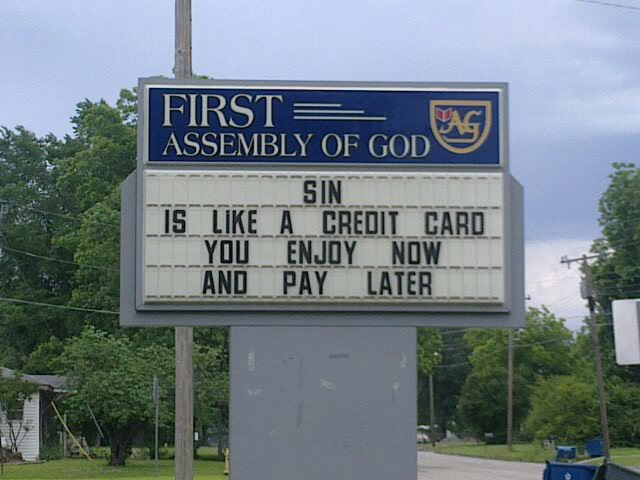
What if the big sins, you know the ones you try hardest to avoid, aren’t the greatest threat?

I was in an engineering class the first time I watched the tragic explosion of the Space Shuttle Challenger. Even though I wasn’t alive when it happened, I caught a glimpse of the horror thousands must have felt as the events unfolded.

And, the first question everyone wanted to know was, “What happened?”

After months of investigation, here’s what the Rogers Commission (the group commissioned to investigate the explosion) discovered: An o-ring seal in the right solid rocket booster failed at take-off. I won’t bore you with the details, but an o-ring is a small device relative to the size of a space shuttle. Very small.

It wasn’t something huge, like a puncture in the rocket booster or a hole in the cabin, that caused this disaster. It was a small, seemingly insignificant, o-ring failure.

I think there’s a lesson here for the church. What if the big sins, you know the ones you try hardest to avoid, aren’t the greatest threat to your joy and the church’s mission?

Maybe it’s the sins lying underneath, the ones considered normal or acceptable, the ones going undetected, that are affecting the church the most. I want to address nine of these sins.

Continue reading here.

Not Everyone Can Be The Mouth

Not Everyone Can Be The Mouth

This article contains an excerpt that was taking from my book, Apocity: The Greatest Omission which can now be downloaded for free.
This portion of the book is emphasizing the true meaning behind 1 Corinthians 12, and how this passage cannot be used as means to say that  evangelism is the “mouth” of the body, and therefore, seeing that we have differing roles/gifts, not everyone can be the mouth. Sadly, there are variations to this excuse.


The idea that not everyone can be a consistent witness because they are not “the mouth” is also wrongly pulled out of 1 Corinthians 12. I have actually heard men (more often pastors and teachers within the congregation) say “not everyone can be the mouth.” In other words, we are
not all gifted with the gift of evangelism, and the mouth is the metaphor they use to describe those that do have it. Once again, this is urban legend, and I will clear up this confusion.

When you look at 1 Corinthians 12, right from the get go, in verse 1 Paul clearly says, “now concerning spiritual gifts.” This is a good clue that Paul is about to clarify some things for the Corinthian church. This issue with spiritual gifts and the divisions within the church was one of the reasons Paul wrote 1 Corinthians in the first place. In verse 4 he mentions how there are “diversities of the gifts” that come from the same Spirit. Verse 11 reveals how the Spirit passes out gifts as He wills (This challenges those who think that you have to speak in tongues as proof that you have received the baptism of the Holy Spirit. See Chapter 5). Then, in verse 12, Paul begins to emphasize the unity of the body not only because we are all partakers of His Spirit through salvation (v13), but also because of how the diversity of the members affect the unity of that body. In other words, Paul is trying to give us an illustration that even though there are different gifts within the body of Christ, these divisions of gifts do not mean we are divided as a body. We are unified together by the Spirit, who distributes these gifts, and one gift is not more important than the other in the grand plan of the Church. Are you following? If not, this next part may be harder for you to grasp.

When you look at the metaphor that Paul uses for the body, he repeatedly gives us clues as to what he is trying to get across to the Corinthian church. In verse 15 he says, “If the foot should say, ‘Because I am not a hand, I am not of the body,’ is it therefore not of the body” (Emphasis added). He asks the same questions concerning another body part in verse 16. Verse 21 he says, “And the eye cannot say to the hand, ‘I have no need of you;’ nor again the head to the feet, ‘I have no need of you.’” Once again, Paul seems to be hinting at something here, and in verse 22 he gets to his point: “… those members of the body which seem to be weaker are necessary.” So basically Paul is trying to say that every member of the body is “necessary” no matter what gift, no matter what background (v13), and no matter how weak one seems to be (v23-24). Paul has said all this so that we realize that everyone within the body should need one another and that we should benefit from each other’s gifts, strengths, weakness, and backgrounds (v25). I might have been very general with my exegesis of this text but my purpose is not to get to the small details (that would be a whole other chapter), but to make some observations that I believe will squash this idea that evangelism is a gift, specifically here, “the mouth.”

If you are one to believe that not everyone can be the mouth (insinuating the mouth being a spiritual gift), or you have heard this from someone and think it is a valid statement, then here are some points to consider. 1) Where in this chapter does it specifically mention evangelism? The urban legend that evangelism is a gift still applies here too, not just Ephesians 4. Also, if you are saying that not everyone
can be the mouth, then you have to show me from 1 Corinthians 12 how believing this is in any way a “get out of witnessing free” card, because that is not Paul’s intent in this particular chapter of Corinthians. 2) Paul did not mean for this chapter to be used as a cop out to not preach the gospel. If you remember what I said in the previous paragraph, Paul’s main concern was unity. There seemed to be divisions in the church for various reasons, and the insinuation that Paul gives in numerous verses is that some believed that there were others that were not needed, or that they were not a part of the body because they seemed weaker or less honorable. There might be more background to this, but the main point is that Paul was more specifically targeting the need for everyone within the body and for every spiritual gift, rather than just emphasizing certain ones over the other. 3) Where does “not being the mouth” come into this metaphor? If you read this chapter carefully, when Paul used the metaphor of the body it wasn’t for us to figure out which body part we are (or think we are), it was to help us understand the importance of unity within a human body and relate that to the body of Christ. This was his main point! It is so absurd when I hear people call this person a foot, or that person the hand, or evangelism the mouth. This is not what Paul is saying! 4) When was the last time you did something without all body parts involved? If evangelism is the mouth, does that mean I don’t use my hands or my feet to preach? The Bible talks about feet being beautiful for preaching the gospel (Romans 10:15), so does this mean not everyone can be the feet either? Do I need someone who is the arms carry me to my corner to pass out tracts because I am not gifted in doing it myself? I am being very caustic for a reason. I have become so sorrowfully burdened about these vain attempts to explain away our responsibility to preach that it has caused me great spiritual distress to see professing believers continually making urban legends, like not being a mouth, a popular excuse. The nature of these excuses call into question the salvation of many who call themselves believers (a topic we will explore in the next chapter).

I can understand that there are persons within the body who are skilled in certain areas in which others are not. For instance, there are men and women who fly missionaries to their destination for the glory of God. These saints risk their lives to fly over dangerous areas to do  amazing things for God. Here is my question though: Just because they metaphorically can be the arms that carry missionaries where they need to go, does that remove their responsibility to preach to the lost themselves? Just because my primary job is “an arm” (I don’t actually believe that, just proving a point) does that mean I don’t have a mouth? If anything, anyone who is supporting evangelism efforts would see the importance of evangelism and would feel the obligation to preach themselves. This example goes for those who mow lawns for the church, who do the finances, those who usher, teenagers in youth group, deacons, pastors, and the list goes on! Your primary duty within the local church includes evangelism. Evangelism is not a secondary duty; it is the indivisible infrastructure of your calling as a Christian!

At this point, I feel it is necessary to say this. As I previously said in Chapter 2, I understand that the roles that God has given within the local church are for us to be perfected and conform to the image of Christ. I am not blind to the reality of our weakness, nor do I think that each
person’s gifting is unimportant. I know that pastors have a part, deacons, leaders, congregations, members, etc.; all play an important part in the whole of the universal church of Christ. What the revelation of Scripture seems to imply, however, is that none of that infringes upon our call to be faithful in our witness. None of it! There is no such gift of evangelism and there are no Scriptures that we can use to justify this position. If we refuse to accept this reality, then gross apocity among many local churches will continue. And I do not know about how you, reader, may feel about it, but I think God is weary of it.


-Until we go home

A Light View of Sin

Each week day I drive through a small town on my to and from work. For the past month or more, this sign has been in the yard of a church building. Even with good content, having a message board can be more of a burden than a benefit – it takes work and diligence to keep truth in a short message updated often enough so people notice. But when the message is wretched, one wonders why it is there at all.

Sin like a credit card

While it’s true that sin can seem enjoyable – what value would temptation be to Satan if the end product was rightly portrayed? – it is a biblical fact that we are to hate sin, not enjoy it. Paul addressed this in teaching how abundant God’s grace to towards His children, far greater than our sin, and then asking the rhetorical question:  Romans 6:1-2 (HCSB)  What should we say then? Should we continue in sin so that grace may multiply?  Absolutely not! How can we who died to sin still live in it?

Does the apostle’s instruction seem more biblical than that of the church board in the picture? Again, the apostle –  2 Corinthians 5:21 (HCSB)  He made the One who did not know sin to be sin for us, so that we might become the righteousness of God in Him.

Knowing this, that Christ Jesus took our sin upon Himself, for them on the cross and was the object of God’s wrath that was due us, how can we abide a professing man of God who tells us to be cavalier towards sin?

Enjoy it now, pay for it later? It was PAID IN FULL on the cross! We add to the debt we owe Him every time we sin. It’s too often when we diligently seek to pursue Christ, how much more wretched would our track record be if we thought we were supposed to enjoy sin? Let the lyrics of this old hymn pierce your heart and mine. May we NO LONGER be at peace with our sin – or those who tell us to enjoy it! Let us not grow weary in well doing, but press on toward the prize that will not tarnish and be done with lesser things!

Stricken, smitten, and afflicted,
See Him dying on the tree!
’Tis the Christ by man rejected;
Yes, my soul, ’tis He, ’tis He!
’Tis the long expected prophet,
David’s Son, yet David’s Lord;
Proofs I see sufficient of it:
’Tis a true and faithful Word.

Tell me, ye who hear Him groaning,
Was there ever grief like His?
Friends through fear His cause disowning,
Foes insulting his distress:
Many hands were raised to wound Him,
None would interpose to save;
But the deepest stroke that pierced Him
Was the stroke that Justice gave.

Ye who think of sin but lightly,
Nor suppose the evil great,
Here may view its nature rightly,
Here its guilt may estimate.
Mark the Sacrifice appointed!
See Who bears the awful load!
’Tis the Word, the Lord’s Anointed,
Son of Man, and Son of God.

Here we have a firm foundation,
Here the refuge of the lost.
Christ the Rock of our salvation,
Christ the Name of which we boast.
Lamb of God for sinners wounded!
Sacrifice to cancel guilt!
None shall ever be confounded
Who on Him their hope have built.