Thoughts on Suicide

*** Note from Mark – knowing how much this has affected Sony, this is not an invitation to debate on this one, nor will derogatory comments be permitted. It is simply meant to be an encouragement to people to reach out if they are struggling with the thought of suicide. We are not all going to agree on every aspect of doctrine, but these words are helpful. ***

*******

Last week, I found out that an acquaintance committed suicide. This was not a close friend but it affected me as I’ve pondered why people take such extreme measures when, more often than not, the trials of life are only temporary afflictions.

This is only the second time I can remember someone I know dying by his own hand. In the other case, the motive seemed to be selfishness: getting back at someone else.

In many cases, the motive is extreme hopelessness, and this makes me sad. Where there is life, there is always hope. It is only after death that nothing can be changed. At that point, not only your past, but your present and future are determined forever.

I wonder, though, if sometimes people commit suicide due to guilt. Could people honestly have done something “so bad” that they don’t think even God would forgive them, so they take the “easy way out” instead of humbling themselves in repentance and trusting God’s saving grace?

This last thought concerns me even more than the others. There is no sin that God won’t forgive IF a person is willing to repent and turn from that sin. The problem is that many don’t want to do that and so they live with the guilt of the life they are living until tragedy claims that life.

psalm55v22

I understand discouragement, and I have been down to the point of wanting to die. But I remind myself that there is a reason that I am still alive, and it has nothing to do with me. The God who placed me on this earth still has a plan for my life and, until that plan is finished, I must be faithful. There is no “easy out” for a Christian. We are called to take up our cross daily and follow Him.

The thoughts going through my mind right now are many. First of all, my heart goes out to those who think the only way out of their problem is to end their life. But I also wonder how many people I know are struggling more deeply than I would ever imagine. We live in a world of “happy” faces, where people don’t want to be burdened with others. Therefore, there are a lot of lonely people in this world. As Christians, we should never be so busy or unconcerned that we don’t take time to listen to someone who is struggling. If someone is willing to open up and talk to you, it may be because they are hoping you will show them the Hope they need.

If you are one who is down and suicide has even crossed your mind, please find someone to talk to. I realize that you can’t trust just anybody but ask God to show you someone who would be willing to pray with you and check on you periodically to make sure you are okay. Although there will always be trials in this life, they truly are temporary, and God can give you the strength to walk through them if you allow Him to.

Don’t become another statistic. Be a victor! And help others to be victorious as well.

trustinggod

True Friendship

criedtogether

Throughout most of my life, I have wondered how many true friends I really have. It’s easy for people to say, “I’m praying for you” or “I think of you even when I don’t write,” but I always wondered if that were really the case (although I am guilty of thinking of people more than I write as well).

Lately, I have realized that I do have a few close friends, and I sometimes wonder why since many seem to have none.

John 15:13 tells us: “Greater love has no one than this, that someone lay down his life for his friends.”

I used to interpret this in terms of dying, but that is not the only way to lay down a life. I have been blessed lately by friends who are willing to serve me, going far and above the call of duty, and I’ve decided nothing says friendship like that does. I am very blessed to have a family that loves me and does so much for me but I’m not sure how to handle it when others do those same things for me. At the same time, I’m very grateful when they do.

I am also thankful for friends who text and email me just to see how I’m doing. This takes a bit of time and thought on my friends’ part so speaks “care” to me as well.

And last but not least are the friends I know who pray for me frequently. I know this is often what gets me through life. Without this, I’m convinced my struggles would be greater so I do not take this for granted.

True friendship can be measured in different ways. What means a lot to me may not mean a lot to you but the point is that the world is in need of people who really care. Christians should radiate love to everyone around them.

onerealfriend

Christians should be trustworthy, not given to gossip or slander. Too often, people suffer in silence because they don’t know who to trust, and the fact is they may not have anyone to trust. This is so sad.

You are called to be a Light in a dark world. Part of being that Light is being different. The only one you should be comparing yourself to is Christ. He epitomized love and care and compassion, and He wanted His children to extend that same love, care, and compassion to others. Instead, we tend to focus on ourselves and our needs that we forget about those who could use a kind, comforting word.

If you have a true friend in your life, someone you can lean on in your times of trial, who will pray with you when you need it and never make you feel like a burden, take time to tell that friend how thankful you are to have them in your life, and be sure to pray for them in return.

If there are people that God has put in your life to be a friend to, be faithful to be that true friend that points them to Jesus and shows them His love. After all, you may be the only true friend they ever have.

Willing to Be Broken

It seems no matter how long I walk with the Lord, there are things that are difficult for me to accept or understand. Especially when my body is under attack, I don’t handle it well. And yet I know that my God does all things well.

Not long ago, I realized that I had fallen into the trap that so many in ministry do: that of being too busy serving God to have a lot of time for Him. This bothered me and I determined to do better. After all, I can’t do what I do without His help. Well, God granted that desire, just not how I would have chosen and, honestly, I’ve struggled with it.

I don’t know why I still fight God sometimes. In my heart, I know His way is best but my mind does not always want to accept it. I hate limitations. But right now God is using these limitations that I despise to draw me closer to Him. I’ve needed this time but it took God intervening, mercifully helping me to slow down and acknowledge Him and allow Him to direct my paths.

broken

The fact is that, even in the valley, God is good. Our job as His children is to be still and know that He is God. He desires to be exalted in our lives and will do whatever He needs to do to accomplish that. I, for one, am thankful. I don’t want to get so far away from my Savior that I don’t realize I’ve strayed.

I’m not through my valley yet but I am learning to rest in the fact that I am where He wants me for a (hopefully short) season.

No one likes being broken. Our pride rebels at the first sign of weakness or not getting our way. And yet Scripture tells us that a broken heart He will not despise (Psalm 51:17). If I want to please Him, I must have a put away all haughtiness and stubbornness and be willing to be broken for Him.

I don’t know what all God is doing in my life right now, but I know whatever He does will be for my good and His glory. I pray I come through this stronger than ever before. And that is my prayer for you as well.

Christians are not always strong. We need God to make it through this life. Storms come. Trials bombard. But we still serve a loving God. He is right there with arms outstretched waiting to comfort and hold and wipe away your tears. All you have to do is ask.

Not Everyone Can Be The Mouth

Not Everyone Can Be The Mouth

This article contains an excerpt that was taking from my book, Apocity: The Greatest Omission which can now be downloaded for free.
This portion of the book is emphasizing the true meaning behind 1 Corinthians 12, and how this passage cannot be used as means to say that  evangelism is the “mouth” of the body, and therefore, seeing that we have differing roles/gifts, not everyone can be the mouth. Sadly, there are variations to this excuse.


The idea that not everyone can be a consistent witness because they are not “the mouth” is also wrongly pulled out of 1 Corinthians 12. I have actually heard men (more often pastors and teachers within the congregation) say “not everyone can be the mouth.” In other words, we are
not all gifted with the gift of evangelism, and the mouth is the metaphor they use to describe those that do have it. Once again, this is urban legend, and I will clear up this confusion.

When you look at 1 Corinthians 12, right from the get go, in verse 1 Paul clearly says, “now concerning spiritual gifts.” This is a good clue that Paul is about to clarify some things for the Corinthian church. This issue with spiritual gifts and the divisions within the church was one of the reasons Paul wrote 1 Corinthians in the first place. In verse 4 he mentions how there are “diversities of the gifts” that come from the same Spirit. Verse 11 reveals how the Spirit passes out gifts as He wills (This challenges those who think that you have to speak in tongues as proof that you have received the baptism of the Holy Spirit. See Chapter 5). Then, in verse 12, Paul begins to emphasize the unity of the body not only because we are all partakers of His Spirit through salvation (v13), but also because of how the diversity of the members affect the unity of that body. In other words, Paul is trying to give us an illustration that even though there are different gifts within the body of Christ, these divisions of gifts do not mean we are divided as a body. We are unified together by the Spirit, who distributes these gifts, and one gift is not more important than the other in the grand plan of the Church. Are you following? If not, this next part may be harder for you to grasp.

When you look at the metaphor that Paul uses for the body, he repeatedly gives us clues as to what he is trying to get across to the Corinthian church. In verse 15 he says, “If the foot should say, ‘Because I am not a hand, I am not of the body,’ is it therefore not of the body” (Emphasis added). He asks the same questions concerning another body part in verse 16. Verse 21 he says, “And the eye cannot say to the hand, ‘I have no need of you;’ nor again the head to the feet, ‘I have no need of you.’” Once again, Paul seems to be hinting at something here, and in verse 22 he gets to his point: “… those members of the body which seem to be weaker are necessary.” So basically Paul is trying to say that every member of the body is “necessary” no matter what gift, no matter what background (v13), and no matter how weak one seems to be (v23-24). Paul has said all this so that we realize that everyone within the body should need one another and that we should benefit from each other’s gifts, strengths, weakness, and backgrounds (v25). I might have been very general with my exegesis of this text but my purpose is not to get to the small details (that would be a whole other chapter), but to make some observations that I believe will squash this idea that evangelism is a gift, specifically here, “the mouth.”

If you are one to believe that not everyone can be the mouth (insinuating the mouth being a spiritual gift), or you have heard this from someone and think it is a valid statement, then here are some points to consider. 1) Where in this chapter does it specifically mention evangelism? The urban legend that evangelism is a gift still applies here too, not just Ephesians 4. Also, if you are saying that not everyone
can be the mouth, then you have to show me from 1 Corinthians 12 how believing this is in any way a “get out of witnessing free” card, because that is not Paul’s intent in this particular chapter of Corinthians. 2) Paul did not mean for this chapter to be used as a cop out to not preach the gospel. If you remember what I said in the previous paragraph, Paul’s main concern was unity. There seemed to be divisions in the church for various reasons, and the insinuation that Paul gives in numerous verses is that some believed that there were others that were not needed, or that they were not a part of the body because they seemed weaker or less honorable. There might be more background to this, but the main point is that Paul was more specifically targeting the need for everyone within the body and for every spiritual gift, rather than just emphasizing certain ones over the other. 3) Where does “not being the mouth” come into this metaphor? If you read this chapter carefully, when Paul used the metaphor of the body it wasn’t for us to figure out which body part we are (or think we are), it was to help us understand the importance of unity within a human body and relate that to the body of Christ. This was his main point! It is so absurd when I hear people call this person a foot, or that person the hand, or evangelism the mouth. This is not what Paul is saying! 4) When was the last time you did something without all body parts involved? If evangelism is the mouth, does that mean I don’t use my hands or my feet to preach? The Bible talks about feet being beautiful for preaching the gospel (Romans 10:15), so does this mean not everyone can be the feet either? Do I need someone who is the arms carry me to my corner to pass out tracts because I am not gifted in doing it myself? I am being very caustic for a reason. I have become so sorrowfully burdened about these vain attempts to explain away our responsibility to preach that it has caused me great spiritual distress to see professing believers continually making urban legends, like not being a mouth, a popular excuse. The nature of these excuses call into question the salvation of many who call themselves believers (a topic we will explore in the next chapter).

I can understand that there are persons within the body who are skilled in certain areas in which others are not. For instance, there are men and women who fly missionaries to their destination for the glory of God. These saints risk their lives to fly over dangerous areas to do  amazing things for God. Here is my question though: Just because they metaphorically can be the arms that carry missionaries where they need to go, does that remove their responsibility to preach to the lost themselves? Just because my primary job is “an arm” (I don’t actually believe that, just proving a point) does that mean I don’t have a mouth? If anything, anyone who is supporting evangelism efforts would see the importance of evangelism and would feel the obligation to preach themselves. This example goes for those who mow lawns for the church, who do the finances, those who usher, teenagers in youth group, deacons, pastors, and the list goes on! Your primary duty within the local church includes evangelism. Evangelism is not a secondary duty; it is the indivisible infrastructure of your calling as a Christian!

At this point, I feel it is necessary to say this. As I previously said in Chapter 2, I understand that the roles that God has given within the local church are for us to be perfected and conform to the image of Christ. I am not blind to the reality of our weakness, nor do I think that each
person’s gifting is unimportant. I know that pastors have a part, deacons, leaders, congregations, members, etc.; all play an important part in the whole of the universal church of Christ. What the revelation of Scripture seems to imply, however, is that none of that infringes upon our call to be faithful in our witness. None of it! There is no such gift of evangelism and there are no Scriptures that we can use to justify this position. If we refuse to accept this reality, then gross apocity among many local churches will continue. And I do not know about how you, reader, may feel about it, but I think God is weary of it.


-Until we go home

A Light View of Sin

Each week day I drive through a small town on my to and from work. For the past month or more, this sign has been in the yard of a church building. Even with good content, having a message board can be more of a burden than a benefit – it takes work and diligence to keep truth in a short message updated often enough so people notice. But when the message is wretched, one wonders why it is there at all.

Sin like a credit card

While it’s true that sin can seem enjoyable – what value would temptation be to Satan if the end product was rightly portrayed? – it is a biblical fact that we are to hate sin, not enjoy it. Paul addressed this in teaching how abundant God’s grace to towards His children, far greater than our sin, and then asking the rhetorical question:  Romans 6:1-2 (HCSB)  What should we say then? Should we continue in sin so that grace may multiply?  Absolutely not! How can we who died to sin still live in it?

Does the apostle’s instruction seem more biblical than that of the church board in the picture? Again, the apostle –  2 Corinthians 5:21 (HCSB)  He made the One who did not know sin to be sin for us, so that we might become the righteousness of God in Him.

Knowing this, that Christ Jesus took our sin upon Himself, for them on the cross and was the object of God’s wrath that was due us, how can we abide a professing man of God who tells us to be cavalier towards sin?

Enjoy it now, pay for it later? It was PAID IN FULL on the cross! We add to the debt we owe Him every time we sin. It’s too often when we diligently seek to pursue Christ, how much more wretched would our track record be if we thought we were supposed to enjoy sin? Let the lyrics of this old hymn pierce your heart and mine. May we NO LONGER be at peace with our sin – or those who tell us to enjoy it! Let us not grow weary in well doing, but press on toward the prize that will not tarnish and be done with lesser things!

Stricken, smitten, and afflicted,
See Him dying on the tree!
’Tis the Christ by man rejected;
Yes, my soul, ’tis He, ’tis He!
’Tis the long expected prophet,
David’s Son, yet David’s Lord;
Proofs I see sufficient of it:
’Tis a true and faithful Word.

Tell me, ye who hear Him groaning,
Was there ever grief like His?
Friends through fear His cause disowning,
Foes insulting his distress:
Many hands were raised to wound Him,
None would interpose to save;
But the deepest stroke that pierced Him
Was the stroke that Justice gave.

Ye who think of sin but lightly,
Nor suppose the evil great,
Here may view its nature rightly,
Here its guilt may estimate.
Mark the Sacrifice appointed!
See Who bears the awful load!
’Tis the Word, the Lord’s Anointed,
Son of Man, and Son of God.

Here we have a firm foundation,
Here the refuge of the lost.
Christ the Rock of our salvation,
Christ the Name of which we boast.
Lamb of God for sinners wounded!
Sacrifice to cancel guilt!
None shall ever be confounded
Who on Him their hope have built.

Faith and Justification

faith alone

There was a man who had made his way in the world. He lived by himself, for himself; spent much of his time in his nice condominium on the 5th floor of a nice building, away from the fray and cares of the world. One day a fire broke out in his building, on his floor. By the time he noticed the danger, the way out was impassible. Fire was breaking into his condo, causing the roaches and other vermin that had lived out of sight to seek escape in the open rooms. Desperation was setting in on the man, as he was seeing the stuff of his life consumed and his hidden companions revealed.

Through the open window he heard people yelling. On the ground below he saw men from the fire department, holding a net and yelling for him to jump. But jumping would not save him unless the firemen caught him. If he missed the net, if the net failed, if the men couldn’t hold it or cruelly moved out of the way; he would die. His jump would not save him. The fire had revealed the passing nature of his life trophies and the hidden pests he had been sharing his home with. But the fire could not save him – it only revealed the condition he was in and threatened his safety.

Do you see the spiritual lesson? The fire represents law, which reveals sin. While we Gentiles were never under the Mosaic Law, we were a law unto ourselves before Christ saved us and we were convicted by our own consciences that we were guilty. Unless we are made aware of this danger, we won’t notice it – man is naturally blind to spiritual truth. Jumping represents faith, a necessary component of our salvation, but not the entire scope. Faith in the firemen and their net wouldn’t save our man but it would get him to the safety they could provide. The firemen called the man, he jumped, the net held. Creator God calls men to Himself, (just as He did Lazarus) and they come to Him and are saved. Far more trustworthy than mere men and their net, our Savior is certain to save His elect. Our anchor holds!

Let’s take a closer look at faith and its part in our salvation. Ephesians 2:8 tells us, by grace you have been saved through faith. And this is not your own doing; it is the gift of God. As a footnote, I want to remind us that this faith is itself a gift from God, not something we contribute. Salvation is monergistic – all God and none of man. We also know that without faith no man can please God (Hebrews 11:6) and that not all men have such faith (2 Thessalonians 3:2). And lastly, we know that demons have some sort of faith which does not save them (James 2:19). This faith that God gives so that we can answer His call to “repent and believe” is special, necessary, and always present in the Christian’s life. This faith is not present in the lost person and the lack thereof keeps him from knowing and loving Christ Jesus.

1 Corinthians 2:14 The natural person does not accept the things of the Spirit of God, for they are folly to him, and he is not able to understand them because they are spiritually discerned.

This verse describes people who do not have the Spirit and do not believe in Christ: “the natural man.” This question must be asked: What work of the Holy Spirit is lacking? Does the unbeliever simply need a non-saving form of illumination (which would support faith preceding regeneration) or does he need regeneration itself (which would demand regeneration preceding faith) to overcome his deficiency? Stated plainly, can one who is classified as dead in sins and trespasses be illumined, given faith, without being regenerated?

Natural or unregenerate man is darkened in his understanding (Eph 4:17), hostile to God (Rom 8:7), incapable of pleasing or trusting God (Rom 8:7–8), and dead (Eph 2:1–5; Col 2:13). This is his nature, and he always discerns, evaluates, and chooses in keeping with this nature. The only satisfactory solution to this condition is for him to be given a new nature and become a spiritual man, a man with the indwelling Spirit—he must be regenerated before he can be illuminated with spiritual understanding that comes with faith. (Mark A. Snoeberger)

As important as faith is, to rightly comprehend its meaning and use, we must understand its role in our salvation. For how a man gets saved is the most important thing we can comprehend.

While faith is important, it is not most important. Faith is not what turns away the wrath of God, the blood of Christ does that. Although by faith we have peace with God, faith does not save us; the finished work of Christ dos that. We cannot be saved without faith, but faith cannot save us. And while the righteousness of God comes to us by faith (Romans 3:22), it is Christ’s righteousness that grants us God’s favor: For our sake he made him to be sin who knew no sin, so that in him we might become the righteousness of God. (2 Cor 5:21) Reconciliation with holy God is possible because we become His righteousness by having been bought by the blood of His Son.

Therefore, in everything we do; Bible study, evangelism, personal devotions, discipleship; Christ Jesus and His glory is to be our focus. The gospel is the proclamation of His sinless life and atoning death. The redemptive plan of God is revealed as the core theme of Scripture from Genesis to Revelation. Once we are born again by the Holy Spirit, we are no longer the carnal human we used to be – drawn and driven by the sinful desires of our flesh; we are new creatures in Christ, no longer regarding one another “in the flesh” but seeing all things through spiritual eyes of faith.

If we have been saved, we walk by faith and not by sight. We are no longer hostile towards God but anxious to know and please Him. While some would tell us sin is no big deal – we’ve been forgiven! – Scripture tells us that if one’s mind is set on the flesh, he is a dead man:

For those who live according to the flesh set their minds on the things of the flesh, but those who live according to the Spirit set their minds on the things of the Spirit. 6 For to set the mind on the flesh is death, but to set the mind on the Spirit is life and peace. 7 For the mind that is set on the flesh is hostile to God, for it does not submit to God’s law; indeed, it cannot. 8 Those who are in the flesh cannot please God.  9 You, however, are not in the flesh but in the Spirit, if in fact the Spirit of God dwells in you. (Romans 8:5-9)

If you and I have been redeemed by the blood of the Lamb, His Spirit does dwell in us and we are pleasing to God for the righteousness of Christ is imputed to us; we are justified by his grace as a gift, through the redemption that is in Christ Jesus, whom God put forward as a propitiation by his blood, to be received by faith. (Romans 3:24 & 25) We are justified and redeemed, by grace alone received by faith alone in Christ alone.

Some teach that justified means “just as if I’d never sinned.” If you say it just right, it sounds really cool. But that catchy phrase does not begin to describe the depth of our need nor the scope of Christ’s provision. The truth of our situation is that we were dead in sins and trespasses and Christ died for us while we were His enemies. A Man of sorrows, He stood in our place, having no sin of His own. His blood paid the price we could not pay. We were great sinners who were even more greatly forgiven by our great and holy God. We are forgiven, redeemed, ransomed, and reconciled – by the blood of Christ; to be shielded from the wrath of God and the Lamb on that great Day of Judgment. Are we to consider ourselves as if we’d never sinned? God forbid! Such a view does violence to the cross and the ongoing intercession our Lord provides. Our sin debt was not merely dismissed as a bad grade on an elementary school report card. Jesus hung on the cross and suffered the wrath of God on our account and there is now no condemnation for those who are in Christ Jesus!

The haunting lyrics of Matthew Smith’s rendition of “All I Owe” portrays how the sinner praises Christ for His sacrifice:

And all I owe you paid for me
From all I owe I’ve been set free
And all I owe proves your great mercy to me

We were bought at a price, we do not belong to ourselves any longer. The Spirit of the living God dwells within us, so we are to glorify God in our bodies (1 Cor 6:20). Paul went on to tell us (Gal 5:16-25) to walk by the Spirit, and you will not gratify the desires of the flesh. He contrasts the fruit of the natural man with the fruit of the spiritual man and finishes with an exhortation: And those who belong to Christ Jesus have crucified the flesh with its passions and desires. If we live by the Spirit, let us also keep in step with the Spirit. This is a life of faith; we struggle against sin, take measures to avoid sin, keep our focus on the unseen realm where we are seated with Christ. We are to be heavenly minded so we can be of earthly good. We won’t walk perfectly, for the flesh will always be tempted and sin too often; which is why no flesh can inherit the kingdom of God. But we have not been left to walk this path alone. We have the Holy Spirit within us, working in us to will and to do that which pleases Him (Phil 2:13). And we have an advocate, the Lord Jesus, Who is ever interceding on our behalf!

Walking in Spirit means we are sensitive to the sinful desires of our flesh and repent from those things that grieve Him (Ephesians 4:30). It also means our focus is to cooperate with Him and do, speak, and think things that please Him.  We have been translated from the kingdom of death to the kingdom of life!

Justification and Regeneration, Charles Leiter

Page 34 – 35: There is nothing in man that causes God to justify him, including his repentance and faith. Repentance does not pay for sin. A criminal’s remorse for his crimes does not satisfy the just demands of the law. Neither does faith pay for sin! Only the blood of Jesus can pay for sin! Justification is based on the blood of Christ.

This explains why a person can have a very weak faith and still be justified. Imagine two bridges crossing a chasm: One is very weak and untrustworthy; the other is very strong. A man may have a very strong faith in the weak bridge and confidently step out onto it. His strong faith will not keep him from plunging to his death. On the other hand, a man may have a very weak faith strong bridge and only barely manage with fear and trembling to venture forth upon it. The bridge will hold him securely, regardless of his weak faith. All that is necessary is for him to have enough faith to get him onto the bridge! When someone told Hudson Taylor that he must be a man of great faith, he replied, “No, I am a man of very little faith in a very great God.”

This little snippet reveal something else about faith that we must understand. The object of our faith is what is important. As the strong bridge in the story was essential, so the right Jesus for us. This is why the Roman Catholic Church is a synagogue of Satan: they have an unbiblical Jesus who cannot save. One can have all the faith in the world in a false savior and be certain of doom. As 1 Corinthians 15 declares, Christ Jesus dies for our sins according to the Scriptures; was crucified according to the Scriptures; He was resurrected according to the Scriptures. The Jesus Who saves is the Jesus of the Scriptures, not of man’s imagination!

Colossians 3:1-3 (ESV) If then you have been raised with Christ, seek the things that are above, where Christ is, seated at the right hand of God.  Set your minds on things that are above, not on things that are on earth.  For you have died, and your life is hidden with Christ in God.

Beloved, we who have been bought by the blood of Christ have died to self and this world, our life is hidden from the world because we are in Christ and they cannot see Him unless they are born again (John 3:3). Our citizenship is in heaven (Phil 3:20), we are seated with Christ in the heavenly places (Eph 2:6), crucified to the world (Gal 6:14). It is only our mortal body, our flesh, which has not been redeemed; that and our mission of reconciliation is all that ties us here. We are to put to death our members that are upon the earth (Col 3:5) and present our bodies as a living sacrifice unto our God (Rom 12:1). We are to resist being conformed into the pattern of the world and instead be transformed by the renewing of our minds on the word of God so we will know discern that which pleases Him (Rom 12:2).

This is the life of faith! Having been raised to new life in Christ, we are able and will want to be people who bring honor and glory to Him. He alone is worthy of all praise and we are those living stones He raise up to be His temple and to sing His praises now and throughout eternity!

John’s apocalyptic view of the end of this age (Revelation 5:1-9):

Then I saw in the right hand of him who was seated on the throne a scroll written within and on the back, sealed with seven seals. And I saw a mighty angel proclaiming with a loud voice, “Who is worthy to open the scroll and break its seals?” And no one in heaven or on earth or under the earth was able to open the scroll or to look into it, and I began to weep loudly because no one was found worthy to open the scroll or to look into it.  And one of the elders said to me, “Weep no more; behold, the Lion of the tribe of Judah, the Root of David, has conquered, so that he can open the scroll and its seven seals.” 

And between the throne and the four living creatures and among the elders I saw a Lamb standing, as though it had been slain, with seven horns and with seven eyes, which are the seven spirits of God sent out into all the earth. And he went and took the scroll from the right hand of him who was seated on the throne. And when he had taken the scroll, the four living creatures and the twenty-four elders fell down before the Lamb, each holding a harp, and golden bowls full of incense, which are the prayers of the saints. And they sang a new song, saying,

“Worthy are you to take the scroll

and to open its seals,

for you were slain, and by your blood you ransomed people for God

from every tribe and language and people and nation,
 and you have made them a kingdom and priests to our God,

and they shall reign on the earth.”

What a glorious Lord and Savior is Christ Jesus! He conquered hell and death and sin; He is the author of life and holds the keys of David. By His obedient life He earned the privilege to open the scrolls that spell out God’s consummation of history. The Lamb Who suffered and died, rules all of creation and will judge the quick and the dead. He is worthy of our praise, our devotion, our lives. And He is faithful even when we are faithless and tempted by the devil.

When Satan tempts me to despair

And tell me of the guilt within,

Upward I look and see Him there

Who made an end of all my sin.

Because the sinless Savior died

My sinful soul is counted free,

For God, the Just, is satisfied

To look on Him and pardon me.

(Charitie L. Bancroft)

What Is Evangelism?

(This is from the last section in the book I am writing on Baptist theology and practice.)

One of the major purposes we are left on this planet after being raised from spiritual death is to Evangeltake the gospel to every nation, tongue, and tribe; being evangelists and ambassadors of reconciliation. We need to clarify what evangelism is and will begin by identifying a couple of popular practices that are not biblical evangelism. First is the notion that inviting lost people to church is evangelism. This reflects the false notion that evangelism is for the “professionals” and it also lets those who are ashamed of or disinterested in Christ Jesus off the hook of being familiar with His message. 1 Corinthians 14:23-25 shows that unbelievers are welcome but not the focus or even normal attendees in the regular worship of the local church. Ephesians 4 teaches that the local church is to be equipped so the sheep will not be tossed about by the wiles of men. Contrary to the idea of inviting lost people to church, YHWH tells us, So Jesus also suffered outside the gate in order to sanctify the people through his own blood. Therefore let us go to him outside the camp and bear the reproach he endured. (Hebrews 13:12-13). By this, God means we are to go therefore and make disciples of all nations (Matthew 28:19); making disciples of those that have answered the call. About that, more later.
Secondly, many church leaders put emphasis on the personal testimony of those witnessing, rather than making sure they can communicate the gospel. Some even acknowledging that the reason for doing so is because no one can argue with your personal testimony, as it is subjective, whereas the gospel is objective and demands a response. They might argue about the content and the demand of the gospel, but not about what God did for you. This is post-modern thinking and goes directly against the biblical instruction we have as ambassadors of our Lord and Savior (2 Corinthians 5:16-21).

The essential element in all evangelism is proclaiming the biblical gospel (this was covered in some detail in Chapter 8). By doing so, we take the pressure of our performance and insure we don’t contribute to false converts, and we also get confidence in the Word and Spirit of God as we see them do the work that only they can do. Being familiar with the Scriptures will embolden us as we see YHWH has gone before us preparing the soil for the seeds we sow, insuring a good return for His kingdom; see Mark 4:1-9 and:

For as the rain and the snow come down from heaven

and do not return there but water the earth,

making it bring forth and sprout,

giving seed to the sower and bread to the eater,

so shall my word be that goes out from my mouth;

it shall not return to me empty,

but it shall accomplish that which I purpose,

and shall succeed in the thing for which I sent it.

(Isaiah 55:10 & 11)

It is His Word, sent out as He intended, that will not return void, not the 3 minute summary of our personal testimony or a twisted version that He has not commissioned.

As we go about faithfully proclaiming our Lord’s message, we would do well to bear in mind that there are two calls involved in evangelism: we give a general call to every creature (Mark 16:15) and God gives an effective call to His elect (John 6:44). Our call is universal, general, and outward, as we do not know who He has chosen to save. His call is specific, effectual, and internal, as He alone knows those chosen before time to be His adopted children (Ephesians 1:3-10) and He will give ears to hear to His elect. We see this graphically portrayed in Scripture in several places, including the scene wherein Paul and Barnabas had been preaching Pisidia and gained the attention of many people.

The next Sabbath almost the whole city gathered to hear the word of the Lord. But when the Jews saw the crowds, they were filled with jealousy and began to contradict what was spoken by Paul, reviling him. And Paul and Barnabas spoke out boldly, saying, “It was necessary that the word of God be spoken first to you. Since you thrust it aside and judge yourselves unworthy of eternal life, behold, we are turning to the Gentiles. For so the Lord has commanded us, saying,

“‘I have made you a light for the Gentiles,

that you may bring salvation to the ends of the earth.’”

And when the Gentiles heard this, they began rejoicing and glorifying the word of the Lord, and as many as were appointed to eternal life believed. And the word of the Lord was spreading throughout the whole region. But the Jews incited the devout women of high standing and the leading men of the city, stirred up persecution against Paul and Barnabas, and drove them out of their district. But they shook off the dust from their feet against them and went to Iconium. And the disciples were filled with joy and with the Holy Spirit. (Acts 13:44-52)

The message preached is found in verses 16 – 41. Gentiles and Jews heard the same general call, bringing them the good news that what God had promised to the Fathers He had fulfilled by raising Jesus from the dead. The seed fell on some rocky and thorny soil, but it fell on some good soil that had been prepared in advance by the good husbandman (John 15:1). As we see in the well-known road to Emmaus scene, it is YHWH Who keeps them from seeing or understanding until the right time (Luke 24:15 & 16; 30 & 31).

Jesus gave this general call in Matthew 11:28 and John 7:37, as people without respect to their persons were called to come to Him and find rest, to come to Him and satisfy their thirst. This is also the context of Peter’s sermon recorded in Acts 2, as men from myriad countries and religious beliefs (verses 9-11) were called to repent and be baptized (as a sign of their belief). The problem with this call is the same problem the Jews had with their Law: neither one can save or enable the hearer to be saved. People can claim to obey the law (Luke 18:18-23) and they can ignore or refute the words of men (Luke 14:15-24).

The general and effectual calls are likewise revealed to us explicitly in Acts 16, wherein we see Paul, Timothy, and Silas making a journey which finds them in Philippi where they stayed for a while. And on the Sabbath day we went outside the gate to the riverside, where we supposed there was a place of prayer, and we sat down and spoke to the women who had come together. One who heard us was a woman named Lydia, from the city of Thyatira, a seller of purple goods, who was a worshiper of God. The Lord opened her heart to pay attention to what was said by Paul. And after she was baptized, and her household as well, she urged us, saying, “If you have judged me to be faithful to the Lord, come to my house and stay.” And she prevailed upon us. (verses 13 – 15) A good number of women who were somewhat aware of God had gathered at the river and all had heard Paul’s gospel message as the general call went out without restriction. At least this one had her heart opened by YHWH so that she heard the effectual call and was obedient to follow in believer’s baptism.

There are some who think the Law ought to be a part of the gospel, as people need to be convicted of their sin before they can see the need of grace. The law provokes us and reveals sin in us, but cannot grant eternal life. John Bunyan is thought to have written this little poem, showing us with memorable lines the difference between the Law and the Gospel:

Run, John, Run! The Law commands;

But gives me neither feet nor hands.

Far grander news the gospel brings;

It bids me fly and GIVES ME WINGS!

Our Savior has said something similar, in Paul’s Roman epistle: For God has done what the law, weakened by the flesh, could not do. By sending his own Son in the likeness of sinful flesh and for sin, he condemned sin in the flesh, in order that the righteous requirement of the law might be fulfilled in us, who walk not according to the flesh but according to the Spirit. (Romans 8:3 & 4)

The gospel is the good news of what Jesus has done to save sinners; refer to the Biblical Gospel in chapter 8. Our focus must be on that message, not 4 spiritual laws or any other nifty scheme man may have invented to make witnessing easy. We are not called to a life of ease; we are called to obedience. We are ambassadors of His message of reconciliation, not a one-off message of our own making. While the Law may rightly be used to show a self-righteous religious man his sin; it is not part of the gospel that every spiritually dead person must hear. Seeing the holiness of God in Christ, even in part, will do more to crush self-righteousness (as in the opening scene in Isaiah 6) than all the heavy yoke of the Law can bring to bear for the one who is being called to new life by the Spirit of the living God.

Much of the activity in a local church under the flag of evangelism takes place in what are called revivals. This is a logical progression under the previously mentioned idea that evangelism is bringing lost people to church. It appears that there is a belief that a specially called meeting with an out-of-town preacher will create an environment for sinners to be saved. I cannot commend revival meetings because I do not find them revealed or recommended in Scripture; I do not find them practiced by the early church; they presume man can schedule the work of the Holy Spirit; they rely on someone other than the shepherd of the local flock to feed them; and they influence many to chase numbers rather than spiritual growth. A century ago, a brother sounded a warning to the church regarding this practice:

The modem “revival,” the work of the “revivalist” who comes under the title of an evangelist, but works as a religious promoter in the organized church, is unexpected in Scripture, except as the word “revival” is used to denote a forward movement in the spiritual life of the church, without including the idea of attempting to regain some spiritual position once held, but now lost. The use of the word usually means, however, a getting up after having fallen down, or a waking after sleeping, or a coming to strength after a period of weakness; while, on the other hand, the Scripture pre-supposes a continual erect, wakeful and aggressive position for service on the part of every Christian (Eph. vi. 10-17). Thus, it may be seen, a “revival” is abnormal rather than normal. It may have a function when needed, but in no way should become a habit, much less a sanctioned method of work. Having regained vitality, believers are not warranted in habitually returning to an anaemic state. … The fact that a “revival” is planned for is a confession on the part of a church of a condition which would render the normal movements of the Spirit in salvation impossible. The call for the evangelist, under those conditions, also reveals the fact that the expectation of the church, to a great extent, is toward the man that is invited, rather than toward the Holy Spirit and His appointed ministry through the church itself. (True Evangelism, Lewis Sperry Chafer, epub, position 38.6 & 40.4, emphasis mine)

Evangelism, like all kingdom work, must be in accordance with the instructions and principles clearly given to us by our God. As discussed in chapters 5 and 6, regarding the nature and use of Scripture, when we use what man has developed to further kingdom work rather than what God has given us, we are betraying a greater trust in man than we have in our Creator. And this should never be the case for people of the Book! God is a jealous God and He will not give His glory to another. There is safety in our standing on and under the Word of God; it is His authority and revelation to us. History aligns with Scripture in bearing this out, as this short extract from an early debate between the reformers and Rome reveals:

Charles Eck had been sent by Rome to Germany to refute what Luther, Melanchthon and others had written in the Augsburg Confession; a document intended to declare essential doctrines and not to be the handmaid or rival to the Word of God. The Duke of Bavaria was the judge. After listening to the reaction to the confession, he asked Rome’s defenders, “can you refute by sound reasons the Confession made by the elector and his allies?” – “With the writings of the apostles and prophets – no!” replied Eck; “but with those of the Fathers and of the councils – yes!” (J.H. Merle D’Aubigne, History Of The Reformation Of The Sixteenth Century, Volume IV, page 187, Sprinkle Publications, 2003) As was pointed out in chapter 7 regarding the use of confessions, this peek into history reveals the absurdity of using man’s documents to defend Christian disputes. If we cannot, by sound reason, defend our beliefs and practices by the writings of the apostles and prophets, we have no business expounded them as Christian doctrine or practice.

When man claims to accomplish by the flesh what only God can do, we steal glory from God and He will not allow that to continue. It is His work to raise sinners to life, as He breathed life into Adam, as He gave life to 4-days dead Lazarus by calling him forth. Let us abandon the false hope that we can defer to pastor-man or that we can cause God to respond to our schedule and schemes. His kingdom, His Word, His temple; He is building the New Jerusalem with spiritual stones that He gathers from every nation, tribe, and tongue. We can work with Him or against Him. ‘Tis a far better thing for professing Christians to work with God than in opposition to Him. May it be so with us, as we herald His glorious name throughout the world.

Fifty Years in the Chuch of Rome

Most magisterial reformers took only a half-step from Rome. Much of what protestant churches hold to was learnt from Rome. Certain doctrines and practices clung to men like the sin that so easily entangles us. The following is from Charles Chiniquy’s book, Fifty Years in the Church of Rome, chapter 30; published in 1886.
Half-step from Rome
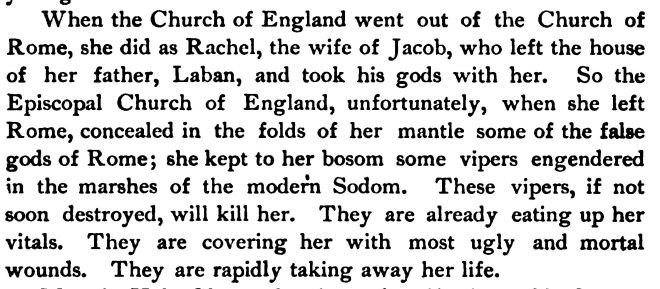
Later in the book, after describing the horrors women experienced in having their most secret sins pried from them by expertly crafted questions, the author reveals one of the vipers mentioned above.
586

Are You Leading Worship or Entertaining?

My brother travels across the country, ministering in a variety of churches, and I have the blessing of traveling with him. There are times, though, that I look around and think, Something is missing.

A few years ago, I was beginning to worry about myself. I felt like I was becoming one of those stodgy old women who refuses to accept modern praise and worship music, because they are not hymns. Now don’t get me wrong. I love hymns and am saddened by the fact that many young people (if not most) will never know the lyrics that have stood the test of time. But I finally realized that my objection is not so much the songs that are sung (although some leave much to be desired); it is the way they are sung.

People complain about the old 7/11 songs but, today, churches introduce songs that are not only shallow; they were not written to be sung by a congregation. They may be great for a praise & worship singer to sing in concert, but they are very difficult for people to sing along with.

praiseworship

Often on Sunday mornings, I am tired. Especially if I’ve been on my feet at a convention all weekend, Sundays can be very hard. I rely on God’s strength to get me through the day, and I look forward to worshiping with His people, but some weeks, I don’t really get that.

There are exceptions, of course. Some churches are full of the presence of the Lord the moment we arrive. It’s obvious the people there love the Lord and each other, and they are eager to see what God is going to do in their midst. This is what the Church should look like.

I would love to see more churches do a mixture of hymns and praise and worship songs. The key to worship is singing songs that honor our Lord while focusing on Him, not the people around us. At the same time, the leader must be in tune with those around him or her. Are they singing? Praying? Worshiping? Or are they merely watching? The difference between a worship service and a concert is that the former should not be a performance. It is not a contest of vocal or musical ability. It is the gift of seeing those who have had a rough week, who are discouraged, who wonder why they are even there, and leading them into the presence of the Lord. Once there, they can leave their burdens at the altar and better hear the message God desires to speak to them.

A true worship leader is just as important as a pastor who preaches the Word without compromise. Together, they will help to build a church that God can use in a mighty way.

Go the Extra Mile

But I say to you, Do not resist the one who is evil. But if anyone slaps you on the right cheek, turn to him the other also. And if anyone would sue you and take your tunic, let him have your cloak as well. And if anyone forces you to go one mile, go with him two miles (Matthew 5:39-41).

I love the Sermon on the Mount, as this is where Jesus taught His followers to not merely obey the law but to go the extra mile in serving God, experiencing life with Him instead of just doing the bare minimum (the Pharisee way).

Although the Bible is the guideline for every true Believer, the above verses are ones I never hear taught. I hear more people who are concerned about being taken advantage of, and whose focus is on defending themselves and their “rights.”

Jesus went on to say:

For if you love those who love you, what reward do you have? Do not even the tax collectors do the same? (Matthew 5:46).

I agree that evildoers should be punished, and Scripture affirms that, but Jesus taught us to go the extra mile in order to live at peace as much as possible and to love those who do us wrong.

extramile

Maybe part of the problem is that we think of love as warm, fuzzy feelings toward a person when, in reality, love is something that comes from the heart. It is refusing to be angry and bitter no matter how much of a right you have to be so.

I realize this is easier said than done, but this is where the Holy Spirit comes in. James 5:16 tells us that “the effectual, fervent prayer of a righteous man avails much.” I am testimony to the fact that, if you desire desperately to have a clean heart toward someone who has wronged you, God will answer that prayer.

My bottom line is this: Do you respond to situations like Jesus would? There is a time to speak and a time to be silent. There may be a time to defend yourself, but I believe that it’s often pride that causes our flesh to become defensive and retaliate. We need to stand for truth, but our focus should be on Christ and glorifying Him. If that is not your motive, pray for wisdom before you do anything other than what Jesus taught in the Sermon on the Mount.

A Testimony of Faith

A poem written during the nascent days of The Reformation.

By Margaret of Valois, duchess of Alencon, France,th

sister of King Francis I, a persecutor of The Reformers.

Is there a gulf of ill, so deep and wide

That can suffice but e’en a tenth to hide

Of my vile sins?

Well do I fell within me is the root,

Without are branch and foliage, flower and fruit.

My God, thou hast come down on earth to me, –

To me, although a naked worm I be.

Word Divine, Jesus the Salvator,

Only Son of the eternal Paer,

The first, the last; of all things renovator,

Bishop and king, and mighty triumphator,

From death by death our liberator.

By faith we’re made the sons of the Creator.

Though poor, and weak, and ignorant I be,

How rich, how strong, how wise I am in Thee!

In spirit noble, – but in nature slave;

Immortal I am, -tending to the grave;

Essence of heaven, – and yet of earthly birth;

God’s dwelling place, – and yet how little worth.

Speak the Truth in Love

I don’t know what your first thought was when you saw the title to this post, but my emphasis is going to be on two small, but very powerful words: in love.

We live in a world where people are willing, and often way too eager, to give their opinions on things. Gone are the days when people would weigh their words and find a way to be gracious toward others (at least to their face).

Although there is a need for honesty in a time where it’s near impossible to know who to trust, many forget that, if they don’t have love, they are merely a noisy gong or a clanging cymbal (1 Corinthians 13). If something needs to be said, there is a way to say it, and that way is with grace and humility.

One could argue that Jesus was not always graceful when He confronted sin, but I don’t feel like this gives us the right to get in people’s face, tear them down, call them names, etc. Jesus taught His disciples to love each other and to think of others as better than themselves. If you truly believe that the person you are confronting is better than you, you will consider your words carefully before you say them.

truthinlove3

People are more likely to receive a rebuke if they know you love them and truly care about them. If you are more concerned with being right than you are about the other person being right with God, then hold your tongue and do not attempt to address the issue. More often than not, you will just make things worse, and they may harden their heart even further and never repent.

I see this in doctrinal debate too. I love being around people who are strong in their faith and know what they believe, but some have a hard time having strong beliefs without condemning those who have different beliefs. Within the Church, there are different callings, gifts, and, yes, even doctrines. Just because someone believes differently than you do does not mean they do not love Jesus. If you are a true Believer, you are most likely at a different place in your spiritual walk than you were ten years ago. We should all be constantly learning and growing, so learn to bear with those who are at a different place than you are.

In John 17:21, Jesus prayed that we would be one, just as He and the Father are one, but that unity will not come by fighting each other. You are responsible to study to show yourself approved (2 Timothy 2:15) and to be ready to give an answer for the hope that lies within you (1 Peter 3:15), but there is a way to do those things, and the answer is lovingly.

I leave you with these words from the apostle Paul: “Let your speech always be gracious, seasoned with salt, so that you may know how you ought to answer each person” (Colossians 4:6). That is my prayer for all of us. Don’t let the enemy use you to bring strife and division among God’s people. Instead, encourage each other to love and good works and, if rebuke is necessary, ask God to help you to do it in love.

Are You Like Judas or Peter?

When I can’t sleep at night, I often listen to my Bible app. Last night, I heard the account of Peter denying the Lord. After declaring three times that he did not know Jesus, Luke 22:61-62 tells us: “And the Lord turned and looked at Peter. And Peter remembered the saying of the Lord, how he had said to him, ‘Before the rooster crows today, you will deny me three times.’ And he went out …”

If I had never heard the story before, I would have been holding my breath. What was he going to do?!

Back in Matthew 26 and 27, we read of Judas betraying Jesus. Matthew 27:3 says that, when Judas saw that Jesus was condemned, Judas changed his mind and returned the money to the chief priests and elders. They had what they wanted, though, so they weren’t going to give up the man they had been waiting for for so long.

willingpraise

Upon hearing this, verse 5 says about Judas, “throwing down the pieces of silver into the temple, he departed, and he went … and hanged himself.” How sad! He could not live with the guilt of knowing he had betrayed an innocent man so he ended his life prematurely.

Peter, on the other hand, had a different outcome. Instead of hanging himself, Peter “went out and wept bitterly.” He too felt the depths of his sin but, instead of giving in to despair, he chose to live.  Because of this, God was able to use him, and he became a bold witness of the One he had once claimed to not know.

I doubt there is a person alive who has not failed the Lord at some point or another. Some give up and decide there is no point in even trying, while others fall on their knees in repentance and then get up, wipe the dust off, and move on, growing stronger than ever before.

Who are you more like? Judas or Peter? When you make a mistake, do you crumble and give up, or do you ask God for forgiveness and then set out to fulfill your calling once again? Let me encourage you to learn from Peter. God is there and ready to forgive a repentant heart. Sometimes it is through failing that we learn our humanity and turn to Him like never before. He loves you. Don’t lose sight of just how much.

Robert Haldane on Mortifying Sin

Robert Haldane quoting William Romaine in his commentary on the book of Romans: Haldane

True spiritual mortification does not consist in sin not being in thee, nor in its being put on the cross daily, nor yet in its being kept upon it. There must be something more to establish perfect peace in thy conscience; and that is the testimony of God concerning the body of sin. He has provided for thy perfect deliverance from it in Christ. Everything needful for this purpose was finished by Him upon the cross. He was the Surety. He suffered for thee. Thy sins were crucified with Him, and nailed to His cross. They were put to death when He died: for He was thy covenant-head, and thou wast legally represented by Him, and art indeed dead to sin by His dying to sin once. The law has now no more right to condemn thee, a believer, than it has to condemn Him. Justice is bound to deal with thee, as it has with thy risen and ascended Savior. If thou dost not thus see thy complete mortification in Him, sin will reign in thee. No sin can be crucified either in heart or life, unless it be first pardoned in conscience; because there will be want of faith to receive the strength of Jesus, by whom alone it can be crucified. If it be not mortified in its guilt, it cannot be subdued in its power. If the believer does not see his perfect deadness to sin in Jesus, he will open a wide door to unbelief; and if he be not persuaded of his completeness in Christ, he gives room for the attacks of self-righteousness and legal tempers. If Christ be not all in all, self must still be looked upon as something great, and there will be food left for the pride of self-importance and self-sufficiency; so that he cannot grow into the death of Christ in sensible experience, further than he believes himself to be dead to sin in Christ. The more clearly and steadfastly he believes this, as the Apostle did–I am crucified with Christ–in proportion will he cleave to Christ, and receive from Him greater power to crucify sin. This believing view of his absolute mortification in Christ, is the true Gospel method of mortifying sin in our own persons. Read the sixth of Romans, and pray for the Spirit of revelation to open it to thee. There thou wilt discover the true way to mortify sin. It is by believing that thou art planted together with Christ in His death; from thence only thy pardon flows, from thence thy daily victory is received, and from thence thy eternal victory will be perfected. –

In Robert Haldane, An Exposition of The Epistle to the Romans, 253-254

A Burden for the Churched

This morning, as I listened to Greater Vision sing “Just One More Soul,” I began to reflect once again on the message of that song. It was the perfect encouragement I needed, as I prepare for another year of conferences and ministry. For those who don’t know, I have the blessing of traveling with my brother as he ministers to people and challenges them to examine their worldview and make sure everything they do is from a Biblical perspective.

Although he has done some street witnessing, prison ministry, etc., most of our outreach is to professing Christians, and those are often the ones I have the greatest burden for. In our travels, we meet a lot of neat people, some of whom are on fire for the Lord and are striving to raise their children to have that same fervor. But many seem to be stressed and depressed, weighed down with the things of this world. Then there are those who are just biding their time, waiting for the service to be over so they can go get together with their friends or go home and watch TV.

gospelchurch

It seems like so many today don’t really care what the Bible teaches. “If it feels good, do it” still permeates our society. If you want to watch movies filled with sex and violence, that’s fine. It’s just a movie. If you’re tired of your wife and you find someone else who will make you “happy,” go for it. But let me interject here that nowhere in the Bible does it say that God wants us to be happy. It does say He wants us to be holy, and that is missing from the lives of so many who claim to be saved.

Hebrews 6:4-8 says, “For it is impossible, in the case of those who have once been enlightened, who have tasted the heavenly gift, and have shared in the Holy Spirit, and have tasted the goodness of the word of God and the powers of the age to come, and then have fallen away, to restore them again to repentance, since they are crucifying once again the Son of God to their own harm and holding him up to contempt. For land that has drunk the rain that often falls on it, and produces a crop useful to those for whose sake it is cultivated, receives a blessing from God. But if it bears thorns and thistles, it is worthless and near to being cursed, and its end is to be burned.”

I believe this speaks to those who say, “Lord, Lord, did we not do all kinds of things in Your name?” And, yet, the end result is that they did not live for Him on earth, so He had to turn them away from the gates of Heaven.

As I write this, my spirit is heavy. I see a world lost and dying, and I feel helpless to do anything about it. The truth is, however, that I can pray. I can live a life that pleases God so that He can use me for His glory. I can be faithful in the little things He has entrusted me with so that He can eventually trust me with bigger things. I can draw nearer to Him every day so that His voice becomes ever clearer. The answer is not to give up, but to press on with more determination than before.

God is not willing that any should perish, but that all should come to repentance, and this repentance must begin in the house of God. You may have sung as a child, “Lord, send a revival and let it begin with me.” May that be our prayer today. If the church begins to see true revival, I believe it will spread to the rest of the nation. Lord, hasten that day!

The Pastor – Chapter 8, Conclusion

If you have listened to this book, you know the author desires only to please YHWH and help Solaequip His people so we will not be tossed about by the whimsy of man. Here’s his wrap for the last chapter:


Having published this book, I know I shall be accused of denigrating both the biblical work of the gospel minister, and the man himself. Indeed, I knew it before I began. But I didn’t agree with it then, and I don’t agree with it now. Yet, if such a critique of an unscriptural title really has undermined what many regard as ‘the ministry ’, then something is seriously wrong with what we think of as ‘the ministry ’. And the sooner we find it out the better. In the 16th century, men like Thomas Cartwright and Robert Browne came to realise that the warrant to preach does not depend on a magistrate’s licence, and they had the courage to destroy the noxious bits of paper which pretended to make a man into a minister. We must show the same courage and the same spirit in our day. If an elder’s authority depends on the invention of an office, on Humpty Dumpty’s misuse of biblical words, or on the use of a title, we ought to recognise where we are – and the consequences of it. To accommodate the words of the Independent, Henry Jacob: A teacher in Christ’s church has a far ‘better original’ than calling him ‘Pastor’; or ought to have! Of course, we must honour all men to whom honour is due (Rom. 13:7). In particular, as I have repeatedly stressed, we should ‘respect’ our elders ‘who work hard among [us], who are over [us] in the Lord and who admonish [us]’, and we should ‘hold them in the highest regard in love
because of their work’ (1 Thess. 5:12-13), but this does not mean we should give them a title.
While we must not undervalue the gifts of Christ to his church, pastor-teachers among them, neither must we make little popes of them! Or big!

Chapter 8 is here.

Chapter 7 can be found here.

Read God’s Word

It has been a while since I have even attempted to read through the Bible in a year. This year, I am doing just that, along with my regular Bible reading (reading through more slowly) and a Bible study.

This has me going through five different sections of Scripture at present. I thought it could be a bit overwhelming but, so far, I am enjoying it. Each portion is different from each other and yet each serves a purpose.

I don’t know if I will do this every year. I’ll have to see how this year goes but, for this year, I am looking forward to seeing what God speaks to me, as I draw near to Him and ask Him to show me the way I should go and to help me to be faithful. This continues to be my constant prayer.

You may not have the time to read as much Scripture as I hope to this year, but I encourage you to read at least some Scripture every day. Even if it’s one verse that you meditate on each day, it will not return void.

Psalm 119:11 says, “Your word have I hid in my heart, that I might not sin against you (emphasis mine). Although sin is sometimes pleasurable for a season, it is the pure in heart that shall see God (Matthew 5:8).

Won’t you take time to read God’s Word today?

PS — Here is a link to Crossway where one of the menus at the top offer several reading plans.

Tribute to a Godly Man

In 1995, Violet​ and I were preparing for life as missionaries overseas but living in a church system that was bound by legalism and very little love. There was little true love for the brethren, for the true church of the Lord outside of each local churches own doors, and even what often appeared as a true lack of love for the Lord Jesus Christ. Worship was perfunctory and traditions were the order of the day.

That year, having only heard of Shannon Hills Bible Chapel, I encouraged my brother, John, to visit. It was a sovereignly ordained plan as John never looked back. He would call us and tell us how wonderful the brothers and sisters were, how accepted he was for who he was, and most importantly, the wonder of the worship, especially around the Lord’s Table, which was celebrated every Sunday morning.

shbc

We planned a trip back to Greensboro to visit the assembly, and oh, the refreshing of our souls that Sunday morning in May 1995. Walking with our boys into the room where the Remembrance Feast was preparing to start. The first person to greet us was actually an older man with a round smiling face and a firm handshake. It was a man we quickly grew to love and respect, a true brother in Christ by the name of Harvey Shelley. In his introduction, he simply welcomed us and with no pretentions asked us if we had a personal relationship with the Lord. Assuring Bro. Harvey that we did, he told us that we were more than welcome to not only attend but to partake of the bread and the wine when the elements were passed.

It was at Shannon Hills that we learned what it meant to truly love others. Our hearts were encouraged, and our lives were changed through the ministry of the word from each brother who brought the Word each week. Celebrating communion each week was the highlight of our week and is still remembered to this day with great fondness.

Later that year, in November, my brother, John, had a massive heart attack at 22 years of age and went to be with the Lord. Through that difficult time, the Shelley family was a great encouragement to us. I remember one Sunday being overcome with grief and we had to leave as we did not want to disturb the others who were worshipping. For whatever reason, Bro. Harvey was walking through the hall back to the meeting room. I could not bring myself to speak and he simply wrapped his arms around us and let us know that they would be praying for us and to know again that we were loved by the Shannon Hills family.

We moved the next year, but have had several opportunities to go back and visit North Carolina. Without a doubt, each visit required us to go and worship with our Shannon Hills family. Every visit included opportunities to speak with those we loved and cherished. Shannon Hills has always sought to encourage us through the passing years and the staples of that encouragement were the elders, including Harvey Shelley. Each time we returned, it was as if we had never left.

This last week, we saw the news that Bro. Harvey went to be with the Lord that he loved. He had served as an elder at Shannon Hills for over 50 years. Yesterday, on Sunday after the worship services had concluded, a memorial service was held for a man who will be greatly missed. His smile, his graciousness, his willingness to just listen when you needed an ear to hear you, a warm friendly hug, his words spoken at the Communion Table, and much more will long be remembered.

Howgreatthouart

Yesterday morning, with no knowledge of what had happened, one of the music selections at our little mission included what is one of my two favorite hymns, “How Great Thou Art.” My heart was stirred again as I remembered all the Lord had done for us and included a prayer in my heart for the Shelley family that they would be encouraged in the Lord.

Last evening, I saw an obituary page had been posted for Bro. Harvey. I clicked on the link and the music for “How Great Thou Art” came flooding out the speakers of my computer. It has been a blessing reading the tributes to a man who loved the Lord so much.

Today is Monday and many have the “Monday blues.” I go to work today celebrating that my brother and friend no longer has to worry about Mondays or any other day of the week. The Remembrance Feast that he loved so much to remember our risen Lord at is now the entire focus of Bro. Harvey’s attention. My brother no longer worries about sin or any distractions from the Lord of glory.

Though we are many miles away, our hearts, thoughts, and prayers are with the Shelley family as well as the Shannon Hills family. May the Lord grant them peace in their hearts. We do not grieve as those who have no hope for we will see him again.