After Hitler was defeated, war crime trials were held in Nuremberg to judge the guilt of Hitler’s henchmen. But a dispute arose as to what laws should be used to try the accused, after all, Hitler’s cronies argued, quite plausibly, that they had not broken any laws; their actions were carried out within the protection of their own legal system. They could not be accused of murder because personhood had been redefined to exclude Jews and other undesirables. These men were simply following the laws handed down by the courts of their day. As Eichmann protested before his execution, “I was simply following the laws of war and my flag!” . . . Moral relativists who believe that laws are nothing more than the result of social conditioning, subject to the whim of leaders and nations, would have to agree with Goering, Hitler’s designated successor, when at Nuremberg he insisted, “This court has no jurisdiction over me, I am a German!” By what laws then, should the Nazis be tried? And what would [be] the basis of such laws? . . . If all laws are relative, and each country has its own idea of what laws they should enact, there is no universal standard by which laws can be judged. . . . Several years ago a group of pro-life protesters who picketed an abortion clinic were sued for slander for calling abortionists murderers. The abortionists argued, just as Hitler’s emissaries had done, that they could not be murderers because they were not breaking any laws! The experience of Nuremberg and the silent holocaust in our abortion clinics bear eloquent witness to the fact that when a state is accountable to no one except itself, it simply assumes whatever is legal is moral. The law is simply whatever the courts or a dictator say it is. Show me your laws and I will show you your God.
Two years ago I published a post about a CCM entertainer’s comments that he gave to a Roman Catholic organization in which the entertainer, David Crowder, admitted:
“Much of the Catholic traditions and writings have been influential in my formation of faith and to be quite contradictory of what was stated earlier, I’ve found much inspiration there.”
Of course, my pointing this out went over like a lead balloon with many professing Christians. Daring to bring to light (or even make mention of) the biblically antithetical theology, leanings, and/or admitted influences of any of their beloved entertainers will always incur the wrath of the American evangelical. (That same post also spoke of David Crowder’s ties to contemplatives too, but for some reason that has never been much of a point of contention with Crowder’s defenders.)
I received numerous responses of defense for Crowder from tons of professing Christians telling me how stupid I was for pointing out Crowder’s obvious Roman Catholic leanings. In the estimation of his defenders, I was just jumping to conclusions, making mountains out of mole hills, and seeing things that were simply not there.
But was I?
(I still wonder how Crowder defenders would have reacted if he had said “Much of the Mormon traditions and writings have been influential in my formation of faith . . .“.)
Apparently I have to venture outside the whitewashed, happy, clappy realm of Americanized Christianity to find someone else who can add 2 plus 2 and come up with 4.
Marc, a Roman Catholic who blogs at Bad Catholic, is one of those out there who also read Crowder’s interview and saw the same handwriting on the wall. On his latest post praising David Crowder, Marc writes what’s so obvious as the noon-day sun to him (and me) but seems to escape the comprehension of so many professing Christians:
“So, remember that time I invited David Crowder to become Catholic? Yeah, that might have been redundant. . . . I’m happy as can be, and praying for Mr. Crowder, hoping he comes into full communion soon, though it seems his heart is already there.”
Although Marc and I will disagree on many (many) things regarding theology, we can at least both agree on what we’re seeing coming from the “evangelical” entertainer, David Crowder.
Because of Crowder’s most recent album, Marc has said that he finds himself “in one of the most incredible moments of my music-loving, Christ-worshipping, Roman Catholic existence” and that “To the Christian, this is awesome. To the Catholic, well, this is freaking fantastic.”
Here is an excerpt from Marc’s article regarding Crowder’s latest album, an album that has at least one Roman Catholic all abuzz:
“So when your album started with a man walking into a Church, and the voice of a priest saying ‘Grant them eternal rest, Lord, and let perpetual light shine on them…’ (in Latin!) I fairly well freaked out. That prayer is not merely a memory of the dead, it is a prayer for the dead, that they might be granted to enter into Heaven.”
Here is Marc’s invitation to “evangelical” entertainer, David Crowder:
“Though I’m sure you’ve been invited before — and if not, I take this opportunity to apologize for it — I’d like to invite you to enter into full communion with the Holy Catholic Church. You’ve been in my prayers and the prayers of my friends for some time now. We heard when you said that many ‘of the Catholic traditions and writings have been influential in [your] formation of faith,’ and about your love for St. Francis when you granted LifeTeen an interview, and we got pretty pumped.”
So, I guess I wasn’t alone with what I concluded in that interview David Crowder gave to LifeTeen; even Marc and some of his Roman Catholic friends understood it and have not only been praying for Crowder, but were “pretty pumped” by what Crowder said. It’s the cultural Christians who have their fingers in their ears and their eyes slammed shut refusing to examine whether or not the CCM emperor is wearing clothes.
I also find it ironic that the very first comment Marc received on his open invitation to David Crowder came from a Roman Catholic who claims to have actually worked with David Crowder and his band, and knows them on a personal level. This commenter scolded Marc, informing him that he’s not giving David Crowder enough credit for his Romainst leanings:
“I’m a Catholic who’s worked with the Crowder band up until their recent retirement. I was standing there when they walked off stage for the last time in Atlanta two weeks ago, and I know all the guys on a personal level. . . . [Y]ou have absolutely no idea what Dave does or does not know about the Catholic faith. Without that knowledge, I’m finding it hard to understand why you chose to write a manifesto about our faith as if you were telling him things he doesn’t already know. It sounds to me you’ve made an awful lot of assumptions here. Dave has a very healthy knowledge of the Catholic faith. He knows much more than you and others are giving him credit for. When the idea of this album came up, Dave sought out Catholic musician Matt Maher and asked for his input and in depth perspective regarding the Catholic funeral liturgy.”
I’ll conclude with a short video posted on Marc’s blog of David Crowder talking about his latest album, “Give Us Rest or (A Requiem Mass in C [The Happiest of All Keys]),” a video in which the first commenter on Marc’s post wrote:
“Did David Crowder, the renowned Protestant musician, just use the words ‘Liturgy’ ‘Latin’ ‘Mass’ and ‘Eucharist’ in that video??! I’m failing to see how this could lead anywhere other than into the welcoming arms of Holy Mother Church.”
Word-Faith (WOF) teaching, identified with Ken Copeland and Ken Hagin, is the foundation for today’s prophetic/apostolic movement. Several years ago Tricia Tillin wrote an article on the Top Ten Reasons for rejecting Word-of-Faith doctrine.
REASON ONE:
It requires ‘revelation knowledge’.
REASON TWO:
It makes the Almighty God and Creator a weak ‘faith-being’ who is at the mercy of His own universal laws.
REASON THREE:
It makes the Divine Son of God into a born-again man who had to die in Hell to pay the price for our treason.
REASON FOUR:
It elevates man to equality with Jesus.
REASON FIVE:
It makes man a god.
REASON SIX:
It makes the redemption into a restoration of dominion for mankind.
REASON SEVEN:
Its goal is the transformation of the earth by spiritual dominion.
REASON EIGHT:
It replaces prayer with confession, and God’s will with the manipulation of ‘forces’.
REASON NINE:
It denies the reality of sin and sickness.
REASON TEN:
It focuses on self and the world instead of God and Heaven.
The Roman Catholic Church teaches that infants are forgiven of original sin when a priest pours water over the baby in the sacrament of baptism. There are two serious problems with this practice. First, there is no occurrence of infant baptism in the New Testament, and second, one must believe in Jesus in order to be forgiven. Clearly a baby cannot respond in faith to the Gospel and thus be forgiven.
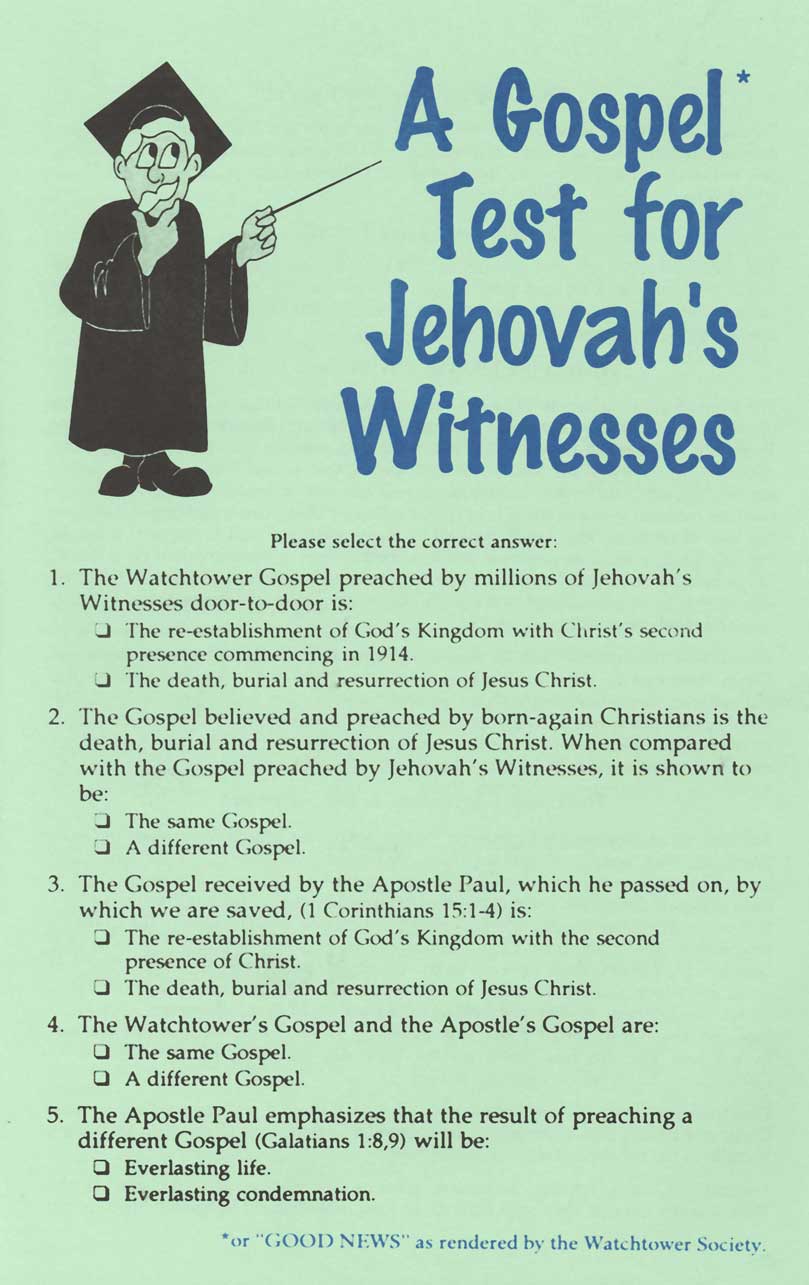
The following five questions for Jehovah’s Witnesses, from a tract sold by Personal Freedom Outreach, is a perfect companion to Paul Washer’s witnessing technique to Jehovah’s Witnesses (found here).
“Over the past few months, I have written several articles dealing with the coming cashless society and the developing technological control grid. I also have written about the surge of government attempts to gain access to and force the use of biometric data for the purposes of identification, tracking, tracing, and surveillance. Unfortunately, the reactions I receive from the general public are almost always the same. While some recognize the danger, most simply deny that governments have the capability or even the desire to create a system in which the population is constantly monitored by virtue of their most private and even biological information. Others, either gripped by apathy or ignorance, cannot believe that the gadgets given to them from the massive tech corporations are designed for anything other than their entertainment and enjoyment.”
“And he causes all, the small and the great, and the rich and the poor, and the free men and the slaves, to be given a mark on their right hand or on their forehead, and he provides that no one will be able to buy or to sell, except the one who has the mark, either the name of the beast or the number of his name. Here is wisdom. Let him who has understanding calculate the number of the beast, for the number is that of a man; and his number is six hundred and sixty-six.”
Christian apologist Walter Martin takes on Mormon apologist Van Hale in a debate entitled Is Mormonism Christian? It is another fine job by Walter Martin in defending the faith from those who would seek to pervert it.
Years after this debate, Van Hale publicly announced (in 2005) that he cannot accept the Book of Mormon as real history about real people (see here). I’m not sure if his debate with Dr. Martin helped bring him to that point, but it is an interesting piece of history.
You can download all three parts of this debate here:
I often hear the lament from anti-theists about Christian hypocrisy as the impetus behind their rejection of God, but rarely is atheist hypocrisy ever mentioned. So let’s look at two glaring hypocrisies of atheism, part one today, and part two coming soon.
________________________________
I recall a time a few years ago when I posted a gospel tract on the community bulletin board of a local coffee shop.
Shortly thereafter, as I sat sipping my hot beverage, a woman in her thirties entered the shop and made her way over to the bulletin board. Upon seeing the tract, she quickly removed it and promptly found a table where she sat and thumbed through the little booklet. Her behavior led me to speculate that she was familiar with what she held in her hands, and I watched from a distance.
Then this woman took out a pen and began to write on the tract (both the front and rear covers). This greatly piqued my interest of course, and I continued to observe.
A short while later another woman entered the establishment and approached the table where the first woman sat. The second woman greeted the first and the first woman gleefully showed the second woman the cover of the tract. The second woman gave a smirk while the first had a grin ear to ear. She then promptly returned the tract to the bulletin board.
My party and I left at the same time as the two women did but my curiosity got the best of me so I returned to the bulletin board inside the business and retrieved the tract. And there I read what the woman in all her giddy-like-a-school-girl excitement had written on the tract.
On the front:
“There is no God!”
On the back:
“Shame on God!”
There you have it . . . classic anti-theist hypocrisy: “Shame on the very thing I believe doesn’t exist.”
How can someone say on one hand, “There is no God!” then on the other hand say, “Shame on God!”? That is either blatant hypocrisy or a mild case of schizophrenia.
You can’t claim that someone or something doesn’t exist, then offer an opinion on that someone or something. Let me offer an example.
If I said that the Loch Ness Monster does not exist, but then warned you that you should be careful while swimming in Loch Ness because the Monster might get you, would you not be justified in questioning the truthfulness of my original claim that Nessie doesn’t exist?
So I came to the realization that most self-proclaimed atheists aren’t atheists because they disbelieve the existence of God, but it’s simply because they hate Him. They don’t want to be limited or prohibited in their lifestyle choices, nor be confronted with their sin, so they self-inflict a seared conscience upon themselves.
I would prefer if these professing atheists would be upfront and honest about their beliefs and come to terms with the fact that they simply hate God and His laws, instead of hiding behind a pretentious facade of pseudo-intellectualism in their declaration that the very thing they hate does not exist.
A little honesty and candor is all I’m seeking. Is that too much to ask for?
Your sermon of the week is an old-fashioned, southern-style preaching experience by R.G. Lee (1886-1978) entitled, Payday Someday.
I can’t think of a better way to begin 2012 than with this powerful sermon given many years ago,the likes of which are hard to find nowadays coming from pulpits across America.
As a side note, the day that DefCon posts its sermons of the week will change this week. Our sermons of the week will no longer post on Thursday mornings but will now post on Sunday mornings beginning this Sunday, January 1st.
Does any Christian reader imagine for a moment that when he or she shall stand before their holy Lord, that they will regret having lived “too strictly” on earth? Is there the slightest danger of His reproving any of His own because they were “too extreme” in “abstaining from fleshly lusts, which war against the soul” (1 Peter 2:11)? We may gain the good will and good works of worldly religionists today, by our compromising on “little points,” but shall we receive His smile and approval on that day? Oh to be more concerned about what He thinks, and less concerned about what perishing mortals think.
God does not exist; belief in God results from superstition
Pantheism: God is impersonal; is above good and evil; everything is God
God is the triune, eternal, personal, almighty, sovereign, all-knowing, loving, just and holy Creator
Metaphysics
The natural order is eternal, self-sufficient and uncreated. It is ultimately matter/energy
The world is divine
The world was created by God
Epistemology
Human sense experience; the scientific method
Truth lies within every human; it is attained through states and mystical consciousness
Truth has objective standing; it is independent of human desire; functional view of truth is false. Humans can know because God created them as rational creatures
Ethics
Ethics is relative
Ethics is relative
Ethics is not relative. The moral law grounded in the being of God
Humans
Humans are highly evolved animals
Humans are spiritual beings who are gods
Humans are creatures made in the image of God
Basic Human Problems
Superstition and ignorance
Ignorance of our true human potential
Sinners in rebellion against God
Solution to the Human Problem
Scientific advancement and technology
Transformation of consciousness
Salvation by faith in the finished work of Christ
Death
The end of human existence
An illusion; the entrance to the next life
The end of our earthly life; eternal life for the believer and eternal wrath for the unbeliever
Jesus Christ
A merely human teacher
One of many gurus or master teachers from history
The unique incarnation of God; the only Lord and Savior
Taken from Worldviews in Conflict by Ronald H., Nash, pages 139 & 140; slightly modified.
As a follow-up to yesterday’s post (found here), and as a testament to the legacy of Joseph Smith (who was born 206 years ago today), I wanted to direct your attention to the resignation letter of former LDS stake bishop, Steve Bloor.
Here is an excerpt:
“I didn’t realise for instance that Joseph Smith practised polygamy, and was married to 33 women, most under the age of 20, one as young as 14. That some of Joseph’s wives were already married to other men when he married them; a practice called polyandry. All of these facts can be confirmed by a simple look at the church’s own website, familysearch.org. . . . There are many other issues, like; there are several accounts of the First Vision and Joseph Smith’s initial personal journal entry about the First Vision didn’t include seeing God the Father and Jesus Christ, but an angel. Then over the years the story got embellished till it changed to what we have today. Yet I was told it was the most momentous event to occur in this dispensation. Why didn’t Joseph initially record it correctly? And there are so many other things that have just dissolved my faith to the point I can no longer bear a testimony of the truthfulness of this church or even God. Can you imagine how I now feel? It’s like my whole world is crumbling around me. I no longer know what I believe, or who I can trust. I don’t even know who I am, it is a most frightening experience. At the moment it feels like a death in the family. My death!”
The Puritan/Presbyterian wing of the Reformation accomplished a purity in worship not seen since the apostolic church. This purity was attained by making the Scriptures of the Old and New Testaments the only infallible standard and authority in determining worship ordinances. Any ordinances solely based on church tradition or man’s authority were discarded. However, this purity attained by our spiritual forefathers has, with the passage of time, been cast aside. Pragmatism, tradition and human opinion are exalted in determining how God’s people are to worship Him. The attitude among many in church leadership positions is to give the people what they want, rather than to submit to God’s divine revelation. . . . . God has set down in Scripture how He is to be worshiped. Man is not to add to or detract from what God says. . . . .
Steve Bloor penned a letter to his congregation after resigning from his position as Bishop in his LDS stake.
What he did took much courage and I commend him for not only being willing to investigate his organization’s history, but also for acting upon what he discovered and not putting the problems of Mormonism on the proverbial Mormon shelf.
Here’s an excerpt from his letter:
I realise this will shock you. It has truly shocked me how quickly a testimony of the Church can unravel when Joseph Smith’s divine calling as God’s prophet is undermined by learning the truth about him.
I have come to believe over the last month that there are so many inconsistencies and problems with the historicity of the Book of Mormon, as well as the divinity of Joseph Smith’s calling as prophet, that I can no longer, in good faith, fulfill my calling as Bishop of Helston Ward.
It has been awhile (too long) since DefCon last featured Don Green, but now we break that drought with today’s sermon of the week, How to Recognize True Repentance.
Here is an excerpt from this sermon:
“I fear that the strong opposition that you see in the Christian church sometimes to the opposition of society’s sins comes at the expense of real personal concern about our own sins, and that needs to be said. Jesus isn’t calling you to mourn over someone else’s sin, He’s calling you to mourn over your sin.”
I have really benefited from Don Green’s teaching over the years and am happy to feature him again.
Something for you to consider (and discuss) from the article, Multi-Site Churches Are from the Devil:
“. . . I think the kind of multi-site churches (realizing there are a few different approaches) that feature one pastor being beamed into several sites around a region—and in some cases around the country or world—is simply idolatry. It’s certainly cult of personality multiplied and digitized for a consumer audience. As a brilliant young man remarked to me this morning, ‘The pastor now becomes the new icon in the midst of the Protestant worship service.’ I think that’s well said. Video multi-site tends to idolatry, pride, and self-promotion—even where the ambition of spreading the gospel is genuine.”
Read the entire article from Thabiti Anyabwilehere.
. . . [W]e must restore to the family the responsibility of ministering to youth. In many churches–but by no means all–the purpose of the youth group is founded on premises that are an impediment to the training of godly children. Some of these false premises are: 1) That young people need a place where their problems are understood–where others of the same age share the same struggles; 2) that as it is often difficult for parents to communicate with and understand their teenagers, a youth leader who can identify with the young people is needed; 3) that it is important for young people to have fun and to see that “church people” have fun too; 4) that a youth group is needed to reach unsaved youth, and by getting them involved in fun activities, they will be more receptive to the presentation of the gospel.
Following the trends of secular culture, age-segregated groups have been established in church educational programs. Christopher Schlect, in his book Critique of Modern Youth Ministry, explains that the “divisions breed immaturity because they hinder younger people from associating with and learning from their elders.” The group can become the source of authority, thus diminishing the authority of the father and mother.
– William & Colleen Dedrick
From: The Little Book of Christian Character & Manners
I recently finished reading an intriguing story by ALOE (A Lady Of England) to my children entitled, The Giant Killer (1856).
This allegorical tale (told in a fashion similar to Bunyan’s Pilgrim’s Progress) is about a noble knight named Fides who battles giant sins such as Giant Untruth, Giant Hate, and Giant Pride. Reading this to my children gave us much to talk about and helped them understand the battles with sin that we all face.
The battle continues to rage, day by day and moment by moment. But must we meet the enemy blindfolded? In order to subdue, we must see the real foe; in order to conquer, we must face the true enemy. Through this allegorical tale, we will be better equipped to recognize, then to effectively slay, the many Giants who confront us. We will break through the web of Sloth, struggle out of the pit of Selfishness, choke up the fount of Anger, flee the secret lurking-place of Untruth, and triumph over our most malicious enemy—Pride. The Giant Killer is the tool to reach for if you or your loved ones need encouragement or confidence to enter into the battlefield once again. If you feel that you have nothing firm upon which to lay hold, this book will help you to grasp the strong cord of Love as your means of safety and deliverance.
And here is a reader’s review:
Another wonderful book from Lamplighter Publishing, The Giant Killer is an allegorical story of Christian warfare. Constantine and Adolphus, twin brothers, are sent to live with the Roby family to have Mr. Roby educate them. The spoiled 10-year-olds have much to learn about kindness, thankfulness, and manners. Mrs. Roby teaches these children and her own about godly character traits through stories about “The Giant Killer.” The Giant Killer must fight and conquer the Giants of Sloth, Selfishness, Untruth, Hate and Pride with the sword and armor given to him by his King. Your children will learn as these fictional children did to fight the enemies of the King that are in their own hearts.
Although this is not the best Lamplighter book I’ve ever read (The Basket of Flowers still holds the position of number one for me), it is still a good book that I recommend, and espeically for Christian parents to read to their children.

 After Hitler was defeated, war crime trials were held in Nuremberg to judge the guilt of Hitler’s henchmen. But a dispute arose as to what laws should be used to try the accused, after all, Hitler’s cronies argued, quite plausibly, that they had not broken any laws; their actions were carried out within the protection of their own legal system. They could not be accused of murder because personhood had been redefined to exclude Jews and other undesirables. These men were simply following the laws handed down by the courts of their day. As Eichmann protested before his execution, “I was simply following the laws of war and my flag!” . . . Moral relativists who believe that laws are nothing more than the result of social conditioning, subject to the whim of leaders and nations, would have to agree with Goering, Hitler’s designated successor, when at Nuremberg he insisted, “This court has no jurisdiction over me, I am a German!” By what laws then, should the Nazis be tried? And what would [be] the basis of such laws? . . . If all laws are relative, and each country has its own idea of what laws they should enact, there is no universal standard by which laws can be judged. . . . Several years ago a group of pro-life protesters who picketed an abortion clinic were sued for slander for calling abortionists murderers. The abortionists argued, just as Hitler’s emissaries had done, that they could not be murderers because they were not breaking any laws! The experience of Nuremberg and the silent holocaust in our abortion clinics bear eloquent witness to the fact that when a state is accountable to no one except itself, it simply assumes whatever is legal is moral. The law is simply whatever the courts or a dictator say it is. Show me your laws and I will show you your God.




 Christ Alone Wyoming