The Pastor – Chapter 7, The All-Body Ministry

What is meant by “the priesthood of believers?” Does the Bible show “the pastor” as being the ruler of all that goes on within the local church? SolaHere’s a note from the author on this chapter:

As we have seen, church rule and care has been ruined, twisted into a monstrosity. In tandem – the one feeding off the other – the priesthood of all believers has been allowed to dwindle into practical neglect, so that it has become the poor relation of the Christian religion, rarely discussed, let alone thought about, least of all acted upon. And for those who do have some concept of it, too frequently they think of it as an individual thing, a personal thing – I can go directly to God for my self. A wonderful truth, of course, but one that fails to exhaust the breadth and depth of meaning of this priesthood.

Chapter 7 is here.

Chapter 6 was posted here.

The Pastor – Chapter 6, The Use of Titles

How men love titles! Does your “pastor” like to be called “doctor” or even “pastor”? Are such titles biblical for the gathered people of God? The Solaauthor gives this peek into today’s message:

Now to grasp another nettle. Titles. The New Testament never uses any title for any man in the church. What is more, it categorically forbids it. Nowadays, however, most Christians do use titles – or one in particular – and do so without turning a hair, even though it contradicts Christ’s plain command. Complaining of the scribes and Pharisees who loved ‘to be greeted in the marketplaces and to have men call them “Rabbi”’, Christ said: But you are not to be called ‘Rabbi’, for you have only one Master and you are all brothers. And do not call any one on earth ‘father’, for you have one Father, and he is in heaven. Nor are you to be called ‘teacher’, for you have one Teacher, the Christ. The greatest among you will be your servant. For whoever exalts himself will be humbled, and whoever humbles himself will be exalted (Matt. 23:1-12). But you, do not be called ‘Rabbi’; for one is your Teacher, the Christ, and you are all brethren. Do not call any one on earth your father… And do not be called teachers… But he who is greatest among you shall be your servant. And whoever exalts himself will be humbled, and he who humbles himself will be exalted (NKJV).

Chapter 6 can be found here.

Chapter 5 is here.

Give me four years to teach the children…

Vladimir Lenin infamously declared, “Give me four years to teach the children and the seed I have sown will never be uprooted.” The national indoctrinationgovernment of this country, formerly known as these United States of America, wants our children from age 5 – 18, 22 if they can get it. Do we think this education is morally neutral? Or is there a system within and of the world that works iniquity and never sleeps?

Colin Gunn has published a movie that aims to educate Americans about the dangers of government education. Parents are not to be condemned but educated about this arena. To that end, Gunn offers this movie for free viewing from 22 – 31 December.

Here’s a note from Colin:

This season, as people spend time at home together, we hope that families will take the time to watch and share our movie with loved ones, especially those that need to hear the truth about the American public school system and decide whether they should continue using them.

Even in the last few years we have seen a dramatic decline in the school system making our message all the more urgent. We’ve recently seen astonishing moves by the educational establishment, with the Department of Education’s full-on support of the Supreme Court ruling on homosexual marriage, and in recent months, a significant campaign to normalize transgender lifestyles to our youth. The public schools have gone from bad to worse, and there are no excuses left.

Now is the time to act.Please take the time to share our message through your emails and social networks. Go here: www.watchindoctrination.com/free

I pray you take the time to watch the movie. Don’t allow the prince of the air to rule your children. Be informed and prepared.

The Pastor – Chapter 5, Four NT Words Misused

Note from the author:  Sola

I closed the previous chapter by saying that the widespread corruption of the New Testament system of church care and government has come about, in part at least, because believers have taken four New Testament words and changed – warped – their meaning. The words in question are pastor, minister, clergy and ordain. I realise several other words have been contaminated beyond recognition – ‘bishop’ among them – but I am trying to get to the root of the problem as it exists among Reformed and evangelical churches – dissenters in the main; in other words, nonepiscopalians. ‘Bishop’ does not seem to be a problem in such churches. But ‘pastor’, ‘minister’, ‘clergy ’ and ‘ordain’ are.

Chapter 5 is found here: http://www.sermonaudio.com/sermoninfo.asp?SID=11614140241

Chapter 4 is here: http://defendingcontending.com/2015/12/06/the-pastor-chapter-4-attempted-recovery/

The Pastor – Chapter 4, Attempted Recovery

From the author:

We take up the story at the start of the 16th century with Martin Luther. But before we do, let us remember that protest against the mutilation of Christ’s church was not unknown during the dark ages. Men and, no doubt, women – men like Claude of Turin (died 827), Tanchelm (died 1115), Peter of Bruy s (flourished c1117- c1131), Henry of Lausanne (flourished c1116-1148), Arnold of Brescia (1110-1155), John Tauler (c1300-1361), John Wycliffe (c1328-1384), John Hus(c1369-1415), the Lollards and their like, should never be forgotten.

They all made their protest against Rome, and in one way or another called for a return to the New Testament. I am not pretending that they had full gospel light. But, in their various way s, they all prepared the ground for the approaching Reformation.

This chapter is here: http://www.sermonaudio.com/sermoninfo.asp?SID=116141234374

Chapter 3 is here: http://defendingcontending.com/2015/11/27/the-pastor-chapter-3-the-system-corrupted/

The Dangers of Drifting

A review by Stuart Brogden   Evangelicals-Adrift-94x150

We must, therefore, pay even more attention to what we have heard, so that we will not drift away. – Hebrews 2:1 (HCSB)

Matthew E. Ferris’ book, Evangelicals Adrift – Supplanting Scripture with Sacramentalism, is a fairly comprehensive examination of the differences between biblical Christianity and that which is based on sacramental rituals. He also provides examples of people who have crossed the Tiber River from both sides. For the evangelical who drifts into sacramentalism, the dangers are pointed out with the concern of one manning a lighthouse in treacherous waters, where sailing vessels are bound to be broken on the rocks if they drift away from the narrow channel.

In ten concise chapters, our author covers the theological crises in evangelicalism, the nature and authority of the church and Scripture, and the various departures from biblical truth posed by sacramentalism. In the first chapter, Ferris tells us, “My task is to the show that the definition of the bride of Christ put forth by sacramentalism is an erroneous one, and that Scripture is the only sure guide for the way forward in the Christian life. … I am not writing as “anti-Catholic” or “anti-Orthodox”, but rather as pro-Scripture.” (page 25) This is an important point that evangelicals need to keep in mind, as it is far too easy to drift into being against error instead of in favor of truth; and our mission is to be ambassadors of reconciliation (2 Cor 5:20).

In his discussion about the nature of the church, Ferris contrasts the Apostles’ teaching found in God’s Word with the progressively developed extra-biblical traditions of the sacramental church, concluding, “The final arbiter for sacramentalism returns once more, not to the Scriptures, but to the church.” (page 35), giving us quotes from Roman Catholics that explicitly confirm this. He then asks, “in what sense can the Church be apostolic if it runs counter to the model the apostles themselves left us?” (page 37) Ferris supports the plurality and equality of elders and the priesthood of all believers in the local church, pointing out the word “clergy” is applied in Scripture to the entire church, not only the elders (page 42). Anticipating the claim that there is unanimity amongst the Church Fathers, our author provides a few quotes to show they had as much variation on issues as do any group of Christians, observing that anyone who wants a clean and supporting historical record to support their view must pick and choose which bits of history to rest on, ignoring those which do not line up with their case. “The Church is the pillar and ground of the truth only in that she upholds and defends it; she does not originate truth.” (page 74)

One way that Christians fail to stay on the narrow road is to neglect church history and conclude that their traditions are biblical. Ferris bemoans the fact that many research or know church history only as far back as the Reformation (page 84), leaving them adrift in the historical influences left unexamined. In commenting on how tradition overshadows Scripture in sacramental churches, he sums up a good quote from Oscar Cullman by saying, “there is no need for a canon at all if the ultimate arbiter of truth is the Church and its magisterium.” (page 86) “Roman Catholic doctrine claims to affirm the inspiration of Scripture and that the Bible is authored by God, yet in practice it severely undermines both of these positions.” (page 102) The Roman Catholic Church demands its dogma be accepted as authoritative, while denying the self-attestation of Scripture. Rather than holding to a proper understanding of Sola Scriptura, the Roman Catholic Church is shown to truly hold to sola ecclesia (page 103). This is compounded by the long-standing position of Rome that only its select clergy can interpret the Scripture, which undermines the authority of the Bible. If the Bible is God’s Word to His people, all of whom are indwelt by His Spirit, does it make sense that only a small number of people selected by a small number of religious leaders would be able to rightly comprehend the essentials of the Christian faith? History records that these select leaders, charged with interpreting the Scriptures for the common folk often disagreed with one another and many changed their minds on topics over time. Heretics and false sons have been in the temporal church since the apostolic era and it flies in the face of history, human nature, and the Bible for Rome to claim immunity from the frailties that each son of Adam faces.

Ferris also discusses how the various sacraments within many churches claim to impart grace, robbing the gift YHWH gives of its meaning. Baptism is one of these, with infant “baptism” having its basis in the false belief that it is needed for salvation. “Sacramentalism practices infant baptism as both an entrance into the new covenant with God and as that which cleanses from sin.” (page 160). If this were true, why was the Apostle Paul’s priority on gospel proclamation (1 Cor 1:14 – 17 & 9:22)? Further, he asks, “If baptism is indeed effective in imparting new life, in washing away sin, in putting one into the church, how is it that so many people who have undergone infant baptism manifest no signs of divine life whatsoever?” (page 166)

Chapters 7 and 8 are excellent reviews of the unbiblical view that sacraments convey grace and that mystical doctrine of Mary worship and veneration. Chapter 9 explores the spurious notion that there is theological and doctrinal unity within the Roman Catholic Church – pointing out there is as much variety within that religion as they claim there is amongst evangelicals.

The final chapter asks, “To Whom Shall We Go?” – and points out that “By insisting on the mediation of the Church in every aspect of the believer’s interaction with God, sacramentalism replaces the role of the Holy Spirit in the life of a Christian.” (page 223) Ferris gives the reader an excellent, concise review of the difference between the Roman view of infused grace and the biblical view of imputed grace as the means of saving sinners. The catechism of the Roman Catholic Church declares that the sacraments are necessary for salvation. Our author observes, “There is no experience of God, no conversion, and indeed no final salvation apart from engaging in the ritual acts defined by the Church. This is diametrically opposed to justification by faith in Christ alone. It is the system, rather than the Savior that assumes the importance in sacramentalism.” (page 225) In light of these dangers that we can drift into, to whom shall we go? As Peter rightly understood, we must flee to Christ Jesus – He has the words of eternal life (John 6:68). And so our faithful author points us to the Word Himself. “Every problem, every shortcoming, every doctrinal aberration with evangelicalism, and indeed with any branch of the church, is solved only by an intentional and sustained engagement with scripture. … Embracing sacramentalism will only lead believers further away from the truth that a relationship, not a ritual, is the scripturally ordained way of growth in Christ. Those who drift away can only regain their moorings by once again submitting to the Bible for everything in their Christian live.” (pages 228 & 229)

This book is a most excellent encouragement to the saints of God and, I pray, a wakeup call to those who are drifting into dangerous waters in the Tiber River. To God alone be the glory and honor and dominion and power – now and forever!

The Pastor – Chapter 3; The System Corrupted

A note from the author:

Sadly, after the death of the apostles, the church began to leave Christ’s revealed will Solaby inventing for itself a system of church care. Take that word ‘hierarchy ’, which we have already met, and which will come up again and again. There is, of course, a New Testament hierarchy in the churches of Christ. Within clearly defined limits, as long as the apostles were alive, they were over the entire people of God, over all the churches of Christ, with elders, overseers, bishops, leaders (as I have explained, the names are virtually synonymous), rulers over local churches.

Paul, writing to believers, spoke clearly about those ‘who are over you in the Lord’ (1 Thess. 5:12; see also Heb. 13:17). So there is, in this sense, a New Testament hierarchy. But in this chapter I am going to look at the Fathers’ corruption of the New Testament pattern, and one of the cardinal marks of their defection was the introduction of an unbiblical hierarchy, a worldly hierarchy. This was, and remains, abhorrent in the churches of Christ. So, when the word ‘hierarchy ’ appears in the rest of this book, the context must decide whether or not we are talking about its proper New Testament use, or the deformed – abominable – idea which has done so much harm to the church of Christ these past two millennia.

Chapter 3 is here: http://www.sermonaudio.com/sermoninfo.asp?SID=116141043204

Chapter 2 is found here: http://defendingcontending.com/2015/11/19/the-pastor-chapter-2/

The Trouble with Trivial Faith

A review by Stuart Brogden     Tinker


The title of Melvin Tinker’s book is designed to catch your attention: A Lost GOD in a LOST WORLD, subtitled From deception to deliverance; a plea for authentic Christianity. That lengthy title conveys the idea that something is terribly wrong and change is desperately needed. If we survey the current offering from professing Christians, we cannot but agree that something is not right. While not addressing everything one might want changed, Tinker’s book is a welcome work that should cause every child of God to examine his own church and life, seeking to be biblical and honorable in the sight of YHWH. Tinker says, “The modest aim of this book is to present those key truths about the lostless of man, the greatness of God and the glory of the future which will correct much wrong thinking and behavior within the church and so enable the church to effectively confront the world by holding out the Gospel.” (page 22) He explores these issues in good measure over nine very readable chapters.

In this short book our author examines the weightlessness of God in our culture and what happens when people turn to idols. In these first two chapters Tinker observes “the West is made up of believers alright, but not Christian believers. It is composed of what the Bible calls idolaters” (page 26), further noting idolatry as “the besetting sin of the human race” (page 27). He describes what he means by God being lost: “Not that God has been lost as when we misplace a set of keys, but rather that the truth about the real God is disappearing fast.” (page29) When professing Christians take God for granted, being thoughtless in how He is worshiped (is celebrating birthdays and wedding anniversaries worshipful?), with shallow prayers (are physical healing and income our most pressing needs?), and absent from our daily conversations He has lost weight in our lives. And something has filled that space, weighing heavily on our minds and our prayers. That something, no matter what it is or where it came from, is an idol. Two short paragraphs sum up the cause and danger of this condition (pages 51 & 52):

The predominate view abroad is that with the right knowledge, the right resources, and the right will, crime on our streets will be reduced, terrorists will be hunted down and brought to account, poverty will be abolished and our environment made safe.

Undoubtedly as human beings we have achieved so much. But herein lies the danger, namely, that of being seduced into thinking that it is by our achievements that we measure our self-worth and thus bolster our self-confidence.

It is the myth of self-achievement, self-sufficiency, and self-aggrandizement. The trap is that such thinking invariably excludes God because our focus is on self.

Do you find these thoughts dominating your mind? Christian – examine yourself to see if you be in the faith! “We cannot really understand why the world is in such a mess, together with the mess of our individual lives, unless we see it as part of the bigger and much more tragic picture of humankind’s devastating fall away from its Maker.” (page 61)

From examining the train-wreck of our natural condition, our author takes the rest of this short book explaining the necessity of various aspects of biblical Christianity (‘tis a pity one needs to use that adjective, but there are so many professing Christian who are not biblical) and how they impact our lives. Chapter 3 addresses The need for the grandeur of God, based on Isaiah 40:1 – 31. Christians know God, but often we hang around the milk cooler rather than spend time and effort at the grill for juicy meats (Hebrews 5:11 – 14). “The highest science, the mightiest philosophy, which can ever engage the attention of a child of God, is the name, nature, the person, the work, the doings, and the existence of the great God whom he calls his Father.” (page 65) “And it is the smallness of man set against the grandeur of God which makes God’s tender kindness towards us all the more remarkable and moving.” (page 81) Chapter 4 brings us to The necessity of the Cross, based on Philippians 2:5 – 11. In becoming a man, creator God revealed part of His character; “this God, the true God, chooses not to exploit his divinity, but to display it differently … he exercise a different divine right – the right to be humble, the right to change his form whilst not ceasing to be God.” (page 86) Augustine wrote of this wonder:

He emptied himself, taking the form of a servant, not losing the form of God. The form of a servant was added; the form of God did not pass away. He lies in a manger, but contains the world. He feeds at the breast, but also feeds the angels. He is wrapped in swaddling clothes, but vests us with immortality. He found no place in the inn, but made for Himself a temple in the hearts of believers. In order that weakness might become strong, strength become weak. (page 90)

The mystery of God in Christ – who gave Himself to save sinners. How can a mere mortal truly comprehend this? The cross, an inhumane tool for the torture of humans, stands as the narrow gate to the path that leads to eternal life. Contrary to men pleasers who care not for the Gospel, we who have been bought with the blood of Christ must line up with Paul, whose “primary concern is not with the niceties of literature (or fancy words, my addition) but with the wonder of the Gospel.” (page 91) One of the wonders that Philippians presses on us is the truth that the eternal and divine Son of God put on flesh and became a human. He kept this form of a human (one of His created beings) after His resurrection, forever identifying with those ransomed sinners. Tinker tells us, “it would be a mistake to so emphasize the divinity of Jesus at this point that we neglect his humanity. In ascending back to the Father he did not shed his human flash as a butterfly might shed its chrysalis. The person of the Son of God is forever united to our human nature.” (page 98) Our high priest intercedes for us in this age, the God-man who reconciled sinful men to holy God. Jesus will walk among us in the age to come, His body then perfected as the eternal temple in which He is pleased to dwell. Brothers and sister – do you wonder at Christ? Is He not marvelous beyond words?

Buy the book and read about the work of the Holy Spirit, the necessity of the Gospel, the need for effective grace, the necessity of the second coming, and the need to be heavenly minded. It’s less than 200 pages and, aside from unqualified quotes from some questionable men, a solid work that will cause the child of God to humble himself before his Savior and King. And that’s about all we can expect from a book – a reminder of who YHWH is and who we are.

“The Pastor” – an audio book

From the author:      Sola

In this book, I draw attention to an aspect of church life which, I admit, at first glance seems small. Many would say I am try ing to ‘strain out a gnat’ (Matt. 23:24). I disagree. Appearances can be deceiving. ‘A great work’, as Andrew Fuller rightly said, ‘may be hindered and stopped by little things. Little follies will spoil the whole (Eccles. 10:1)’

If we are honest, all of us would have to admit we believe and practice things in our churches that cannot be found commanded or recommended to us in the Word of God. This book aims to provoke us Christians to consider myriad issues and see if they be of man or God.

There are 8 chapters in this book – I will post one per week. I highly encourage those who name Christ to listen with an eager mind to be drawn closer to YHWH. Have your Bible at the ready.

The first chapter can be found here: http://www.sermonaudio.com/sermoninfo.asp?SID=11514104433

Titus – a Fresh Look at an Old Letter

A review by Stuart Brogden

Aldred Genade has written a very thought provoking guide to Titus (The Letter To Titus: TitusBecoming a Persuasive Leader and Preacher), with the aim of showing how the Apostle intended Christian leaders to be persuasive. Which preacher does not want to be persuasive? The first chapter provides us a review of the various ways pastoral epistles and Titus in particular have been addressed by theologians and gives us this author’s thesis: “This book is an attempt to advance the dialogue concerning the macrostructural coherence of Titus in a meaningful way. The instrument that will be employed toward this end is a modified rhetorical critical method.” 1 He explains that rhetorical reading entails seeking to truly understand the meaning intended by the author by exploring the bits of the letter and the letter as a whole. This intentional endeavor to grab hold of the author’s intended meaning is a wonderful alternative to the inherent post-modernist view so pervasive and unexamined in our world.

In discussing the salutation found in Titus, Genade observes it is meant “to emphasize the divine basis of legitimate ministry.” 2 (emphasis in original) We see in several places in his letters how Paul emphasized his appointment as Christ’s Apostle as a means of impressing on Christians the truth of his message (Romans 1:1; 1 Corinthians 1:1; 2 Corinthians 1:1; Galatians 1:1; Ephesians 1:1; Colossians 1:1; 1 Timothy 1:1; and 2 Timothy 1:1). I think this is an example of being unashamed of the calling; something we could all learn from. Staking our identity in Christ (not as an Apostle, but as an ambassador of the gospel – 2 Corinthians 5:20) is the proper way for every one of us to establish authority; not our own, which every man can claim, but that which comes from the Creator and Judge of all people. This is the basis of Paul’s authority and that’s what makes his – and ours – legitimate ministry. False teachers and false converts have no such solid foundation (Matthew 7:24 – 27). Our author points out the focus of Paul’s ministry (and, by extension, that of the local church) is with the elect of God: Titus, his true son in the faith in Christ they have in common. As we will see later in this book, much of Paul’s message to Titus is meant for the entire church located in Crete.

So as not write a book about this book, I will highlight a few points that I think will serve the reader best. Genade’s book is heavily end-noted; this is good news as a careful writer will always let his readers know his sources. He also uses Greek words “in the open” as part of his dialogue with the reader. If you are like me, ignorant of Greek, the letters and words will make no sense; but the paragraphs in which these appear give us excellent context and explanation so as not to left in the dark. Our author also provides a brief summary and some excellent questions at the end of each chapter. If you have ever tried to formulate questions that require some thought and more than a one-word answer, you will recognize hard work here; and it pays off for those who pay attention.

Each of the twelve chapters covers a different aspect of persuasion, as Genade works through the epistle. Chapter 4 is Persuade by Exposing the Opposition, 5 is by Affirming the ministry of Others. Chapter 7 is Knowing Why You Obey, and is where we will dig in a bit before I sum up. In the previous chapter the lesson was on right behavior, based on Titus 2:5 & 10. This brings us to chapter 7 (Titus 2:11 – 15) and the importance of knowing why we obey. To do good one must have the right goal, the right method, and the right motive. Saints want to do good and we know obedience is better than sacrifice, so know our motives is critical! Genade claims, “Paul is now arguing that God is the one teaching the doctrine, making the doctrine and the behavior inseparable. The teaching as well as the Teacher are transcendent and must therefore be obeyed because they are not of human origin. This line of reasoning stresses the obligatory nature of sound doctrine upon the minds of the Cretans. In other words, sound doctrine must be obeyed because it is the exact opposite of “the commandments of men” (1: 14). Not to obey the doctrine and therefore not to manifest these particular behavioral characteristics is tantamount to disobedience to God.”3 The Christian who cares not about obeying God is testing God: a double bad place to be.

We are further instructed, “Obedience to the instruction becomes obedience to “someone,” rather than something. This is a very persuasive angle. Grace offers the complete opposite of what the false teachers have to offer. By formulating the proposition in this way, the appeal of sound doctrine is highlighted, making the argument for compliance to it even more persuasive. Furthermore, the personification of grace reinforces the notion of accountability.”4 This builds on the same foundation as noted in the opening chapter – Christ Jesus is our righteousness and if one has been made a new creature (2 Corinthians 5:17), he will be humbled to be so clothed, knowing how filthy his own righteousness is apart from Christ (Isaiah 64:6) and this makes each of us who have been born again willing and able to obey our Lord. Again, the false teachers have no foundation and the false convert has no clothes (Matthew 22:11 – 14). As our author tells us a bit later,

They have become in Jesus Christ the objects of divine interest, when he gave himself for them (ὃς ἔδωκεν ἐαυτὸν ὑπὲρ ἡμῶν). The inclusive language in this part is also emphatic. They are no longer mere Cretans, but the people of God— God’s own peculiar people (ἑαυτῷ λαός περιούσιος). Their identity and consequently their natures have been changed. They have been made God’s own “unique people.” This expression reinforces the communal sense prevalent in this section. Thus, when Cretan believers perform good deeds, in other words, when they obey the instructions of divine grace, they are acting consistently with their new character.5

So it ought to be in each local church, this sense of unity in Christ and the desire to honor Him and encourage one another to do so. A church that does not embrace this “communal sense” nor recognize their identity as God’s “peculiar people” is adrift in humanism and the Lord Jesus bids them to return to their first love.

While this book is mostly academic in style and content, it is engaging and provocative, a book I intend to return to time and again when the Lord brings this epistle to mind. We need such books if we are to renew our minds and test what we believe to see if these things be so. For the child of God will seek to be aligned with Holy Writ, not content with the mere words of men. Our brother has written a book that will help us examine our thoughts and God’s Word, and submit the former to the latter.

Footnotes:

1 Genade, Aldred (2015-09-21). The Letter To Titus: Becoming a Persuasive Leader and Preacher (Rhetorical Bible Commentary Book 1) (Kindle Locations 126-128). Africa Scholars Press. Kindle Edition.

2 ibid; Kindle Locations 267-268

3 ibid; Kindle Locations 1057-1061

4 ibid; Kindle Locations 1106-1109

5 ibid; Kindle Locations 1205-1210

Christ and the Gospel

A review by Stuart Brogden. Book available on Amazon.

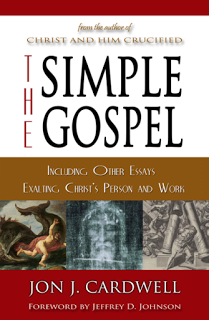
The subtitles of Jon Cardwell’s book must not be overlooked or you will be confused. The focus Screen Shot 2015-10-27 at 9.43.03 AMof this book is the proper understanding of the biblical gospel – that is the title: The Simple Gospel. What our brother rightly understands is that one cannot have a true understanding of the gospel if one does not have a true understanding of the person and work of the Lord Jesus. Without a biblical Jesus, faithfully fulfilling the requirements of the Law and the Prophets and taking our place in facing God the Father’s wrath for our sins (Him being without sin), we do not have the biblical gospel. The subtitle, Including Other Essays Exalting Christ’s Person and Work, gives us advance notice that we will spend some time reading about essentials that provide the foundation of the true gospel.

In this title chapter our author gives us his summary of what the Bible presents as the gospel:

The gospel of Jesus Christ is the revelation of God, according to the scriptures of the Old and New Testaments, which focuses on the Person and work of Jesus Christ in His incarnation, crucifixion, resurrection, ascension, and restitution of all things in His bodily return. 1

Note this: the gospel is about the redemptive work of Christ and our need of Him; the gospel is not the entire Bible, although all Scripture has this meta-plan as its ultimate purpose. A little later in this chapter, while reviewing the meaning and significance of the crucifixion, Jon pleads the sufficiency of Christ’s blood, saying, “The power of the purity of Christ’s blood is sufficient to cleanse the redeemed soul from every confessed sin he has committed after he has been saved by God’s grace (1 John 1: 7-10).” 2 While I agree with the intent, I think this idea would be better stated as “The power of the purity of Christ’s blood is sufficient to cleanse the redeemed soul from every sin he has committed or will commit, and is applied when he is saved by God’s grace (1 John 1: 7-10).” For we are commanded to confess our sins, all the sins of the redeemed are forgiven when he raised from spiritual death to new life, not just those committed after salvation and not only those confessed.

Still in this section, Jon brings to our mind the picture of Christ suffering God the Father’s wrath for our sins – a much more horrifying punishment than physical death on the cross, as painful and horrible as that is. If we don’t see Jesus being punished spiritually for the sins you and I committed, we are taking His sacrifice too lightly. This is closely tied to this statement: “The shame that comes to our souls in the light of the revelation of the offense our very lives bring to God, far exceeds the shame of Adam and Eve when their nakedness was revealed to them.”3 Far more powerful than our shortcomings in our foolhardy attempts to keep the law or earn God’s favor by our own strength, seeing the glory of God in Christ will undo us as it did Isaiah and the Apostle John and others who were privileged to see Him clearly. This is the power of the cross!

When he quickly reviews the resurrection’s part in the biblical gospel, our brother tells us two dear truths: “The resurrection of Christ is God’s open display to the entire creation of His seal and acceptance of Christ’s sacrifice.” 4 and “When we speak of the resurrection of Christ we also speak of God’s assurance of a resurrection to come. God promises to all whom He has saved in Christ will one day be resurrected from the dead. The importance of the resurrection is such that a denial of the bodily resurrection of Christ means a denial of the faith altogether (1 Corinthians 15:12-19).” 5 Let no one who claims Christ forget the import of the resurrection – if Christ be not raised from the dead, we are to be most pitied.

His last section on The Simply Gospel is about the restitution or restoration of all things. We cannot, Jon tells us, fully comprehend the recreation of heaven and earth and the Lord’s glorious return without understanding the biblical doctrine of hell. And, he goes on, we cannot rightly comprehend either the new earth or hell if we do not rightly comprehend God! “The same presence of God that is a consuming fire for the wicked dead, Christ’s presence is peace and comfort (2 Corinthians 1: 3), and fullness of joy with pleasures forever more at His right hand (Psalm 16: 11).” 6 This oft-repeated exhortation to see the Lord as He is in His glory and power is a welcome one that does the souls of the saints much good.

Chapter 2 – Propitiation through Faith is an enlightening walk through Romans 3:23 – 27. Our faithful author tells us, “Romans 1: 17 is the key to this epistle, Romans 3: 23-27 is most certainly the door the key unlocks.”7 and “It is through this door one must pass in order to enter life eternal. In one way, it may be here that the Lord’s cryptic words become especially insightful: “I am the door: by me if any man enter in, he shall be saved, and shall go in and out, and find pasture” (John 10: 9; cf. 10: 7). The door of this passage is that wicket gate Mr. Bunyan’s allegory refers. Jesus Christ is that door, that wicket gate, and His cross, His propitiation, is eternal treasure.”8 Such exegesis is welcomed in this day of shallow, superficial reading, as is this: “To sum it up, God’s righteousness was openly displayed and manifested in the… Person of Christ Presentation at the Cross Power of Christ’s resurrection Perfection in Christ’s ascension.”9 As the Apostle Peter told us (2 Peter 1:12), we need to be reminded of the essential things even though we already know them. Cardwell does well in this regard, as he desires to stir up the saints of God to dig into the Word and walk as those who have been raised from the dead. I do wish Jon had spent some time on exploring what Paul meant by the phrase, “the law of faith” in verse 27. I think it is tied to what he elsewhere calls “the law of Christ,” which (I believe) is defined by the Lord’s answer to the Pharisee in Matthew 22:37 – 40 (I highly recommend Charles Leiter’s excellent book, The Law of Christ).

Cardwell emphasizes the fact that the life of a person who has been raised from spiritual death will be evident: “the result of the saved life will be evidenced by, but not limited to these things: a growing resemblance to the life of Christ in sanctification (1 John 1: 7); repentance of sins as the illumination of His light reveals them (1 John 1: 8-10); a love for God’s Word (1 John 2: 3-5); abiding in the Holy Spirit-led life (1 John 2: 6); exhibiting a sacrificial love for fellow-believers (1 John 2: 9-11); a hatred for the things of this world and hatred for the lusts of the flesh because those things are at enmity with the Father (1 John 2: 13-17); and a love for and discernment of the truth (1 John 2: 20-21).” 10 Let no one go easily on with the lie that one can be saved yet unchanged.

I will only touch on the topics of the balance of the book, each chapter will challenge the reader to examine his belief in the Word and the meaning of specific passages and traditions as Cardwell examines the meaning of the sign of Jonah, the Shroud of Turin, traditions of men, and a few other topics.

The fifth chapter examines the Chief End of Man, and Jon does well to debunk the seeker sensitive madness Rick Warren is famous for, but he also takes the Westminster Shorter Catechism without question to answer the question. The problem with the catechism and its answer is the lack of defining the audience. About which man is it asking about the chief end – fallen man or redeemed man? In the context of the catechism, the very beginning, the catechism must be talking about man in general, not the redeemed. And because of this, their answer fails – because those who are bound for eternal torment do not have, as their chief aim “enjoying God.” Further, I find no support in Scripture that our benefit (the redeemed enjoying God forever) is our chief end. All of creation has as its chief end the glory of God. They should have put a period after the first phrase and worked out the latter portion in a later part of the catechism, making it clear enjoying God is a blessed benefit the redeemed will reap. Jon does point out that, to “enjoy God forever did not mean that man’s ultimate happiness comes as the result of what we receive from God. Following this thought toward its logical conclusion would ultimately suggest that God exists for man’s good pleasure and not the other way around.”11 Amen!

Christian – are you satisfied with your understanding of God’s Word and how it applies to you? I trust that is not the case. This short book is a good one to provoke any believer to dig deeper into the Scriptures, to pray for God’s wisdom, and examine some of those things we have been taught but never have thought about. Take and read!


Footnotes:

1 Cardwell, Jon J. (2014-11-15). The Simple Gospel – Including Other Essays Exalting Jesus Christ’s Person and Work: The Gospel Truth of Jesus Christ According to Scripture (The Biblical Gospel of Jesus Christ Book 2) (Kindle Locations 172-174). Vayahiy Press. Kindle Edition.

2 ibid; Kindle Locations 210-211

3 ibid; Kindle Locations 241-242

4 ibid; Kindle Locations 252-253

5 ibid; Kindle Locations 259-262

6 ibid; Kindle Locations 299-301

7 ibid Kindle Location 332

8 ibid Kindle Locations 339-342

9 ibid Kindle Locations 361-365

10 ibid Kindle Locations 504-509

11 ibid Kindle Locations 915-917

The Insanity Of Transubstantiation

Testimony of a former Roman Catholic priest, Herman Hegger: Magic

“This doctrine of transubstantiation never fascinated me. I felt a certain reluctance to kneel before those external elements. Something in me refused to offer prayers to the Host. A God localized by the forms of bread and wine was against the grain of my deepest religious sentiments. I felt it difficult to lift up my soul to a God Who appeared to me in those dead things. I could not really discover the splendor of the glorified Savior in the Host that I was eating.

“Roman Catholic authors are also aware of this difficulty. They never mention “Jesus who is in my stomach,” but speak of “Jesus who rests on my heart.” Involuntarily they change over in some way to a spiritualization of the formula: “This IS my body!” And indeed, what is the point in transubstantiation? What use is it to me if Jesus ultimately lands in my stomach in the shape of bread and wine?

“The truly great thing is my living communion with the Savior. What good is a bodily presence in those forms? They only divert my attention from the glorious shape of my Redeemer. Jesus appears to me through His Word and Spirit. I rest on Him as He reveals Himself in His Gospel.”

Ortho-what?

Orthodoxy is defined “in the Christian sense” to mean “conforming to the Christian faith as represented in the creeds of the early Church.” This word comes from the Greek orthos meaning correct and the Greek doxy meaning opinion.

Orthopraxy is defined as “correctness or orthodoxy of action or practice.” The word comes from the Greek orthos meaning correct and the Greek praxis meaning deed or action.

It is often stated in many circles that doctrine divides. Doctrine does certainly divide but the belief or conformity to the Christian faith is a lofty ideal that many hold to unswervingly. The average person may not fully understand all the words or theological terms, but they have no issue repeating the creeds or stating that they believe just like their church believes.

The problem is NOT with too much orthodoxy in the church. Orthodoxy is easy to fine in most evangelical churches. Creeds grace the walls of many sanctuaries. Hymnbooks contain creeds or doctrinal statements that encourage the reader to understand what his or her chosen congregation believes. Bulletins include calls to recitation of orthodox doctrine. Books line the walls of the libraries found in the pastor’s study or the church lending room. Many of these books are a basis or a foundation of what can be expected in regards to doctrine. Pastors and teachers speak each week and many messages are based on a particular aspect of Christian doctrine. In essence, they are standing to share the “correct opinion” of what the Word of God has to say to the hearer.

The problem in much of what passes for American Christianity is that the orthodoxy rarely translates into orthopraxy. “Correct opinion” of the Word of God is not being seen as “correct deeds or actions” either within the church or outside of the church.

follow-me

Orthodoxy vs. Orthopraxy means:

  1. We believe God’s Word is sufficient for all that pertains to life and godliness (2 Peter 1:3), AND we practice this in each aspect of our daily walk.
  1. We believe the law of Christ (Luke 10:27), AND we show that we love God and our neighbor through daily interaction.
  1. We believe we are to have godly families (Ephesians 5 & 6), AND we show to those closest to us that our correct opinion translates into correct actions.
  1. We believe we are to be lights to a dark, sin-sick world (Matthew 5:16), AND we strive to share the truth of the Gospel by reaching out to those around us.
  1. We believe church is to be a fellowship of true blood-bought believers (1 Peter 1 & 2), AND we practice fellowship by desiring to spend MORE time than just 1 hour and 20 minutes on a Sunday morning each week.
  1. We believe church should be a representation of the fellowship we will enjoy together for all of eternity, AND we work diligently not to let minor things separate us.
  1. We believe covenanting together in Christian unity (Acts 2), AND we stop shopping for the next big fad on the Christian church horizon.
  1. We believe pastor-teachers are called to edify and exhort and encourage the local body of Christ (Ephesians 4), AND we refuse to compare them with the latest and greatest speakers on TV, radio, or internet.
  1. We believe pastor-teachers are to protect the flock (1 Peter 5), AND we take comfort as they lead us in straight paths instead of looking for reasons to leave.
  1. We believe we are to bear one another’s burden (Galatians 6), AND we take an active interest in the lives of those we have covenanted together with to ensure that needs are being met (including emotional and spiritual needs).
  1. We believe Christ died for His Bride (Ephesians 5), AND we take delight in loving and forgiving those for whom He died.
  1. We believe Christ forgives us of our sins (1 John 1), AND we do not hold unforgiveness or bitterness in our hearts toward those who can NEVER wrong us to the degree that we did to Christ before He saved us.
  1. We believe strife and contention are not part of the fruit of the Spirit (Galatians 5), AND we refuse to take needless offense when others don’t respond JUST like we do or JUST like we expect them to do.
  1. We believe prayer is vital in the life of every true believer (James 5:16), AND we learn to discipline our lives and the life of the church to pray without ceasing.
  1. We believe only Christ is Perfect (1 Peter 1), AND we encourage each other to become more like Christ daily instead of demanding perfection from imperfect sinners saved by grace.
  1. We believe the Scriptures are infallible and inspired by God (2 Peter 1:21), AND we stop running to the local so-called Christian bookstore for the latest drivel that makes vain attempts to make us feel better about ourselves.
  1. We believe we are not to be conformed to the world (Romans 12), AND this means we will stop liking and loving what God hates. Wizardry, witches, demonology, vampires, titillating reality shows, etc. are NOT what God likes. In fact, if you can love these things of the world, 1 John makes it clear that the love of God is not in you and you are NOT a true believer.
  1. We believe we are but sojourners in this world (Hebrews 11), AND we strive to keep our focus on things of heaven and to have a continual perspective of eternity.

These are just a few ways in which we must grow in our spiritual walk if we are to make a difference in the world. All of the orthodoxy (or correct opinion) of God’s Word will never change you or those who know you unless it can be seen that such orthodoxy transforms you into having a biblical orthopraxy (or correct deeds).

The church has no business even claiming they believe correct orthodoxy if they do not also believe and strive to practice correct orthopraxy.

So, the question is this for each of us to consider today and every day – does your orthopraxy proclaim your orthodoxy or does your orthodoxy get in the way of your orthodoxy?

Why You MUST Leave the Roman Catholic Church

I ran across this article a few days ago and think it sums up very concisely several arguments as pope_benedict_to why a child of God cannot peacefully remain in the Roman Catholic Church. It is simply not a Christian religion.

Posted here.

While I’ve been overwhelmed with the positive response about last week’s article, “Why Evangelicals and Roman Catholics Cannot Be Together,” some seem to not quite grasp the reason for it. After all, they say that they have neighbors or family members who really love Jesus, who attend a Roman Catholic Church. While I have spoken to many Catholics and have yet to meet one who can explain the Gospel, I am sure that at least in America there has to be some believers who Sunday after Sunday are attending RCC’s. If you are one of these people, here are four reasons you need to leave today. Or if you know someone whom you believe to be born again, here are four reasons you need to encourage them to leave.

You are severed from the Church body

The weekly Church gathering is not about evangelism. It’s about worship, fellowship and equipping (Eph 4:11-15). We love for unbelievers to come to Church and see the radical difference between how Christians love one another and how the world loves one another. We love for unbelievers to come to our services and be exposed to the preaching of the Word. But ultimately the Church is literally made up only of the saints. It is foolish to go to a place on Sunday morning, instead of Church, for the purpose of “evangelism”. Sundays are not for evangelism. Let me clarify because many Sundays I do evangelize someone, but ultimately the gathering of the believers has been instituted by Christ for mutual encouragement and serving each other, not to evangelize each other. If you go to a “church” where the majority of the people around you are unsaved then you are disobeying Hebrews 10:24-25. If you are a believer attending a RCC, then Christ wants you to leave and join a church where HE is the head. You have gifts the Holy Spirit has given to you that you need to be using to serve your fellow Christians. The one-another’s are for believers not unbelievers.

You are missing out on expository preaching 

I contend that the main avenue Christ uses to sanctify his bride as a whole is through the weekly exposition of the Scripture. God has gifted certain men with the ability and time to study His Word in depth, and has blessed the Church with the Sunday morning gathering of the saints. It is crucial that we are part of a church that preaches through the Bible. It is imperative that we sit under solid teaching. I have never met a priest who preaches through the Bible verse by verse. Paul’s charge to Timothy was to preach the word (2 Tim 4:2) and to rightly handle the word of truth (2 Tim 2:15). This simply does not happen in the RCC and any believer who subjects himself to false teaching will be affected by it more than they can affect those around them.

You can’t reform an apostate religion

I sometimes hear that there are genuine believers attending RCC’s, and they are there for the purpose of being a light in a dark place. They agree that Catholicism is a dead religion without the true Gospel, but that they are so concerned for their friends and families that they choose to stay and reform from the inside. I understand this attitude and I truly appreciate the intent and the desire to reach people for Christ, but we have a misunderstanding of what the Church is meant to be when we do this. We also have a inflated view of our ability to do what the apostle Peter and James couldn’t do with Judaism, though it seemed that they tried, and what Luther and Calvin couldn’t do in the Roman Catholic Church and ultimately had to branch off and start new churches.

You are blaspheming God

I pray that this statement will come across with love and with a concerned heart attitude. But if you are attending a mass then you are blaspheming God. As we saw in last week’s post, each time you eat the bread and drink the wine you are saying that Christ’s sacrifice on the cross two-thousand years ago was not sufficient and that Christ must continue to die each and every week. While you may be taking it as a symbol and in thankfulness to your Savior, the RCC is saying that Jesus is still on the cross and must continue dying for last week’s sins. Jesus is not still on the cross. His death was effectual in what was intended. He died Once and for all for sin (I beg you to read carefully Hebrews 10:10-18), and shouted “It Is Finished!” He does not need to continue dying, and the blood he shed that day was sufficient to cover all our sin, past, present and future. When we partake in the RCC communion we are blaspheming Christ by telling Him that His death and resurrection was unsuccessful.

So many people are bothered with posts like these. They feel like it’s unloving and unaccepting to tell someone they are wrong or doing the wrong thing. I beg you to reconsider. I believe it’s unloving to allow your friends and neighbors to continue going to a “church” Sunday after Sunday after Sunday, that is not going to provide for them spiritually and where they will be forced to insult Jesus.

If you wish to learn more about evangelizing Catholics consider these tools.

A Catholic Fable

A Catholic Fable   Francis

A review by Stuart Brogden

I tried to give this book, My God and My All – The Life of Saint Francis of Assisi, an honest opportunity to impress me. Elizabeth Goudge was a 20th century novelist and it is most appropriate that a fiction author wrote about this topic. The cover art gives us a peak into the perspective the reader will face: it’s a well-known (in Roman Catholic circles) painting of Francis in prayer. His hands are crossed over his chest and there is a nail hole visible in his left hand. Several segments within the Roman Catholic Church believe they are obedient to Scripture when they punish their bodies in imitation of the physical punishment our Lord took upon Himself in obedience to His call as being born under the Law, cursed for the sake of those He was sent to save. This may also be a twisted view of Colossians 1:24. Sam Storms has a very good analysis of this verse (posted here: http://www.samstorms.com/all-articles/post/filling-up-the-afflictions-of-christ–1:24-) that, may it please the Lord, will help some Roman Catholics see the truth of Scripture on this topic.

It is fitting that a novelist wrote this book for two reasons. First, the book is a fictionalized account of Francis’ life. Secondly, it presents a thoroughly Roman Catholic view of Francis’ life, which is as much a work of fiction as is every distinctive of that religion. I’ll focus on this second aspect, as fiction presented as truth is a danger that we cannot blithely ignore. And we see this false religion on pages 1 and 2:

In the case of those whom we call the saints, this power is immeasurable. They are the true makers of men. Other great men may alter the material aspect of life for millions, but the saints make us for eternity. By emptying themselves, by getting rid of self altogether, they become the channels of God’s creative power and by him, through them, we are made. … And so his (Francis’) power lives on and we cannot measure it because it is nowhere near its end.

The Bible calls all of His redeemed people, saints. There is no determination by any man-made religion as to whom is worthy of being identified as such. The one who plants and the one who waters are nothing – the growth comes from God and He, alone, is everything (1 Cor 3:7). The “saints” of Rome do not “make us for eternity,” they were in every bit the same need of God’s grace to be saved as any other men. There are no “great men” in the world or in the body of Christ; all men are weak and sinful and the only good we have claim to is the good He (not any religious pretender) works in and through us.

Another short insight into the dual nature of this being a novel: on page 6 the author shows us her method of weaving this story together, speaking of Francis’ birth:

Tradition says it was long and hard and that as the hours passed and her child was not born she asked to be taken to the stable that adjoined the house, that she might feel a little nearer to Mary, the Mother of God, and that in the stable her child was born. Today the little place is a chapel, the Chapel of the Infant Francis.

Many Roman Catholics deify Mary, who was a sinner used by God, not a sinless woman God was fortunate to have on His team. She was the mother of Jesus, the man, not God. Jesus, being eternally existent as the second member of the Trinity, was not born of a women in the sense that would validate this phrase beloved by Rome – Mary, mother of God. That is a blasphemous statement, but not seen as such by those who worship Mary. We also see here the practice of building a shrine at “sacred places,” as if Jesus did not have the conversation with the Samaritan woman in John 4. Places are not sacred in the Christian world, only in the pagan world. God’s people (individually and corporately) are His temple (1 Cor 3:16; 6:19; Eph 2:17 – 22). He does not require nor even want temples made by human hands (Acts 7:48; 17:24) and when men make ornate buildings as places of worship, the tendency is to take pleasure in the grand architecture and the images normally found therein – forgetting the God Who made all things and is Lord of all things.

Francis was, as many Roman Catholics are, a mystic who imagined he heard direct from God apart from His Word (page 22). In one such moment he dreamed YHWH revealed the perfect bride for him, “Lady Poverty” (page 21). And by so determining he must deny self by becoming temporally poor, “Francis entered upon this battle of winning himself for God.” (page 22) This reveals one danger of the mystical life: a person can be misled by various voices which lead away from God’s Word. This shows up again on page 28 as Francis “heard the Lord speaking with the voice of a friend, and saying, ‘Francis, go and repair my church, which as thou seest is wholly in ruin.” In focusing on the crucifix, Francis “realized that though the sufferings of Christ in his human body were ended yet the At-one-ment was always going on. Christ still reigned from the cross, looking out over the suffering world, drawing all men to himself on his cross that might unite them to God in himself.” When Jesus finished His work of redemption, He sat down at the right hand of God (Heb 1:3). He is not still hanging on the cross!

Francis is recorded in this novel as working on the rebuilding of three buildings, which are called churches. This is a vital error, putting places in the place of the body of Christ, as noted earlier. Of His church, the Lord said He would build her (Matt 16:18), this spiritual building that is the work of God alone. He does not need the help of men, although He does command us to be obedient in proclaiming the gospel to men everywhere and to disciple the saints within the local church.

Chapter 5 carries the book’s title and describes the Roman Catholic mass as the center of worship. “Nothing could be greater than the coming of Christ the King in the sacrament of the altar. Soon the little church would be as holy as the courts of heaven” (page 50). So much of the Roman religion is taken from the Jewish religion without any discernment. The New Covenant church has no altar, and Christ the King is not offered up on any altar! His empty cross serves as a spiritual altar (Heb 13:10). Note how this is explained by the Jamieson-Fausset-Brown Bible Commentary:

Christianity and Judaism are so totally distinct, that “they who serve the (Jewish) tabernacle,” have no right to eat our spiritual Gospel meat, namely, the Jewish priests, and those who follow their guidance in serving the ceremonial ordinance. He says, “serve the tabernacle,” not “serve in the tabernacle.” Contrast with this servile worship ours.

an altar—the cross of Christ, whereon His body was offered. The Lord’s table represents this altar, the cross; as the bread and wine represent the sacrifice offered on it. Our meat, which we by faith spiritually eat, is the flesh of Christ, in contrast to the typical ceremonial meats. The two cannot be combined (Gal 5:2). That not a literal eating of the sacrifice of Christ is meant in the Lord’s Supper, but a spiritual is meant, appears from comparing Heb 13:9 with Heb 13:10, “with grace, not with meats.”

The last thing I will briefly cover comes from chapter 6 – The Rule. We have a snippet written by Francis wherein he reveals his authority: the pope. “And when the Lord gave me some brothers, no one showed me what I ought to do, but the Most High himself revealed to me that I should according to the form of the holy gospel. And I cause it to be written in a few words and simply, and the pope confirmed it for me.” Also on page 73 the author says “Francis was a devoted and loyal son of the Church.” When Francis and his brothers formed their group, “Francis promised obedience and reverence to both Innocent and his successors after him. All the brothers were to take the three evangelical vows of poverty, chastity, and obedience, and they were to live without any property whatever” (pages 74 & 75). These “evangelical vows” are not found in Scripture. We find in God’s Word that His children are to be poor in spirit, not proud; sexually pure, in marriage unless gifted with singleness; and obedient to Christ as revealed in Scripture, not to traditions and words of men.

The god of Francis appears, from this book, not to be the God of the Bible. If that god was his all, his end was worse than his beginning. I pray all who claim to be in Christ examine themselves to see if they be in the faith (2 Cor 13:5). The Christian religion is not the product of men. It is the work of God in the people He called to new life in Christ (2 Cor 5:17) from their natural condition of spiritual death (Eph 2:1 – 10). To Him alone be all honor and glory and dominion, and none of that to any man.

What Does 2 Peter 3:9 Teach?

There are many in the Christian community who believe that God wants to save all men, based in part on 2 Peter 3:9 (KJV): The Lord is not slack concerning his promise, as some men count slackness; but is longsuffering to us-ward, not willing that any should perish, but that all should come to repentance. It seems clear to many that this verse teaches exactly that – God wants all men to come to faith in Christ Jesus. Since it is just as clear that not all men do come to faith in Christ Jesus, something else is needed. Enter Charles Finney and his “new methods” and other things within our control. Is this what honors our Creator and King?  bibleTeaching

This short article is not a comprehensive examination of any “new methods” nor of the overall nature of the atonement – Is it intended for all men or only for those chosen by God to be saved? I simply want to examine the question, What does 2 Peter 3:9 teach? As with all such questions, we run to the first rule of hermeneutics – context! What does the paragraph teach, what does the chapter and book teach? What does the whole Bible teach about the topic?

The first contextual element gives clear evidence of the intended meaning of verse 9. Let’s read the paragraph in which this verse appears. It is widely agreed that a new paragraph starts with verse 8, although where the paragraph ends appears to be another matter. The ESV is shown below.

2 Peter 3:8 – 10 But do not overlook this one fact, beloved, that with the Lord one day is as a thousand years, and a thousand years as one day. The Lord is not slow to fulfill his promise as some count slowness, but is patient toward you, not wishing that any should perish, but that all should reach repentance. But the day of the Lord will come like a thief, and then the heavens will pass away with a roar, and the heavenly bodies will be burned up and dissolved, and the earth and the works that are done on it will be exposed.

Peter opens this paragraph addressing his audience: the beloved, his brothers and sisters in Christ. Whatever comes directly after this is intended for Christians, not for the world. The main idea presented in this paragraph is that our Lord is not tied to calendars and time, that His promise to the elect is a sure thing that will come to pass, culminating in a dramatic event that cannot be missed.

Verse 9 begins with a clear indication of the subject of the Lord’s desire: YHWH is patient toward you (ESV), or longsuffering to us-ward (KJV). God is patient towards the beloved, not wishing that any should perish, but that all should reach repentance. Not wishing that any of what group should perish? If we take verse 9b out of its context, we are free to imagine that Creator God wants to save everybody. As I observed in the opening, that brings in all sorts of questions and has serious consequences on our theology of salvation.  But if we allow the Word of God to guide us, the immediate context tells about whom verse 9 speaks. YHWH is addressing His beloved, and towards them He is patient, not willing that any of His redeemed lose heart but trust Him to bring to completion that which He started, as YHWH Himself builds His temple (1 Cor 3:9 & 16; 6:19; 2 Cor 6:16) with the spiritual stones (Eph 2:19 – 22; 1 Peter 2:4 & 5) He has chosen. To claim verse 9 shows that YHWH desires all men to be saved actually works violence on the Scriptures, leading one to conclude the Creator and Sustainer and Judge of all things is unable to bring His desires to pass – contrary to what is declared about Him in Psalms 115:3 and 135:6.

When our interpretation of Scripture puts limits on God (beyond what the Bible describes, in that He cannot lie nor can He stop being YHWH), we know our interpretation is wrong. Every instance I know of wherein men do such a thing has been founded on a view of man that is too high and a view of God that is too low. Rather than attempt to bring God down to our understanding, we should bow before Him as revealed in Scripture and worship Him in humility.

Before we take a look at the greater context within this letter, it will be helpful to review the overall structure of this letter. Chapter 1 has a short greeting with an emphatic description of the believer’s positon and security in Christ Jesus, and an exhortation regarding the truth of the gospel. Chapter 2 is a warning about false teachers, their characteristics and their doom. Chapter 3 turns again to the believers to provide comfort in the promises of God, His power over all creation, and the beautiful culmination of His grand plan of redemption of sinners, with words of instruction to continue to learn about our Lord until He returns.

Now let’s see if there be any reason to overturn the clear meaning of our subject paragraph. Chapter 3 begins in much the same way as verse 8, as Peter addresses the audience of his letter as “beloved”, contrasting these dear brothers and sisters with scoffers and false prophets who question whether Christ will return. And in passage that ends this chapter, and the letter, Creator God addresses His people as “beloved” in verse 14 and 17, connecting them with this characterization with the Apostle Paul in verse 15.

The letter begins with a greeting to the saints, who are the beloved: Simeon Peter, a servant and apostle of Jesus Christ, To those who have obtained a faith of equal standing with ours by the righteousness of our God and Savior Jesus Christ. Every sentence in this chapter is addressed to these saints, and we see the first use of the word “beloved” in verse 17 as it is used to describe God the Father’s view of His Son. There can be no argument that being called “beloved” in this letter is anything less than a glorious reference to our status as children of the most high God.

Since chapter 2 addresses believers indirectly, as Peter describes the enemies of God, we have nothing to add to our review of the topic in this chapter.

2 Peter begins and ends calling Christians “beloved”, as a reflection of our standing in Christ, and in verse 3:9 it is these people about whom Peter says God is patient towards and not willing that any of them would perish. This is not a half-baked promise to lost people that they can ask Jesus into their hearts and be saved. It is a glorious promise to Christians that those chosen before time (Eph 1:4; Rev 13:8) will be raised from spiritual death to new life in Christ Jesus before that terrible day of judgment. When He returns, one time, it will be bring salvation to those who are waiting for Him (Heb 9:28), those who have been called (John 6:36 – 44). Verse 9 is a promise from God that God will keep His promise to save every sinner He chose – none will perish, but all will come to faith and repentance. Let the saints praise His name!

Comparing Adam and Israel

Scripture records Christ as “the last Adam” in 1 Cor 15:45. Were there others who stood in as an “Adam” in the course of redemptive history? I think the Bible shows this to be the case, with Noah, Abraham, David, and the nation of Israel (summed up in Abraham, Isaac, and Jacob) being the “interim Adams” before the last One appeared.

This chart shows my view on how Israel fulfilled this role.

Comparing Adam and Israel

ADAM ISRAEL
Formed by God from the dust of the earth.

(Gen 2:7; 1 Cor 15:47)

Formed by God from the dust of the people of the world. (Gen 11:10 – 11:3; Deut 7:7)
Was brought to life by the word and breath of God. (Gen 1:26 & 27; 2:7) Was brought into being by the word of God. (Gen 12:2 & 3; 15:1; Ex 3)
Had close fellowship with God. (Gen 2:15ff; 3:8a) Had close fellowship with God. (Gen 15; Ex 15; 2 Kings 23:1 – 27)
Was given a covenant within which to live and prosper. (Gen 2:16 & 17; Hosea 6:7) Was given a covenant within which to live and prosper. (Gen 17:14; Ex 19:3 – 6; 24:3 – 8; Neh 9 & 10)
Broke the covenant and received the penalty of death, which was carried out in due time. (Gen 3:6 & 7; 22 – 24; 5:5) Broke the covenant and received the penalty of death, which was carried out in the fullness of time. (Deut 31:16 – 18; Judges 2:11 – 15; Jer 11:10 – 13; 1 Kings 11:9 – 11; Ezek 44:1 – 7; Hosea 6:7)
Was cast out of the garden, cursed to walk and work in the world which was wrecked by The Fall. (Gen 3:23 & 24; 3:17 – 19) Was divorced by God, left desolate, cursed to walk and work in darkness until the light of Christ. (Jer 3:6 – 10; Matt 15:12 – 14; 23:37 & 38; 2 Cor 3:12 – 17)
As a type of Christ, Adam points us to the anti-type, Christ Jesus, in whom there is life for Adam’s children who are secure in the Last Adam. (1 Cor 15:45) As an echo of Adam, Israel points us to the anti-type, Christ Jesus, in whom there is life for Abraham’s children of promise. (Gal 4:21 – 31)

My Gay Conundrum

My Gay ConundrumCar

In many ways, I am a curmudgeon, refusing to cooperate with the culture on a host of issues. The push for euphemistic terms in all aspects of society particularly gripes me – from “sanitation engineers” to “gays”; I see no reason to go along with the subtle, evil scheme to redefine the terms that describe life.

Having said that, here’s my “Gay Conundrum”:

In 1999, I bought a used Ford Escort station wagon; it was purple (very much like the one in the picture). While my car was a deep, rich shade of purple – opposed to a light, soft shade – many in my circle of family and friends had fun telling me my car was “gay”. One brother in Christ gleefully called this car (upon which were several bumper stickers witnessing for Jesus) my “LAMBDA-mobile” (look up LAMBDA on the Internet if the significance of this term is lost on you).

In 2000, my employer was laying people off. A VP, with whom I was friends and related to in Christ Jesus, told me how he was pressured to “protect” homosexuals during the layoff as he was to do so with historically protected minorities. He joked that his best protection against being laid-off was to declare himself “gay”. I told him that I embraced the “gay” label – with the explicit acknowledgment that my use of the term hadn’t fallen into the Humpty Dumpty redefinition process. Coupled with my driving a purple car, how could I lose? At any rate, he and I both survived the RIF. I gaily drove on in my purple chariot, not offended by the comments of friends and family who made fun of my car. Dark purple, as any student of ancient history knows, was a sign of royalty and honor. And that little purple Escort wagon was the best car I had owned. And it had a luggage rack on the top!

Until the summer of 2006. A young woman, driving her first car, blissfully ran through a red light and smashed into the driver’s side rear of my beloved car, rendering it “uneconomically repairable” – with increasingly debilitating electrical failures.

As news of this tragedy spread, my dear friend who labeled my car “LAMBDA-mobile” told me I should file a “hate-crime” report with the police and the homosexual activist crowd. Certainly, this blatant attack on the public declaration of my gayness was a hate crime!

Here’s the rub: I do not subscribe to the Orwellian view of “hate crimes”. A.) What are non-hate-crimes to be called? “Love crimes”? B.) Motive should not be a constituent of the crime, but a consideration in the punishment. “Hate crimes” is a PC accommodation of Orwell’s infamous “thought crimes”. (If you have not read George Orwell’s 1984, correct this deficiency at once!)

So here I sit: a gay man whose LAMBDA-mobile was taken away too early. What’s a gay man to do? Sadly, my replacement car is a non-descript but tasteful silver – not “gay” at all. Has my identity been stripped from me? Has the “hate-crime” committed against me taken that away? No – a thousand times no! A man is not defined by his car. He is defined by his motorcycle!

Just kidding about that last part (although my dear wife of more than 30 years would agree that I spend too much time with my motorcycle).

I am struck by the insanity of defining crimes by attempting to see into the perpetrator’s mind and make his mental state a crime unto itself. Does one man’s hate for another make the taking of life or property any worse? In our post-modern culture, where the only truth is that perceived to be truth by hearer, it’s nigh impossible to convince any authority that facts matter more than perceptions. This is the fundamental reason so many churches are awash in false teaching and why education is a train wreck. People have lost the ability to think, the schools have not been teaching children to critically examine anything. This environment cannot help but give birth to “zero tolerance” policies that criminalize boys who “shoot” one another with their fingers or a banana.

Co-opting the word “gay” to mean homosexual is another symptom of this mindset. People taking offense at anything they would rather not hear is another. All these things – hate-crimes, “gay” conversations, zero-tolerance, thin-skinned offended folk – are the outworking of a post-modern mindset where meaning is assigned by the receiver of the information and no moral absolutes exist. This brings me to an interesting quote I saw on the Internet recently – with no idea who said it. But it pulls all this gay conundrum of mine into perspective and brings it full circle.

To be offended by what someone else says is your own choice, as you don’t have to care about what other people think, and nothing has actually happened to you. Information merely passed from their [sic] mind to yours.

In other words, you actually want to stop certain information from being communicated. You must believe that you have some sort of right to dictate not only what people can and can’t communicate, but they can and can’t think.

To be offended is to take the first step in being a totalitarian megalomaniac.

If any of us were honest, we would admit to holding to one or more ideas that fit into that ugly picture painted in the quote above. The recent hub-bub about florists and pizza parlors that refuse to service homosexual weddings shows how many “conservatives” have fallen into this unfortunate world of political correctness. These well-meaning people have drawn their line of support for these businesses based on religious expression and the freedom we have in that arena. They ignore the fundamental rights being trampled on – freedom of association and ownership of private property.

20 or 30 years ago countless businesses had signs displayed notifying patrons of the store owner’s right to refuse service to anyone. The market taught them which policies were beneficial. Now, “conservatives” ignore the Constitutional issues, agreeing that government ought to enforce “anti-discrimination” – meaning businesses cannot refuse service to anyone. The government should not discriminate – they are funded by everyone. Privately owned businesses are free to discriminate (even though we have laws that forbid it); yet the only discrimination allowed in this new version of Wonderland is against those who are accused of having historical advantages – either real or imagined. Facts don’t matter. The inferred or assumed injury is judged by how serious or outrageous it sounds, not by the facts of the matter.

When it’s all said and done, I am not as gay as I was 10 years ago. This world has lost its mind and I’m weary of it. But in the larger scope of eternity, that’s a good thing – for all who are truly in Christ, this world is not our home. The trials and craziness we experience here serve mainly to remind us of the Fall and how serious sin is – that which infects us and that which we do. So the message for my fellow saints is simple – fix your eyes on that which is unseen, remember His words, from John 14:1-3 (ESV) “Let not your hearts be troubled. Believe in God; believe also in me. In my Father’s house are many rooms. If it were not so, would I have told you that I go to prepare a place for you? And if I go and prepare a place for you, I will come again and will take you to myself, that where I am you may be also.” And that’s really good news for all those who are in Christ Jesus.

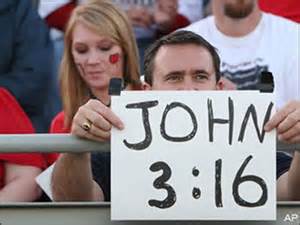
What Does John 3:16 Teach?

The following is part of the book I am writing, from a section on the gospel which is a necessary element of a biblical church. th

There are truths in God’s Word that rub our flesh the wrong way; predestination is one of them. I refer the reader to Appendix 5 for a biblical defense of this doctrine. We must embrace the truth of Scripture, even if it goes against what we’ve learned from me. For the word of God is living and active, sharper than any two-edged sword, piercing to the division of soul and of spirit, of joints and of marrow, and discerning the thoughts and intentions of the heart. (Hebrews 4:12) God’s Word is sharp and, as wielded by the Holy Spirit, cuts like a scalpel, bringing healing to our broken souls. False teaching is seen as less threatening, like a butter knife. And it works the same way – tearing the flesh as it pierces, bringing destruction rather than healing. Good counsel presents the truth of Scripture; this is biblical love – even though our beloved traditions may have to be abandoned.

Many who disbelieve predestination run to John 3:16, as if this verse disproves it. Let us briefly examine this verse to see what its message truly is. Here’s the verse, from the King James: For God so loved the world, that he gave his only begotten Son, that whosoever believeth in him should not perish, but have everlasting life. That settles it for many, who do not stop to see if the words may have had a different meaning when written 500 years ago than they do today; including Baptist preachers who ought to know better. But contrary to a popular hermeneutic which declares, “when the plain sense of Scripture makes common sense, seek no other sense”, the plain sense of Scripture often contradicts the true meaning of Scripture and our common sense often makes no heavenly sense. The genre of the text we are reading will indicate how we are to read it – poetry and apocalyptic books cannot be taken literally, and even historical narratives are full of word pictures that must be interpreted rightly to get God’s view of His Scriptures. The Jews of the first century had common sense and they took certain prophecies in the plain sense. This caused them to look for a king like David – a man of war – and miss the true meaning of their own Scripture.

In regards to John 3:16, let’s examine a couple of key words upon which the meaning of this verse hang. In English, the word “so” can be either an adverb or an adjective. We see it in verse 14: And as Moses lifted up the serpent in the wilderness, even so must the Son of man be lifted up (KJV). Here, the word “so” is an adverb, meaning “in like manner” or “in the same way” – describing the nature of something. Many people think the word “so” is an adjective in verse 16 – describing the degree of the thing that follows: God loves the world SO much. The problem with this view is that the Greek word translated as “so” in English (houtos – Strong’s #3779) is rarely used as an adjective. Strong’s Greek and Hebrew dictionary defines it only as an adverb. Houtos shows up more than 200 places in the Greek New Testament. In only four occurrences it is definitely an adjective: Galatians 1:6; 3:3; Hebrews 12:21 (houto); and Revelation 16:18. In more than 97% of the uses the word houtos is an adverb. (http://www.brenthobbs.com/index_files/john_3_16.php accessed 25 May 2015) Now looking back John’s gospel, let’s read a little more for context:

John 3:14-16 (KJV) And as Moses lifted up the serpent in the wilderness, even so must the Son of man be lifted up: That whosoever believeth in him should not perish, but have eternal life. For God so loved the world, that he gave his only begotten Son, that whosoever believeth in him should not perish, but have everlasting life.

Is there a compelling argument that John’s use of houtos changes from the common adverb in verse 14 to the extremely rare adjective in verse16? If its use in verse 16 is as an adjective, the Bible tells us God loved the world to a great degree that He sent Christ to die for the same world He said we are not to love (1 John 2:15). Since Jesus said Scripture cannot be broken (John 10:35) we must interpret Scripture with Scripture and lean not on our own understanding (Proverbs 3:5), even if the plain sense makes common sense to us. Our common sense is our understanding, not God’s. I don’t have space here to examine “the world” and how it’s used; but since not everybody at all times in every nation, tribe, and tongue has been forgiven, it’s reasonable and in keeping with Christ’s high priestly prayer in John 17 that Jesus did not come to save the whole world in the comprehensive sense some assert. As noted in Ephesians 5:25, Jesus gave His life for the church, not everybody in the world. And since “the world” often means a region (Luke 2:1; John 12:19), or the system which lies under Satan’s rule (John 15:19; 17:13; 1 Corinthians 2:12), we have no reason to assume this term means everyone everywhere as regards salvation, as the Lamb of God died for the redeemed, not the damned.

The argument is not whether or not the death of Christ is sufficient to save everyone – His death is more than sufficient for the entire human race. The question is, did Christ die for all men – is the atonement universal? One English Bible translates this phrase, “in tasting death He should stand for us all” – those for whom Christ stands are the redeemed. The word, man, is not in the Greek text, meaning the original phrase would be “should taste death for the whole” – the whole body, the church for whom Christ gave Himself (Ephesians 5:25); Jesus died for every son God brings to glory. God the Father chooses only some to be saved – election is not universal. God the Spirit regenerates only some to bring them to new life, He only seals those who are born again – the Spirit’s work in saving and sealing is not universal. For Christ’s death to be universal, it would mean that some of His blood, some of His trials and suffering under the wrath of God the Father, was for those who are spending eternity under God’s wrath. Any blood or work done by Christ on their account would be wasted! And if the death of Christ was universal, it would put Him at odds with the Father and the Spirit, because their work in salvation is particular, not universal.

Let’s read the passage from John 3 in the Holman Christian Standard Bible:

Just as Moses lifted up the snake in the wilderness, so the Son of Man must be lifted up, so that everyone who believes in Him will have eternal life. “For God loved the world in this way: He gave His One and Only Son, so that everyone who believes in Him will not perish but have eternal life.

This is more in line with the common use of the Greek and keeps consistency within the passage and with the whole teaching of the redemptive work of the Lord Jesus.