Sermon of the Week: “The Subtlety of Satan ” by Jim Murphy.

In this week’s sermon, The Subtlety of Satan, Pastor Murphy gives a scathing indictment on what today’s version of a “Christian” is:

“(Today’s Christian is) someone who has made the decision to be an emotionally well-adjusted, self-actualized risk-taking leader who knows his purpose, lives a no regret life of significance, has overcome his fears, enjoys a healthy marriage, is an attentive parent celebrating recovery from all their hurts, their habits, their hang-ups, and that practices biblical stress relief techniques, is financially free from consumer debt, fosters emotionally healthy relationships with his peers, attends a weekly life group, volunteers regularly at church, tithes off his gross, and has taken at least one humanitarian aid trip to a third world nation. . . . Never once do you read in that modern contextualized interpretation that a Christian is one who sees their sin, confesses their sin, repents of their sin, and receives the gift of salvation in Christ alone. That’s how far we’ve come. So Christianity now is dictated and defined by culture.”

Pastor Murphy also exhorts his congregation to “connect the dots,” between the many dangers we are warned about repeatedly in Scripture and what is being taught under our noses in many churches and by many Christian authors and leaders today.

‎”The mood is that if you have a reformed soteriology you get a pass on everything else.”  -John MacArthur

What Mac says is so true – Calvinistic preachers are assumed to be orthodox because they have one doctrine correct. Yet those who serve as elders in the local church are to preach the whole counsel of God’s Word. This will humble any man and cause the sheep to be less dependent on the preacher and more on the Lord.

As we’ve pointed out in other posts, here and here, for example, the Bible has plenty of warnings about being deceived and misled by men. No man is above having his teaching tested against Scripture, because only the God Man Jesus was and is without error – and He is the Word of God!

HT: Sola Sisters

Homosexuality, Polyester, and Shellfish.

The following article, Homosexuality, Polyester, and Shellfish (found here), is a condensed version of a larger article of the same name (found here).

I hope this helps to answer the false charges of “inconsistency” leveled against Christians based on ignorance of the scriptures (and poor hermeneutics) from those making the accusations.

Jun 19, 2012 • By David Murray

Churches and ministries are coming under increasingly aggressive pressure from militant homosexuality. Some homosexuals are combing websites looking for sermons and statements that they can use in the media to ridicule Christianity and build sympathy for their cause.

When challenged, many Christians and even many pastors, struggle to defend and explain their position in a way that is Scriptural, consistent, and loving. Homosexuals and the media often point to other Old Testament verses that forbid things that Christians now eat or use. How do we explain that? 

Well, here’s a short briefing paper that I hope will answer some of these questions, and also help Christians and pastors to explain the Bible’s teaching in a loving way. Below you will find a bullet point summary of the paper (each point is explained in fuller detail in the paper). For further reading, please see the books referenced in the footnotes. And a huge thank you to my Research Assistant for the huge amount of work he put into this paper. 

Homosexuality, polyester, and shellfish.

What do these three things have in common? Well, they are all mentioned in the Bible as forbidden by God. And the latter two come up in conversations about the first.  The charge is often that Christians are being inconsistent – we allow polyester and enjoy shellfish, but we still condemn homosexuality.

The real question is not why Christians are inconsistent. The real question is why and how Christians do make a distinction between homosexuality, polyester, and shellfish. Because they do, and it matters.

The short answer is because Scripture demands that we must. The long answer is that when we take into account some basic hermeneutical principles and some Scriptural principles, we realize that we must relate differently to homosexuality than to shellfish.

Basic Hermeneutical Principles.  Our interpretation of Scripture is based on the following convictions:

  • Scripture is an authoritative revelation of God.
  • The central unifying theme of Scripture is Jesus Christ.
  • Old Testament law is divided into three main types: civil, ceremonial, and moral:
    • The civil laws were given to a unique nation (Israel) for a unique purpose and time.
    • The ceremonial laws pointed to Christ’s sacrifice and were abolished by His sacrifice.
    • The moral laws define sin and continue in force.
  • Homosexuality falls under the moral law.
  • The punishments for the moral law have changed.
  • The Old Testament needs to be understood in light of the New Testament.
  • The Old Testament law is still relevant today.

So, since the Bible is the authoritative Word of God, and we can distinguish between various Old Testament commands, what does the Bible say about homosexuality?

Relevant Scriptural Principles. Our position on homosexuality is based on Scriptural principles:

  • God created all things, including sexuality.
  • All humans are God’s creation.
  • Sex has a limited role and purpose in life.
  • Sin impacts all of life, including sex.
  • Homosexuality is a consequence of sin.
  • Scripture states that homosexuality is sinful behavior.
  • Homosexuality is not the only sin in society.
  • Sinners, including homosexual sinners, can receive salvation.
  • Believers cannot be characterized as having a homosexual life.
  • Victory over sin, including homosexuality, is possible.

Basic Relational Principles. Our interactions and relationships will be based on Scriptural principles:

  • Remember that salvation is more important than being heterosexual, or outlawing same-sex marriage.
  • Homosexuality is being used as a cultural battleground.
  • Fear and hatred of homosexuals are not proper responses.
  • Christians need to show grace to those who misunderstand.
  • Addressing the issue of homosexuality gives the church a unique opportunity to witness. 
  • All ministry on earth (apart from Christ’s) is from sinners to sinners.
  • Love sometimes demands non-approval.

Therefore the difference between homosexuality, polyester, or shellfish is not a reactionary choice between homophobia or vestiphobia or ichthyophobia. It is not an inconsistent personal preference.

It is a principled decision based on divine revelation.

Five errors of pragmatic churches.

The following article is from A Twisted Crown of Thorns:

Do they want bigger hot dogs? Flavored water or cushions for their ankles the customer is king. This is the approach to successful entrepreneurship. It is sometimes no different when it comes to modern day church marketing only that it is called being ‘purpose driven’. Long gone are the days of preaching the gospel and teaching sound doctrine. It’s not uncommon to hear pastors talk and ask questions like ‘what’s the vision for your church?’ or ‘how is your church going to grow?’ By ‘vision’ they usually mean ‘a purpose driven plan’ or pragmatic approach to church growth.

You see, the purpose driven church movement makes several assumptions but here we will look at 5 common errors and how they deviate from scripture.

Continue reading here.

Book recommendation: “Under the Banner of Heaven” by Jon Krakauer.

I recently finished Jon Krakauer’s book, Under the Banner of Heaven: A Story of Violent Faith. I found the book to be very revealing of early Mormon history (much of the stuff modern day Mormons prefer you didn’t know about). Namely this book tackled Mormonism’s twin doctrines of polygamy and Blood Atonement (and detailing the hellish results those unbiblical doctrines wrought on Mormons and non-Mormons alike).

Although this work was a scathing revelation of Mormonism’s twisted and violent history, I could not help but detect the author’s occasional sympathetic bent toward Joseph Smith and the Mormon organization as a whole.

Sympathy or poor research in some instances (I am not certain which), but one example of less-than accurate reporting is when Krakauer said that when Joseph Smith fired his gun at the angry mob (the gun that was smuggled into the Carthage jail), he wounded “at least one.”

However, Mormonism’s own History of the Church cites that Jospeh Smith actually “snapped the pistol six successive times; only three of the barrels, however, were discharged. I afterwards understood that two or three were wounded by these discharges, two of whom, I am informed, died.”

I must say that there’s a chasm of difference between “wounding at least one” and “two or three were wounded . . . two of whom . . . died.”

Another instance in the book where the author would have done well to have done better research is when he writes that Calvinists teach that God is “bent on making humans atone for Adam’s original sin.”

If Krakauer did his homework he would have known that that is not the historic Calvinist position (and never has been). Calvinism teaches that God’s Son (and Him alone) is the only One able to atone for mankind’s sin that was inherited through Adam and for the sins man commits daily. It is actually the belief of Mormonism (and Roman Catholics, and Jehovah’s Witnesses, and Seventh Day Adventists, and Muslims, etc.) that man can atone for or add to Christ’s atoning work on the cross; and this in direct opposition to Galatians 5:4.

In all, although the author was incorrect on a few points, I found the book to be a fascinating look into both the mainstream LDS organization (the one’s who broke away from the original teachings of Joseph Smith and Brigham Young) and the varios fundamental LDS organizations (the one’s who still follow the original teachings of Joseph Smith and Brigham Young) with the Lafferty brothers’ murder of Erica Lafferty and her baby, Erica, on July 24, 1984, as the back drop of the book.

The book, although containing a critical overtone toward all religion, horrifyingly exposes the results of following Joseph Smith and Brigham Young’s teachings faithfully, showing that Mormonism (much like Islam) is a violent religion full of lies, deception, adultery, sexual immorality, and forever marked by the bloodshed of innocent men, women, and children.

The passing of blogging pioneer, Jim Bublitz.

Coming on the heels of Phil Johnson’s announcement of his retiring from blogging, it is with sadness that I report that I’ve been notified by Lyn of Saved by Grace (and confirmed by Lane Chaplin on his Facebook page), that retired blogger, Jim Bublitz, has passed away.

Bublitz, who retired from blogging due to illness in 2008, was one of, if not the blogger, who inspired me to enter the world of blogging. In fact, Jim’s blog, Old Truth, was the first Christian blog (along with Ingrid Schleuter’s Slice of Laodicea) that I came across and was the inspiration and impetus behind the blog you are reading right now.

You can still read Jim’s blog (which I encourage you to do) at OldTruth.com.

I do not know any further details of Jim’s passing, but I’m certain more information will come out in the next few days.

Please keep the Bublitz family in your prayers.

You Versus God: Who’s View is More Important?

What is more important? What you think of yourself, or what God thinks of you? In our current culture, how we view ourselves is considered of the utmost importance. In fact, many believe that the single greatest thing that we can do for ourselves is to perfect our self image. The greater and more positively we view ourselves, the more likely we will be successful in life. The more negatively we view ourselves, the less likely we will be able to cope with life’s difficulties. On the surface this sounds very compelling. When there are so many people and events that attempt to make us feel like we are worthless or failures, thinking positively seems to make sense so that we can avoid the inevitable depression that would come. Looking at all the positive aspects of our lives, seeing ourselves as good people in the midst of difficult circumstances, would seem to help us because we are not dwelling on the negatives. We are not being drug down emotionally, but we are able to keep our minds free and clear. Thus, it is argued, self image is far more important that anything else.

However, there is an aspect to this that is rarely considered. Self image addresses our perceived needs in the here and now. It concerns itself with how we feel at this moment, how we perceive ourselves in the present. While self image does claim to look back at past mistakes to learn from, and makes the additional claim that it benefits for future life decisions, it primarily concerns itself with our life in this world, at this moment in time. It does not, in fact cannot, deal with what comes after. It can only address how we exist in this life. So, if there is a life yet to come, one which God has much to say about, does it not conclude that solely concerning ourselves with how we feel about ourselves excludes a major aspect of our existence? And if it is how God perceives us that determines our eternal existence, then focusing solely on how we feel in the here and now could well prove detrimental to us. For if we concern ourselves with only how we view our life, then we could well neglect God’s view of us and, by natural extension, live in such a way that brings us into conflict with Him.

We are God’s creation. When God made the universe (see Genesis 1-2) He designed it to declare His glory and majesty (Psalm 19:1). But to whom did it declare? On day 6, God made man. Man was created in God’s image. He was created with the unique breath of life, the awareness of himself, the ability think and perceive outside of basic animal instinct. Man was created with the unique opportunity to understand he was created by God, to be in fellowship with God, to worship and obey God. Man, being God’s unique creation in the universe, finds his being and purpose in loving and worshipping his Creator alone. However, it was in chapter 3 of the book of Genesis where man turned that purpose on its head. At that time, man chose to seek his own purpose, to determine for himself what was right and wrong. In that moment, when man ate of the forbidden fruit, he actively chose to place his desires, his own feelings, over that which God had designed man for. In that moment, man chose how he felt about himself and forever changed his standing before God.

SInce that time, mankind has lived in a state of rebellion against God. Every thought, every word and deed, has been tainted by this desire to satisfy one’s self. And while man does often demonstrate an ability to show mercy, kindness and even love, it is all affected ultimately by the self centered sinfulness that first manifested itself in the garden. If you doubt it, then ask yourself this: who among us can ever say that they have never lied? How about theft, and the value of the stolen item is not the issue. The willful taking of that which is not yours, the depriving of another’s property, ideas or livelihood is theft. What about lust? Some may say that lust is what drives mankind’s ability to reproduce. But is also a demonstration of one’s inability to control the emotional and hormonal drives that God gave us to be used for our spouses alone. The inability to simply bring our thoughts under control when we look at another person again demonstrates how far we are in bondage to sin. What about how we view God? All one must do is look around at the various world religions to realize mankind has failed to acknowledge God as He truly is. From Buddhism to Islam to Catholicism and all points in between, mankind has designed “gods” that resemble the desires of its own heart. Every world religion establishes as system of “good works” that can appease its “god,” hopefully to the point of atoning for the very sins we just looked at. Yet, this demonstrates the fallen nature of man for it demonstrates a “god” that can somehow be bribed or cajoled into ignoring the guilt men have when they sin.

The point of all this is to say that God designed us to be in loving fellowship with Him, yet we have rebelled against Him. Our Creator is now not just the loving God who made us, but He is also the righteous judge who must hold us accountable for the sins we have committed against Him. Where we were once to be ushered into a beautiful, eternal existence with God, we are now barred from such a paradise. Where we were once in a state of being children of the King, we are now condemned criminals, traitors against our sovereign Lord. God cannot view us as positively as we hope to view ourselves. We were created to worship Him, but we have chosen a life of sin against Him.

So we come back to our original question: what is more important, our view of ourselves, or God’s view? If we only were ever to exist in this life, we could say that how we viewed ourselves was very important. But we were created by a being who exists outside of all space and time. We were created to love, honor and worship Him alone, yet we have sinned against Him. The end result is that, when this life ends, we will stand before that Creator, and he will be our Judge. The books of our lives will be opened and every sin we have ever committed will be judged. And like any good judge, God will find us guilty, condemning us to an eternal torment that justly fits our crimes. So the answer is simple, yet very profound, it is God’s view of us that has the greatest importance. And no matter how positively we view our own life, God sees it as utter rebellion. It is not a positive ending we are headed for, but one of eternal suffering.

So, we now ask, if man cannot appease God, cannot atone for himself, what do we do? Should we just “eat, drink and be merry, for tomorrow we die?” If we are honest, we have to admit it would seem that if we are to be condemned, should we not just “live it up?” If that were the end of the story, perhaps that would be the answer. But it is not. Remember, God made us to be in fellowship with Him. It is our sinful nature that keeps that from happening, Therefore, God made the way for that fellowship to be restored. We cannot make ourselves “un-guilty” of our sins, Nor can we convince God to simply “forget about it.” So, the only possible means of addressing the consequences of sin was for God to pay the price for it Himself!

Jesus Christ, the Son of God, second Person of the triune God, fully God and fully Man, came to this world approximately 2,000 years ago and did what we could never do. He lived a perfect life, free of sin in every aspect. He perfectly obeyed the will of His Father in every single moment of His life. Then, despite His being innocent of any offense, He willingly, voluntarily placed Himself in the hands of sinful man, endured an unfair trial, was humiliated, beaten and tortured. All the while, He could have called down legions of angels to rescue Him, yet He remained silent and received it all. Then Jesus allowed Himself to be placed on the cross, an instrument of cruel execution. He suffered and died, all the while being reviled by those He came to save. In doing so, He took upon Himself the punishment due for all our sins. The perfect, sinless Son of God took on the righteous and holy wrath of the Father so that the perfect law could be satisfied. We have earned eternal death from God, but the eternal Son died in our place. Then, on the third day after His death, Christ rose Himself from the grave. In doing so, Jesus proved that He had defeated sin and death. His own death paid the price for us, His resurrection secured life for us.

Today, that forgiveness of sins and promise of eternal life is available to us, but there is only one means by which it is obtained. We must acknowledge our that our life is one of wretched sinfulness, and is deserving of the judgment of God. We must turn away from that life of sin and commit ourselves to a life that is pleasing to the Lord. We must trust in the finished work of Jesus Christ alone, knowing that no work we could ever do would satisfy the law of God. Having total and complete faith that Christ has paid that price and devoting our lives to Him alone.

The question was who’s view of us was more important, our’s or God’s. Clearly, God’s view is the supreme view we must submit to. Yet, God’s view of His own Son is one of perfection and righteousness. If we will humble ourselves, repent of our sins and trust in the death and resurrection of Jesus, then God’s view of Christ is placed on us, rather than his view of of our sins. Place yourself in the hands of Christ. Trust not in your view of who you are, but trust in the holy and righteous God alone for salvation.

Original article posted here.

Debate: Mariology – Who is Mary according to Scripture?

When you build a theology on pagan goddess worship, man’s traditions, a dead religion of works, and arguing from silence, you will always lose the debate when faced with God’s Word.

See also: It’s All About Mary?

HT: Cup of Joe

Sermon of the week: “Jesus Christ Teaches Limited Atonement” by James McClarty.

The battle continues to rage within the evangelical community – for whom did Christ die? Did He die for all who ever lived or did He die for the elect? Read the lyrics below and listen to the sermon from James McClarty and humbly see if what these men represent is true. Not, do you like it; not, does it line up with your thinking. Is it in line with the clear teaching and intent of God’s Word, for the glory of His name?

You can download the sermon here.

Mission Accomplished, Shai Linne:

Here’s a controversial subject that tends to divide
For years it’s had Christians lining up on both sides
By God’s grace, I’ll address this without pride
The question concerns those for whom Christ died
Was He trying to save everybody worldwide?
Was He trying to make the entire world His Bride?
Does man’s unbelief keep the Savior’s hands tied?
Biblically, each of these must be denied
It’s true, Jesus gave up His life for His Bride
But His Bride is the elect, to whom His death is applied
If on judgment day, you see that you can’t hide
And because of your sin, God’s wrath on you abides
And hell is the place you eternally reside
That means your wrath from God hasn’t been satisfied
But we believe His mission was accomplished when He died
But how the cross relates to those in hell?
Well, they be saying:

Lord knows He tried

Father, Son and Spirit: three and yet one
Working as a unit to get things done
Our salvation began in eternity past
God certainly has to bring all His purpose to pass
A triune, eternal bond no one could ever sever
When it comes to the church, peep how they work together
The Father foreknew first, the Son came to earth
To die- the Holy Spirit gives the new birth
The Father elects them, the Son pays their debt and protects them
The Spirit is the One who resurrects them
The Father chooses them, the Son gets bruised for them
The Spirit renews them and produces fruit in them
Everybody’s not elect, the Father decides
And it’s only the elect in whom the Spirit resides
The Father and the Spirit- completely unified
But when it comes to Christ and those in hell?
Well, they be saying:

Lord knows He tried

My third and final verse- here’s the situation
Just a couple more things for your consideration
If saving everybody was why Christ came in history
With so many in hell, we’d have to say He failed miserably
So many think He only came to make it possible
Let’s follow this solution to a conclusion that’s logical
What about those who were already in the grave?
The Old Testament wicked- condemned as depraved
Did He die for them? C’mon, behave
But worst of all, you’re saying the cross by itself doesn’t save
That we must do something to give the cross its power
That means, at the end of the day, the glory’s ours
That man-centered thinking is not recommended
The cross will save all for whom it was intended
Because for the elect, God’s wrath was satisfied
But still, when it comes to those in hell
Well, they be saying:

Lord knows He tried

Please Pray for Michael

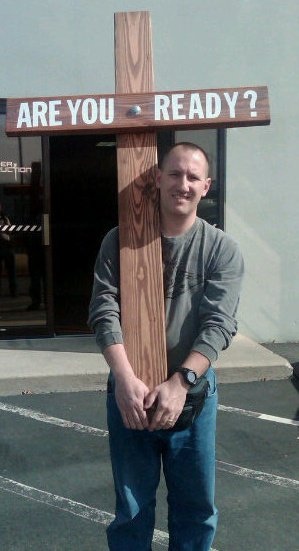
When I am not busy working, raising my family or blogging, God allows me to share the gospel with people in evangelistic endeavors. One such effort was inspired by Tony Miano of Living Waters (who has recently been blogged about here and here). In the picture you see here, I constructed a cross with the words “Are You Ready?” on it. The original intent of Mr. Miano had been to use such a cross in his town as yet another tool to share the gospel. Many other evangelists, including myself, made similar crosses and a small but growing group has been taking the gospel to the streets in this unique manner. But the point of this article is not to brag on our evangelism technique.

Meet Michael. He is the point of this article. I met Michael today on a street corner in my home town where I was out with the cross trying to evangelize. As you can see, Michael spends a lot of time walking the roads and sleeping in the outdoors. When I saw Michael walking down the street towards me, I prepared to hand him a gospel tract, but I doubted he would be willing to stop and talk with me. I was quite surprised when he stopped directly in front of me and asked “Are you a crosswalker?” I explained to him that I was attempting to share the gospel of Jesus Christ with people. What followed next was a half hour conversation where Michael explained he had become disillusioned with the “physical processes of life” and was looking to determine if he was something more than a biological machine that simply existed for itself and then died.

I was blessed to be able to share with Michael that he had been created for God’s glory. That because of his sin, Michael stood guilty before God and would be condemned to Hell. Yet, God in His mercy, poured His wrath out on Jesus Christ so that the righteous law of God could be satisfied. I explained that through repentance and faith in Jesus Christ, Michael could receive salvation and spend eternity with the God who created him. I explained that God created him so that God Himself could be glorified by redeeming him out of his sinful state. While Michael did not immediately repent and place his faith in Christ, he stated he was very glad to hear that redemption was possible.

After talking for a half hour, Michael and I had to part ways. It was such a blessing to talk with Michael. It was a reminder of how desperately the world needs to hear the gospel of Jesus Christ, that forgiveness is indeed available to wretched and vile sinners. So often we get caught up in discerning false religions and teachers, or we get caught up in the political machinations of the government to shut down the church’s influence, or even in discussing the watering down of the Word that is going on in evangelicalism. And while those can be worthwhile endeavors, the first and primary effort of every Christian is to share the gospel. The souls of people like Michael depend on our daily obedience to the command of Christ to go forth and preach the gospel to every creature. Let us not fail in this, but let us make every possible effort to share gospel with people so that souls might be saved.

Please pray for Michael. Pray that God would keep him safe as he continues to walk the roads and pray that God would lead him to true repentance and faith. Pray that we will one day meet Michael in Heaven.

What Do You Do When You Ask Jesus Into Your Heart But He Doesn’t Stick Around?

I have heard this story before. A young boy or girl attends VBS and at the end of the week, they raised their hand and said the prayer. Or maybe, when they were older they came forward at the altar call at church or at the local evangelist crusade. No matter the venue, they were told to “ask Jesus into their heart,” and assured that once He came in, life would get better. They were assured they were a Christian now, and were told to never question it, no matter what. The initial spiritual high carried them for a time. They read their Bibles, went to church, talked about how great it was to be a Christian. But in time, the buzz wore off. The feeling just wasn’t there anymore. Other things, people or events just seemed more interesting. Or they began to be ostracized by their peers, so the compromises began. Before long, life was like it was before, or maybe worse because they began to look for other things to fill the void. But no matter how bad it might be, they were still a Christian…weren’t they?

When it comes to the modern day evangelism of “asking Jesus into your heart” there is a very big problem in that it rarely, if ever, addresses the issue that a person is a wretched, vile sinner. A spiritual criminal deserving of God’s righteous judgment. It avoids examining the life of the person under God’s law. It fails to show that when we lie, steal, lust, hate, blaspheme God, or any other sin, we are committing crimes against our Lord. It fails to reveal that on the day that we stand before God, every sin, every thought, word and deed is called into account. And because God is a good and just Judge, He will condemn us to Hell for eternity. It does not explain that the punishment is infinite because we have sinned against an infinite God.

When the church tells a person to, “just ask Jesus into your heart” there is very little weighing of the issue. Very little understanding of the severity of their sins. Consequently, many people will experimentally ask Jesus to become part of their lives without ever turning away from the sinful life they have lead. In other words, because they didn’t understand how wicked they were, they never obeyed the command to repent. They simply saw Jesus as a way to make their life better, or as some sort of “fire insurance.” There was no genuine commitment or surrender of their lives. If that happens, that person is not genuinely born again. And if they are not born again, they are still slaves to their sinful nature.

Often times, churches today will ask people to repeat a prayer, sign a card and get them baptized. Once that is done, they absolutely assure them they are saved and tell them to never doubt it. And if they see that person returning back to worldly pursuits, they claim they are backslidden, a person who is a Christian, but is actively sinning.

Such an evangelistic program, while certainly adding numbers to church roles, actually does more damage than good. The problem is twofold. First, the Bible tells us to examine ourselves to see if we are truly in the faith. Both the books of James and 1 John help us examine our walk to see if we are actually producing fruit that is consistent with a born again Christian. That doesn’t mean that once a Christian gets saved he is suddenly perfect, but what is the course of his life. If a person can look at their life and see that it is, bit by bit, growing in a God honoring direction, then they can see true spiritual fruit that is consistent with being born again. But if they look like the rest of the world day to day, if there is no brokenness, no desire for true repentance, then it would become prudent to ask if they were ever actually born again.

The second problem with the modern day gospel presentation is that it ignores the truth of false converts. In the parable of the soils, Jesus taught of two groups of people who spring up as apparent converts upon hearing the gospel. However, in due time, they fall away either because of the cares of the world or from persecution. The falling away demonstrates that they never were in the faith to begin with. So when the church baptizes someone and assures them they are saved without ever looking at the fruit of their walk, it can actually add numbers of false converts to the list.

So what does all this mean for you the reader? Well, the first question would be to ask yourself if you are truly saved. Examine your walk in the light of the Bible. Do you truly love the Lord? Do you desire to obey His commandments above all else? Do you hate your sin because you love Lord and don’t wish to sin against Him? Or do you care more about the things of this world? Is the only time you feel bad about sin is when you have to suffer the consequences?

If it is the former, I would encourage you to dig into the gospels again. Learn what it is that Christ did for you because He loves you. Gain assurance by preaching the gospel to yourself daily. But if it is the latter, then you need to repent of your sins and trust in Christ now. You need to get saved for the first time. What happened before may have only been an experimental attempt, but one where, like so many others, you never truly repented and trusted in the Savior. If that is so, then examine your life, understand that your sins are an offense to God deserving of judgment. Yet know that His Son died to pay the price that you deserved. Turn away from those sins and trust in the Savior today.

(Note: this article is also published on my personal blog at fernleycrossguy.wordpress.com)

Like a lamb to the slaughter? The final moments of Joseph Smith.

The following article from the Mormonism Research Ministry was written by Bill McKeever:

“The events leading to the death of Mormon founder Joseph Smith are much like the events surrounding his life—full of contradiction. To hear Mormons tell the story, Smith did no wrong; for others, he did no right. Like most stories, the truth lies somewhere in the middle.”

Continue reading here.

Roman Catholic cardinal claims Adam and Eve were a mythology.

Below is the article from The Australian:


AUSTRALIA’S Cardinal George Pell has described the biblical story of Adam and Eve as a sophisticated myth used to explain evil and suffering rather than a scientific truth.

Cardinal Pell last night appeared on the ABC’s Q&A program, where he was debating British evolutionary biologist and atheist Richard Dawkins.

Cardinal Pell said humans “probably” evolved from Neanderthals but it was impossible to say exactly when there was a first human. “But we have to say if there are humans, there must have been a first one,” he said.

According to Genesis, God created Adam and Eve as the first man and woman.

Asked by journalist Tony Jones if he believed in the existence of an actual Garden of Eden with an Adam and Eve, Cardinal Pell said it was not a matter of science but rather a beautiful mythological account.

“It’s a very sophisticated mythology to try to explain the evil and the suffering in the world,” he said.

“It’s certainly not a scientific truth. And it’s a religious story told for religious purposes.”

Cardinal Pell argued that the “great atheist movements” of Hitler and Stalin were the personification of social Darwinism.

“It’s the struggle for survival, the strong take what they can, and the weak give what they must and there’s nothing to restrain them.” he said. “And we’ve seen that in the two great atheist movements of the last century.”

Professor Dawkins, author of The God Delusion, rejected the notion as “ridiculous”.

He said Stalin was an atheist and Hitler was not, and they each perpetrated their acts for different reasons.

Towards the end of the debate, the head of the Catholic Church in Australia appeared to lament his struggle to promote Christ.

“My life would be much easier if I didn’t have to go into bat for . . . Christian principles,” he said.

Cardinal Pell then mused that he sometimes wondered if he should regret his life’s work, before asserting: “No, no.”